
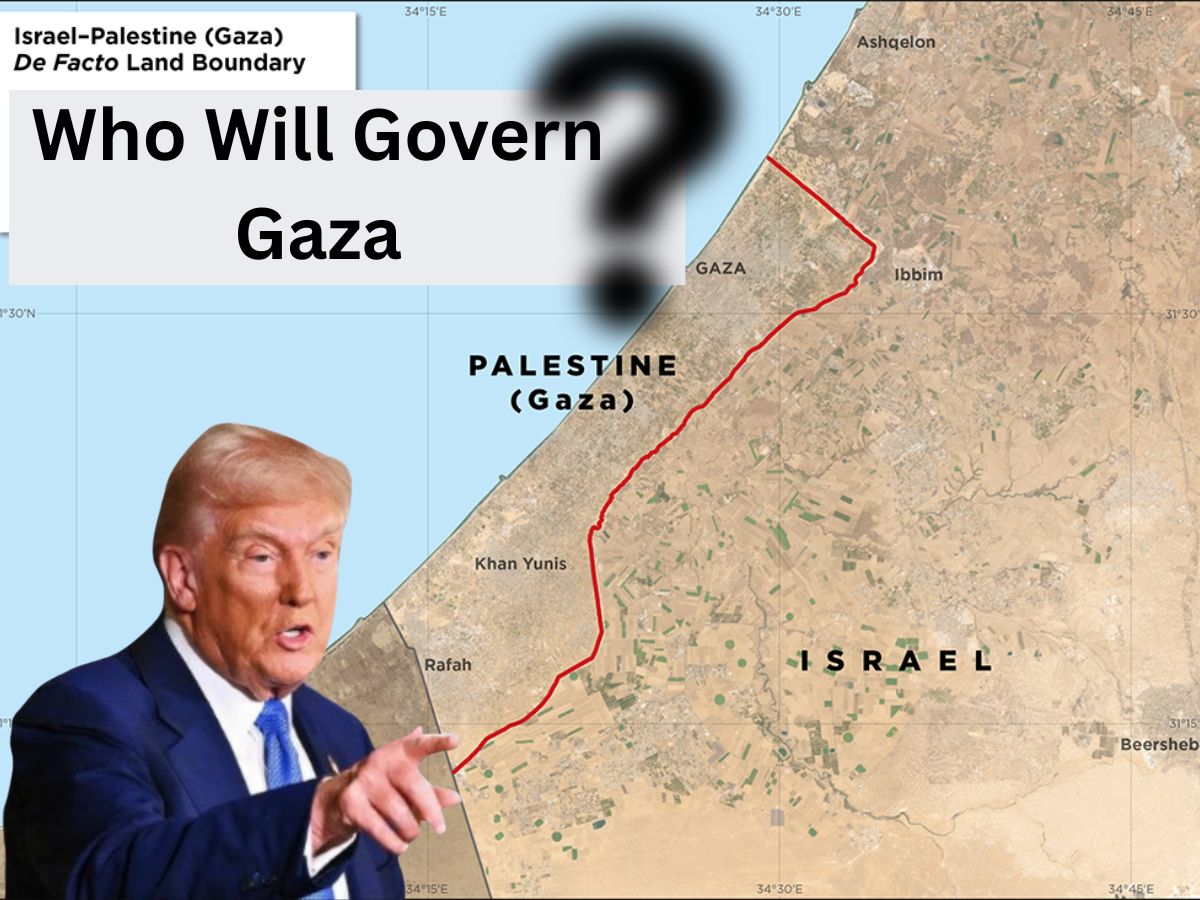
The ruling of Gaza under US President Donald Trump’s newly released peace proposal recently calls for a leadership different from the former political or militant rule. The proposal, as part of a two-decade 20-point plan to bring an end to the long-ongoing conflict between Israel and Hamas, emphasises on a transitional government framework, aimed at stabilising Gaza and paving the way for reconstruction and peace hoping for a calm region in West Asia.
Technocratic, Apolitical Palestinian Committee
Trump’s solution suggests that Gaza would be administered by a temporary transitional authority made up of capable Palestinians together with international specialists. The committee would be technocratic and firmly non-political, i.e., would function free from the influence of current political parties or militant organisations, particularly Hamas in any direct or indirect capacity. Member identities have not been released, but the aim is to provide neutral administration with an emphasis on public service and local administration.
International Oversight Through the Board of Peace
Monitoring of this peace committee will be left to a new international organisation known as the “Board of Peace,” which will be chaired by President Trump himself. The board will consist of other global leaders, including former UK Prime Minister Tony Blair, among others. The Board of Peace will be tasked with overseeing the execution of the peace plan, monitoring adherence to demilitarisation and reconstruction targets, and promoting coordination between Israeli, Palestinian, and international players.
Demilitarisation and Security Framework
One of the central requirements of Trump’s proposal is the full demilitarisation of Gaza. Military and terrorist infrastructures of Hamas-affiliated activities such as tunnels, weapon-producing factories, and military inventories are to be disassembled under rigorous international oversight. An international stabilisation force will be deployed to work in cooperation with Israel, Egypt, and Palestinian police within the region to provide security, especially along Gaza’s borders.
Economic Redevelopment and Civil Governance
The strategy highlights that Gaza will be redeveloped for the interests of its inhabitants through economic development and investment, with the aim of creating jobs and opportunities to incentivise people to stay in Gaza instead of leaving. Gaza will be established as a special economic zone with preferential tariffs and access, backed by an international panel of experts.
Exclusion of Hamas and Path to Peace
Hamas is excluded from rule and shall not be included in the transitional government. The plan calls for Hamas to free all Israeli hostages and to end military action as conditions precedent to peace. It also keeps open the option of creating a future Palestinian state, if reforms and de-militarisation are upheld.
Diverging Perspectives and Challenges
Israeli Prime Minister Netanyahu has stated a slightly varied stance, indicating Israel could maintain some security control over Gaza’s border. Hamas is yet to agree to the plan, and international responses are varied, although many Middle Eastern and European leaders have embraced the initiative as a possible solution to the long-running conflict.
In short, Trump’s Gaza plan for governance sees a politically balanced, internationally monitored technocratic rule to tear down militancy, restore civilian existence, and promote peace through collaboration and total oversight. It is an unprecedented policy with a focus on stability and structural reform with Hamas ousted from authority.