
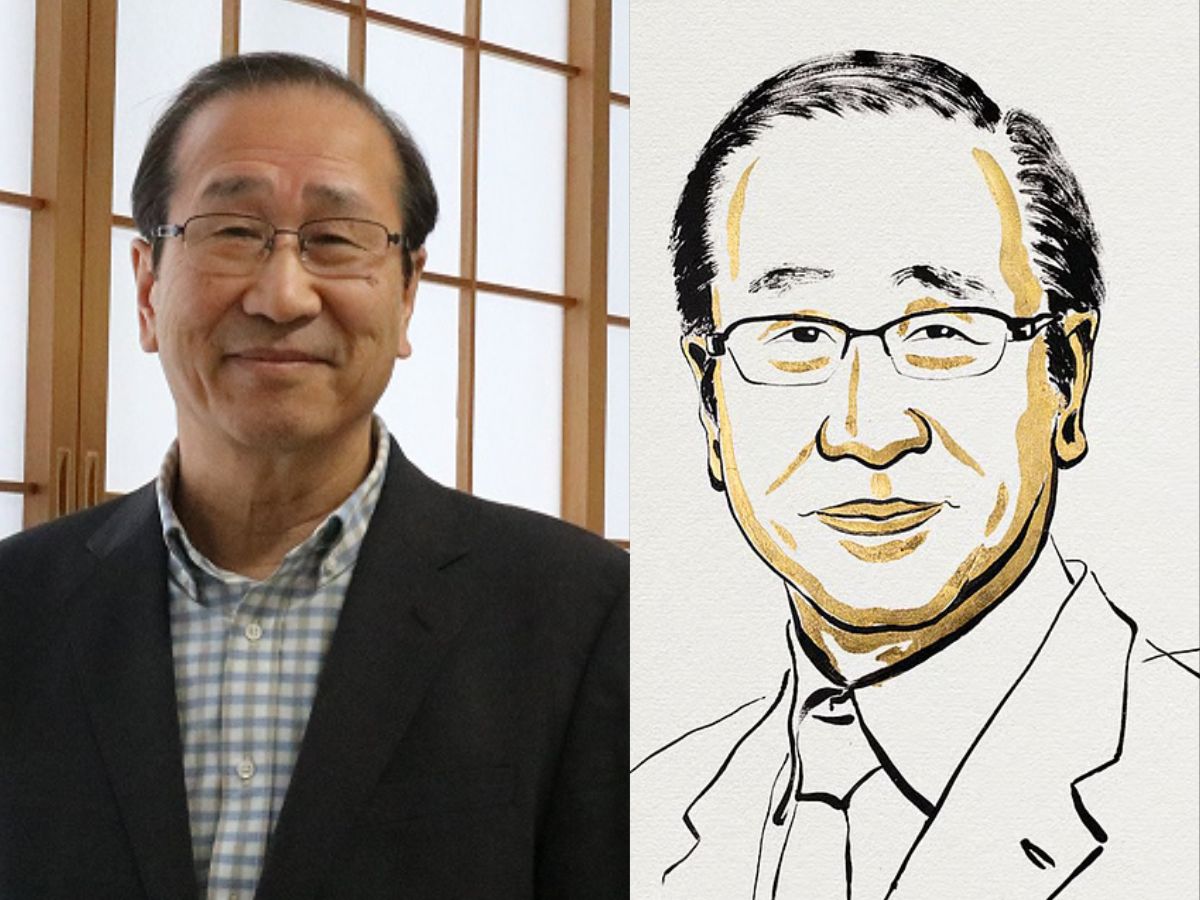
Susumu Kitagawa’s breakthrough work on metal-organic frameworks (MOFs) has earned him the 2025 Nobel Prize in Chemistry. His research opens doors to cleaner air, better water purification, and advanced materials. In this profile, we trace his life, lab, accomplishments, and what the Nobel means for science and society.
Who Is Susumu Kitagawa?
Susumu Kitagawa (born 4 July 1951, Kyoto, Japan) is a Japanese chemist known for pioneering porous coordination polymers / MOFs in the chemistry world.
He currently holds positions at Kyoto University, including Distinguished Professor, and serves in leadership roles at KUIAS (Kyoto University Institute for Advanced Study).
His field blends inorganic chemistry, materials chemistry, and coordination space chemistry — studying how metal ions and organic molecules can form structures with built-in “rooms” or pores.
Susumu Kitagawa: Nobel Prize 2025
In October 2025, Kitagawa won the Nobel Prize in Chemistry, jointly with Richard Robson and Omar M. Yaghi, “for the development of metal-organic frameworks.” The Nobel committee praised their “molecular architecture” that contains large internal spaces, enabling gases and chemicals to flow in and out.
They likened some of their materials to Hermione’s magical handbag, since a material the size of a sugar cube can have an internal surface area comparable to a football pitch. Kitagawa was recognised especially for demonstrating that such frameworks can be stable, dynamic, and functionally tunable.
For What He Got the Nobel Prize?
Susumu Kitagawa received the 2025 Nobel Prize in Chemistry for developing the world’s first stable porous coordination polymer and pioneering the field of metal-organic frameworks (MOFs).
His innovations allow materials to trap, store, and release molecules in a controlled way — critical for applications such as carbon capture, clean hydrogen storage, and environmental purification. The Nobel Committee praised Kitagawa’s research for its “transformative impact on chemistry, sustainability, and material design.”
Susumu Kitagawa’s Net Worth
As of 2025, Susumu Kitagawa’s estimated net worth ranges between $1 million and $3 million USD. His income primarily comes from research positions, academic roles, global awards, and the Nobel Prize, which includes a monetary reward of around 11 million Swedish kronor (approx. $1 million USD).
Susumu Kitagawa’s Net Worth in Rupees
As of 2025, Susumu Kitagawa’s estimated net worth ranges between INR 85,000,000 to INR 26,62,36,800.
Susumu Kitagawa’s Age
Born in 1951, Susumu Kitagawa is 74 years old in 2025. Despite his age, he continues to lead active research at Kyoto University and mentor young scientists worldwide.
Susumu Kitagawa Lab
In his lab at Kyoto, Kitagawa focuses on designing and synthesising new porous materials — often called porous coordination polymers or metal-organic frameworks (MOFs). He was among the first to demonstrate that coordination polymers can be porous, using gas adsorption experiments in 1997.
A hallmark of his work is exploring flexible or “soft” MOFs, ones that respond to external stimuli (guest molecules, pressure, temperature) by changing shape or configuration. His lab collaborates globally, publishing extensively on synthesis, structure, gas sorption, separation, and applications in energy, environment, catalysis, and storage.
What Will He Get from the Prize?
- He shares the Nobel monetary award (11 million Swedish kronor) with the other laureates.
- Global recognition: the Nobel spotlight boosts awareness of MOFs and their potential for environmental and industrial impact.
- Enhanced opportunities: funding, partnerships, and influence to scale his breakthroughs in real-world applications (carbon capture, water purification, gas separation).
- Legacy: his name now anchors a major chapter in materials science and chemistry history.
Susumu Kitagawa’s Educational Qualifications
- BSc (1974) — Kyoto University
- MSc (1976) — Kyoto University
- PhD (1979) — Kyoto University, in hydrocarbon chemistry
Susumu Kitagawa’s Other Qualifications
- He was an Assistant, Lecturer, and Associate Professor at Kindai University early in his career (1979–1988). He also served as Professor at Tokyo Metropolitan University (1992–1998) before returning to Kyoto University.
- Leadership roles: Director of iCeMS (Institute for Integrated Cell-Material Sciences), Deputy Director-General at KUIAS, Executive Vice-President for research promotion at Kyoto University.
- Honours include: Humboldt Research Prize (2008), Medal with Purple Ribbon (Japan), De Gennes Prize, Japan Academy Prize, membership in Japan Academy, election as Foreign Member/ForMemRS, among others.
Susumu Kitagawa’s Awards & Honours
Over his remarkable career, Susumu Kitagawa has received numerous international awards:
- 2003 – Creative Society of Japan (CSJ) Prize for Creative Work
- 2008 – Humboldt Research Prize
- 2009 – Chemical Society of Japan Award
- 2010 – Thomson Reuters Citation Laureates
- 2011 – Medal with Purple Ribbon
- 2013 – De Gennes Prize
- 2015 – Japan Academy Prize
- 2016 – Fred Basolo Medal, Northwestern University
- 2017 – Chemistry for the Future Solvay Prize
- 2017 – Fujihara Award
- 2019 – Grand Prix de la Fondation de la Maison de la Chimie
- 2019 – Emanuel Merck Lectureship
- 2019 – Member of the Japan Academy
- 2023 – Fellow of the Royal Society
- 2025 – Nobel Prize in Chemistry
Broader Impact & Legacy
Kitagawa’s work on MOFs is not just academic. These materials promise real solutions to pressing problems:
- Carbon capture & separation — trapping CO₂ from air or industrial emissions
- Water harvesting & purification — extracting water from arid air, removing contaminants
- Gas storage & delivery — hydrogen, methane, toxic gases
- Catalysis & chemical transformations — enabling reactions through porous environments
His legacy also lies in pushing materials science to think in terms of nanoscale “rooms” or space architecture, where the design of internal pores is as critical as the chemical composition.