
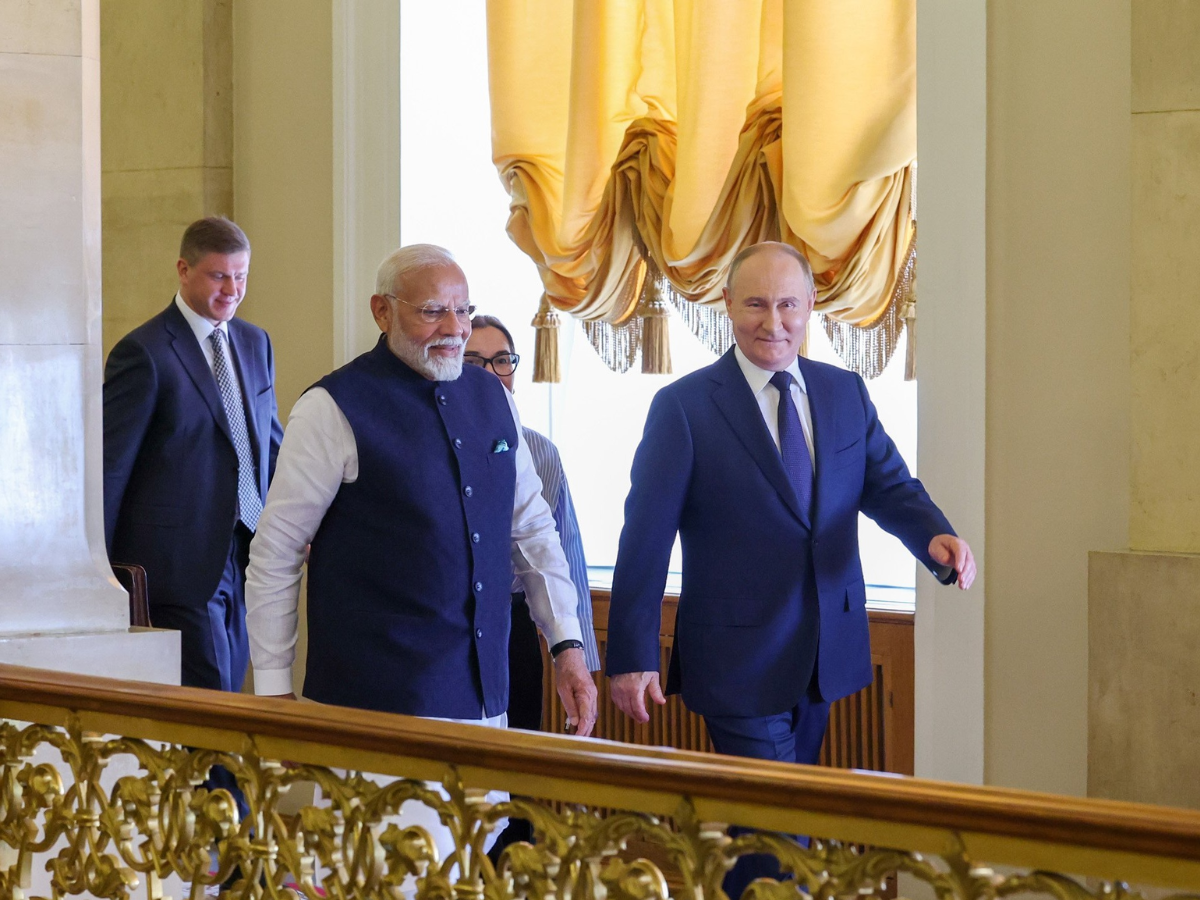
Russian President Vladimir Putin is set to arrive in New Delhi on Thursday for the 23rd India-Russia Annual Summit, marking his first visit since Russia’s invasion of Ukraine. His two-day trip focuses on strengthening defence cooperation, boosting trade, and expanding energy partnerships.
According to Putin’s aide Yury Ushakov, the agenda includes discussions on major “promising projects” in industrial cooperation, new technologies, transport, peaceful space research, mining, healthcare and labour migration programmes, adding that political dialogue between both nations remains “regular and confidential”.
The timing of the visit is significant, coming months after the US imposed 50% tariffs on Indian imports, a move seen as pressure over India’s continued purchase of Russian oil.
Putin’s High-Profile India Visit Key Discussions
Putin will meet President Droupadi Murmu and attend a private dinner hosted by Prime Minister Narendra Modi shortly after landing in Delhi. Talks are expected to cover:
-
Deepening defence ties
-
Trade and economic cooperation
-
Oil trade and currency settlement systems
-
Agreements on worker mobility and free-trade prospects
-
New collaborative sectors including technology, space and healthcare
Kremlin spokesperson Dmitry Peskov said both sides may also discuss the possible supply of Su-57 fifth-generation fighter jets to India.
Putin will participate in the Russia-India Business Forum and attend the launch of RT TV channel in India, reflecting expanding media engagement.
India Aims to Boost Trade and Secure Affordable Energy
India, which heavily depends on oil imports, wants to balance its need for discounted Russian crude with its interest in avoiding sanctions or penalties from Washington. According to Bloomberg, oil trade remains a central point of negotiation.
Both leaders are expected to discuss raising bilateral trade from $68 billion to $100 billion by 2030. They will also explore systems to settle transactions in local currencies, reducing risk from sanctions.
Other priorities include:
-
Shielding India-Russia trade from US restrictions
-
Cooperation on small modular nuclear reactors
-
Long-term fertilizer supply
-
Removal of non-tariff barriers
-
Expanding India’s exports of pharmaceuticals, agriculture goods and textiles
An agreement on the safe migration of Indian skilled workers to Russia is also likely.
US Pressure Over Russian Oil Purchases
The United States has repeatedly urged India to reduce imports of discounted Russian oil, arguing the purchases help fund Moscow’s war. In August, President Donald Trump increased tariffs to 50% on Indian goods as part of this pressure strategy.
India has rejected these claims, saying its energy policies are guided by national interest, market stability and the needs of 1.4 billion citizens.
However, New Delhi may avoid buying from newly sanctioned companies such as Rosneft and Lukoil, while continuing transactions with other non-sanctioned Russian suppliers.
Foreign policy expert Harsh Pant noted that India will clarify that it has “no desire to cut off energy supplies from Russia completely,” but future imports will depend on market trends and sanction impacts.
Energy cooperation—including India’s investments in Russia’s Far East and expanded civil nuclear projects such as Kudankulam—will feature prominently in the summit.
Defence Cooperation Remains Central
India will push for faster delivery of the remaining two S-400 missile defence system squadrons, after already receiving three from the 2018 deal worth $5.4 billion. Delays have been linked to supply chain disruptions due to the Ukraine war.
New Delhi may also explore:
-
Additional or upgraded S-400 systems
-
Faster delivery of pending defence hardware
-
Upgrades to Su-30MKI fighter jets
-
Closer coordination on joint military exercises
-
Cooperation in disaster relief operations
India’s Defence Secretary Rajesh Kumar Singh recently said the meeting would aim to “ensure that delivery delays are ended,” though no major announcements on new S-400 units are expected.
Despite efforts to diversify defence partnerships, Russia remains India’s largest military supplier. Moscow is keen to sell its Su-57 stealth fighters, although India is still evaluating options from other global manufacturers.
Diplomatic Backdrop: Ukraine Peace Push and Modi’s Quiet Role
Putin’s visit takes place as the United States renews its push for a Ukraine peace proposal. Critics argue Trump’s initial plan leaned too far toward Moscow, prompting revisions after talks in Geneva.
India has avoided openly criticising Russia for the war while repeatedly calling for dialogue and a peaceful resolution.
International affairs scholar Sreeram Sundar Chaulia said that although India does not want to act as a formal mediator due to its ties with both nations, “behind-the-scenes diplomacy by Modi is feasible, and has happened already to some extent”.
He added that Modi could subtly encourage Putin to “accommodate some Ukrainian and European concerns to bring about a cessation of hostilities.”
What can be expected in Puti Modi Meet
India and Russia are expected to sign multiple agreements covering trade, worker mobility, energy, media cooperation and defence. As both nations navigate US pressure, global tensions and shifting geopolitical alignments, the summit aims to reinforce a long-standing partnership while adapting it to today’s complex international landscape.
Also Read: What You Didn’t Know About Putin: 20 Facts That Define Vladimir Putin’s Life and Rule