
Ankara [Turkey], July 8 (ANI): US President Donald Trump has expressed deep dissatisfaction with the response of NATO allies regarding the military conflict with Iran, revealing that he used the crisis as a test of alliance solidarity.
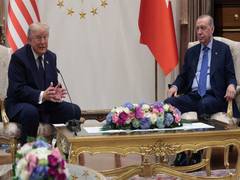
Speaking to reporters on Tuesday during a bilateral meeting with Turkish President Recep Tayyip Erdogan ahead of the NATO leaders’ summit in Ankara, the US President confirmed that his long-standing scepticism regarding the Western alliance had intensified following recent friction over strategic military cooperation.
For a considerable period, Trump has publicly questioned whether Washington’s closest international partners possess the strength, loyalty, or utility required to justify the American security guarantees they have depended upon since the conclusion of the Second World War.
The reluctance of specific allied nations to permit the use of their air bases for American strikes against Iranian positions, coupled with their refusal to deploy military assets to secure the strategic Strait of Hormuz, has shifted the US President’s traditional alliance scepticism into overt disapproval.
In the weeks following the outbreak of the hostilities, Trump has repeatedly targeted European heads of government, including those who previously anticipated that their personal rapport with the US President would shield them from public criticism. He recently mocked Italian Prime Minister Giorgia Meloni, alleging she had “begged” him for a photograph at the G7 gathering, and subsequently shared a meme of her on social media platform X, captioned “Restraining order needed.”
The US President also prematurely disclosed the resignation of UK Prime Minister Keir Starmer before publicly labelling him weak, asserting that the British leader’s hesitant stance on the Iran crisis indicated that he was no Churchill. Furthermore, NATO Secretary-General Mark Rutte, widely viewed as Europe’s most effective interlocutor with the US President, failed to alter Trump’s stance last month despite presenting a gold-lettered chart commemorating what he termed “The Trump Trillion” in allied defence spending.
Addressing the media pool alongside Erdogan, Trump asserted that the recent geopolitical developments had validated his underlying doubts concerning the collective reliability of the alliance.
“I was very disappointed with NATO,” Trump stated. “We didn’t need any help at all, and in a way, I was testing people,” he explained. “I was testing to see whether or not they’d be there because I’ve long said that we helped them, but I’m not sure that they’d be there for us.”
Trump went on to detail specific diplomatic friction with the Italian Prime Minister, noting that Meloni’s refusal to align with Washington’s operational strategy in the region had negatively impacted their bilateral dynamic, despite his ongoing personal affection for her.
“She refused to get involved with the Hormuz Strait, or you could also say just Iran,” Trump stated. “So it soured my relationship with her a little bit. But I like her. I think she’s a nice person. But I think she made a mistake.”
The US President observed that Italy’s significant dependency on crude oil imports from the Gulf region rendered its diplomatic reluctance particularly glaring, contrasting Europe’s energy vulnerabilities with America’s extensive domestic production capabilities.
“We have a lot of oil. The United States has more oil than anybody. And when you add Venezuela to it, it’s like we have far more oil than anybody. We don’t need the straits,” Trump remarked.
“We do this because we think it’s an important thing to do. But she just wasn’t there for us. And I wasn’t happy about that,” he added.
Shifting his focus to Ankara’s geopolitical position, Trump lauded Erdogan’s comprehension of regional dynamics and commended Turkey for playing a constructive role in diplomatic efforts to de-escalate the situation. He notably characterised the conflict not as an open war, but as a targeted mission designed to neutralise Tehran’s non-conventional capabilities.
“They know Iran very well, and they know the problems with Iran,” Trump remarked regarding Turkish officials. “They’ve been very instrumental, along with a couple of other countries, in helping.”
“With respect to our relationship, including trying to end the war with Iran, or whatever you call it, it’s not even a war. It’s a military operation. It’s a denuclearization,” the US President asserted.
Trump observed that while Turkey possesses substantial military capabilities, the leadership in Ankara had deliberately chosen to avoid direct kinetic involvement in the regional hostilities.
“He could have gotten into the fight,” Trump said, characterising Turkey as “a very powerful military nation.”
Regarding Iran’s non-conventional ambitions, Trump indicated his firm belief that Erdogan remains completely aligned with Washington’s strategic objective of preventing Tehran from securing an operational nuclear capability.
“I don’t think he wants to see them have a nuclear weapon either,” Trump stated. “I’m pretty sure of that. In fact, I’m totally sure of that.”
The high-level exchanges took place as NATO heads of state converged on the Turkish capital for a high-stakes summit set to confront the geopolitical fallout of the Middle Eastern conflict, alongside fundamental disputes regarding alliance solidarity and collective burden-sharing. (ANI)
The article has been published through a syndicated feed. Except for the headline, the content has been published verbatim. Liability lies with original publisher.