
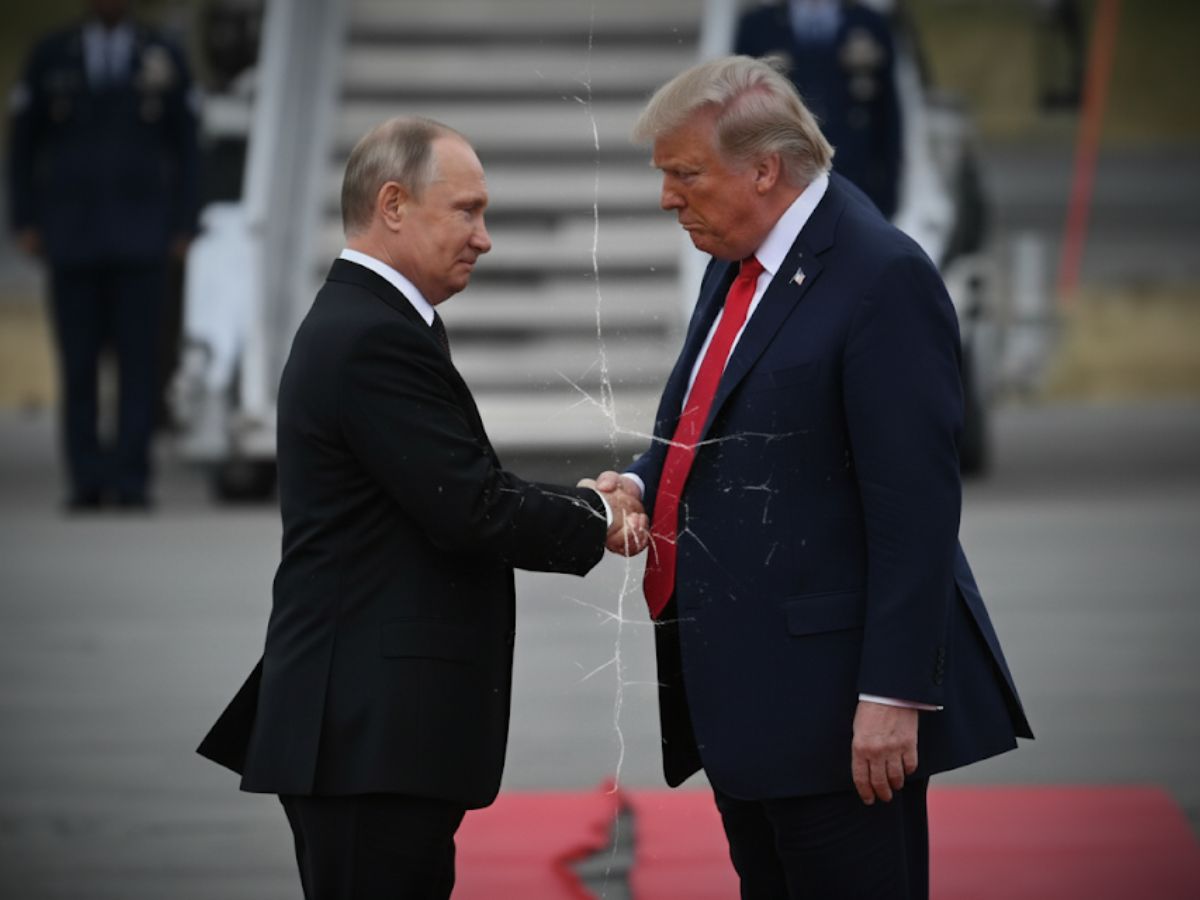
American President Donald Trump publicly voiced his dissatisfaction with Russian President Vladimir Putin about the ongoing conflict in Ukraine, which was a significant departure from his customarily friendly tone. During a joint press conference with UK Prime Minister Keir Starmer at Chequers, Trump admitted that the conflict he once believed would be the “easiest” to solve due to his personal relationship with Putin has instead become a point of profound letdown, citing the grim human cost of the war.
What Did President Trump Say About Putin?
The core of Trump’s remarks centered on a personal sense of betrayal by the Russian leader. “The one that I thought would be easiest would be because of my relationship with President Putin, but he’s let me down. He’s really let me down,” Trump stated. This admission marks a significant tonal change for a president who has long championed his friendly ties with Moscow as a unique asset for brokering peace.
The harsh reality of the war was further explained by Trump, who admitted that Putin is “killing many people” and disclosed a startling estimate of Russian casualties: “he’s losing more people than he’s killing… the Russian soldiers are being killed at a higher rate than the Ukrainian soldiers.” “War is a different thing,” he said, framing the unpredictable nature of the conflict. Things happen that are very opposite of what you thought.”
What is the US Stance on the War’s Impact?
A key element of Trump’s long-standing position on Ukraine was reiterated: his belief that the war “does not affect the United States.” This perspective has been the foundation of his criticism of massive US military aid packages to Kyiv, which were authorized under his predecessor, Joe Biden. Even though Ukraine secured more than $2 billion in fresh financing for US-made weapons like Patriots and HIMARS through a NATO-led system, the Trump administration has so far only continued arms sales and shipments started under the previous administration.
What Was the Joint Message from Trump and Starmer?
Despite having different strategies, both leaders agreed to put further pressure on Russia, mainly by focusing on its economy. President Trump issued a clear directive to Europe: “if the price of oil comes down, Putin’s going to drop out of that war.” He urged European nations to stop buying Russian oil, a move designed to cripple the Kremlin’s war-funding revenues.
Prime Minister Starmer echoed this sentiment, suggesting “a number of European countries which are too reliant on energy from Russia.” He outlined that their discussions focused on “how we can build our defenses to further support Ukraine and decisively increase the pressure on Putin to get him to agree a peace deal that will last.” Starmer condemned Putin’s recent escalations as actions that are not of someone “who wants peace.”
Also Read: Erika Kirk Takes Helm of TPUSA After Charlie Kirk’s Murder, Pledging to Continue Husband’s Mission
What Does This Mean for the Future of the Conflict?
Trump’s public disappointment signals a potential hardening of his stance towards Moscow, even as he maintains his America-first view on direct involvement. The joint call with a key European ally to cut off Russian energy supplies represents a concrete strategy being promoted at the highest level. But the road ahead is still complicated. The success of this approach depends on coordinated European action to wean itself from Russian energy, which is a difficult and unpleasant economic undertaking for many countries, even while the US and UK talk about increasing pressure.