
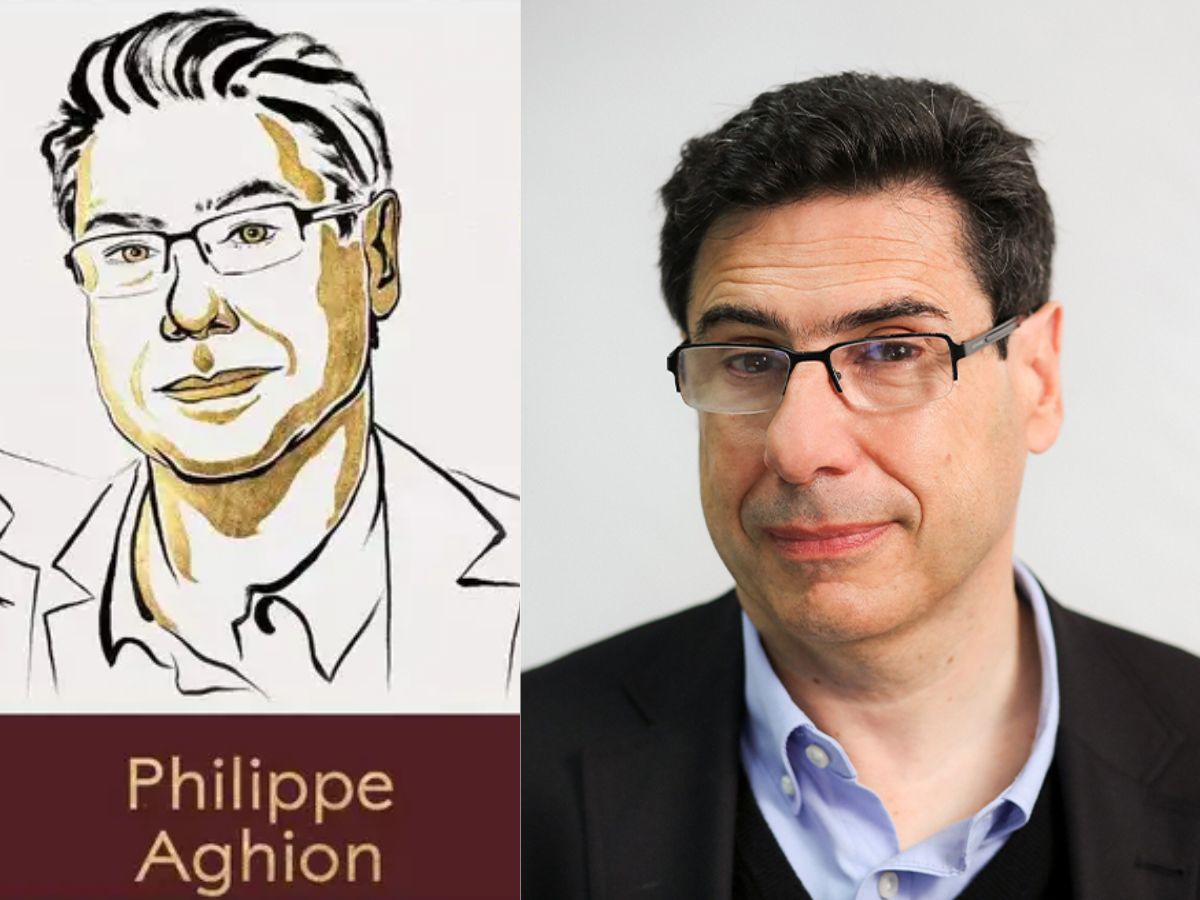
Philippe Aghion is a French economist known for his groundbreaking work on economic growth and innovation. In 2025, he received the Nobel Memorial Prize in Economic Sciences along with Peter Howitt and Joel Mokyr. Their research has helped the world understand how innovation drives economic development and improves living standards over the long term.
Who is Philippe Aghion?
Born on August 17, 1956, in Paris, France, Philippe Aghion is one of the most influential economists of his generation. He currently teaches at several prestigious institutions, including the Collège de France, INSEAD, and the London School of Economics.
Aghion’s academic journey began at the École Normale Supérieure de Cachan, where he studied mathematics. He later earned advanced degrees in economics from Université Paris I Panthéon-Sorbonne. In 1987, he completed his Ph.D. in economics from Harvard University.
His research focuses on the economics of innovation, growth, and competition, especially the concept of “creative destruction,” which explains how old technologies are replaced by new ones to fuel economic progress.
Philippe Aghion Education
- École Normale Supérieure de Cachan – Studied mathematics.
- Université Paris I Panthéon-Sorbonne – Completed a diplôme d’études approfondies and a doctorat de troisième cycle in mathematical economics.
- Harvard University – PhD in economics, 1987.
Philippe Aghion Age
As of October 2025, Philippe Aghion is 69 years old. He was born on 17 August 1956 in Paris, France.
What Did He Win the Nobel Prize For?
Philippe Aghion shared the 2025 Nobel Memorial Prize in Economic Sciences with Peter Howitt and Joel Mokyr. They were recognized for their theory of sustained economic growth through “creative destruction.”
The idea of creative destruction, first introduced by economist Joseph Schumpeter, shows how new technologies replace older ones, making economies more productive and improving living standards.
Philippe Aghion and his colleagues developed mathematical models to show how continuous innovation drives long-term growth. Their work has shaped modern understanding of innovation and its role in economic progress.
Philippe Aghion Discovery
Philippe Aghion’s key discovery is his model of sustained economic growth through creative destruction. This theory demonstrates how constant innovation leads to replacing outdated technologies. By doing so, it helps economies grow faster and raises the overall standard of living.
His work has provided deep insights into how economic progress happens and how technological advancement drives development in both rich and developing countries.
Philippe Aghion Awards
- 2025 Nobel Memorial Prize in Economic Sciences – For work on innovation-driven economic growth and creative destruction.
- BBVA Foundation Frontiers of Knowledge Award in Economics (2019) – Recognized for contributions to growth theory.
- Médaille d’Argent du CNRS (2006) – Awarded by the French National Centre for Scientific Research.
- Schumpeter Prize (2006) – Awarded by the International Schumpeter Society.
- John Von Neumann Award (2009) – Recognized for contributions to economics.
- Global Award in Entrepreneurship Research (2016) – Honoured for research in entrepreneurship.
Philippe Aghion Career
Philippe Aghion has had a remarkable academic career. He started at the Massachusetts Institute of Technology (MIT) in 1987. Later, he held positions at Nuffield College, Oxford, and University College London. In 2002, he became the Robert C. Waggoner Professor of Economics at Harvard University.
Since 2015, he has been a professor at Collège de France, INSEAD, and the London School of Economics. Aghion has also contributed to global economic policy, serving on the World Bank–IMF High-Level Advisory Group on Sustainable and Inclusive Recovery and Growth.
His work continues to influence economists, policymakers, and governments worldwide. By highlighting the role of innovation and competition, Aghion has shown how economies can grow sustainably while adapting to technological change.