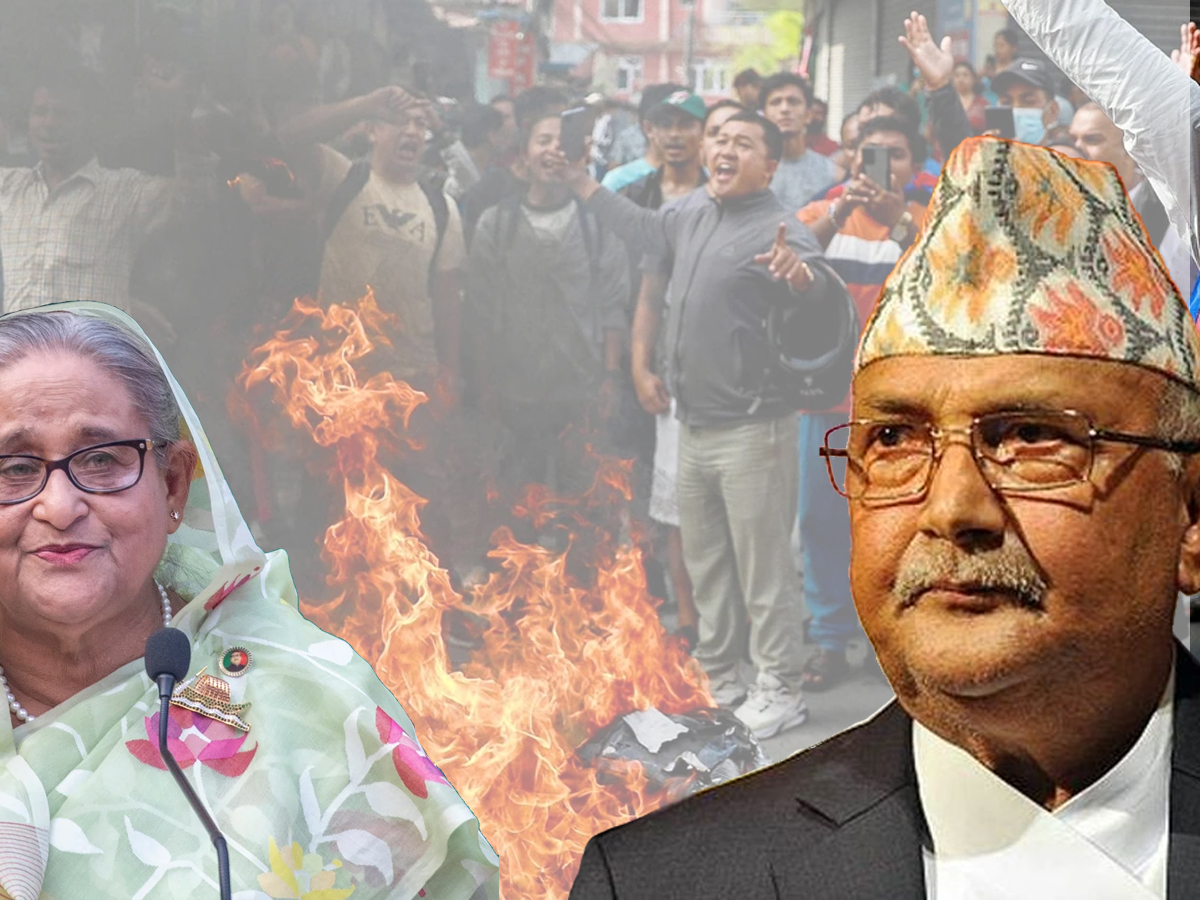
In August 2024, Bangladesh’s Prime Minister Sheikh Hasina resigned after huge protests and went to India for safety.
Nepal is currently facing a big political crisis, which is similar to what happened in Bangladesh in 2024. People protested violently, leaders resigned, and the army had to step in to maintain law and order in both countries, and now many are asking, could Nepal go the same way as Bangladesh?
In August 2024, Bangladesh’s Prime Minister Sheikh Hasina resigned after huge protests and went to India for safety. The protests started over job quota reforms but grew into a bigger movement against corruption and authoritarian rule. Demonstrators set fire to the government offices, looted homes, and even set fire to the presidential palace.
Similarly, in September 2025, Nepal’s Prime Minister K.P. Sharma Oli resigned after violent protests over corruption. At least 20 people died and more than 340 were injured. Protesters attacked government buildings, including the parliament and top leaders’ residences. The unrest was fueled by anger over corruption, economic troubles, and the government's blocking of 26 social media platforms.
In both Bangladesh (2024) and Nepal (2025), the protests were mostly led by young people and students, especially Gen Z. In Nepal, thousands took to the streets against corruption and the social media ban, carrying banners like "Youths Against Corruption."
In Bangladesh, students protested government quotas that favored political elites. In both countries, social media was key in spreading messages and organizing the protests.
In both Bangladesh and Nepal, young protesters were killed during the demonstrations. In Bangladesh, about 1,500 people died in the July–August 2024 protests. In Nepal, 20 protesters, mostly students, were killed. These deaths made people angrier and fueled even bigger protests, pushing the governments to take action.
In both Bangladesh and Nepal, protesters went after important government buildings and leaders’ homes. In Bangladesh, people looted and set fire to Sheikh Hasina’s house, the parliament, and police stations.
In Nepal, protesters burned PM Oli’s home, attacked ministers’ houses, and damaged government buildings. Both protests used these actions to show anger against corruption and authoritarian rule.
In both countries, the army had to step in when the crisis turned so cruel and angry. In Bangladesh, soldiers worked to control the violence, and on the other hand, in Nepal, the army imposed curfews, protected important buildings, and arrested people involved in looting.
This shows how serious both crises have been and the challenges governments face in maintaining order.
After resigning, KP Sharma Oli reportedly went to Dubai for “medical treatment.” Some think he might ask India for shelter because he has had good relations with the country.
ALSO READ: Nepal Army Chief Chooses Prithvi Narayan Shah’s Portrait for Rare Address | Here’s Why
In contrast, Sheikh Hasina’s move to India was fast and well-organized. She flew by helicopter from Dhaka to Delhi and stayed in India until it was safe to return. Her arrival got mixed reactions, showing how tricky it can be for neighboring countries to help politically.
Nepal and Bangladesh share some clear similarities, both had leaders step down, mass protests, and military intervention. For Nepal, the next steps are very important, as the country needs an interim government, fair elections, and strong democratic institutions, and restoring public trust will be an important key.
The international community, including India, will likely play a role in helping Nepal, but as Bangladesh’s example shows, foreign help must respect Nepal’s independence and the will of its people.
ALSO READ: Air Travel Suspended, Trucks Stranded as Nepal Unrest Impacts India-Nepal Border