
New Delhi:
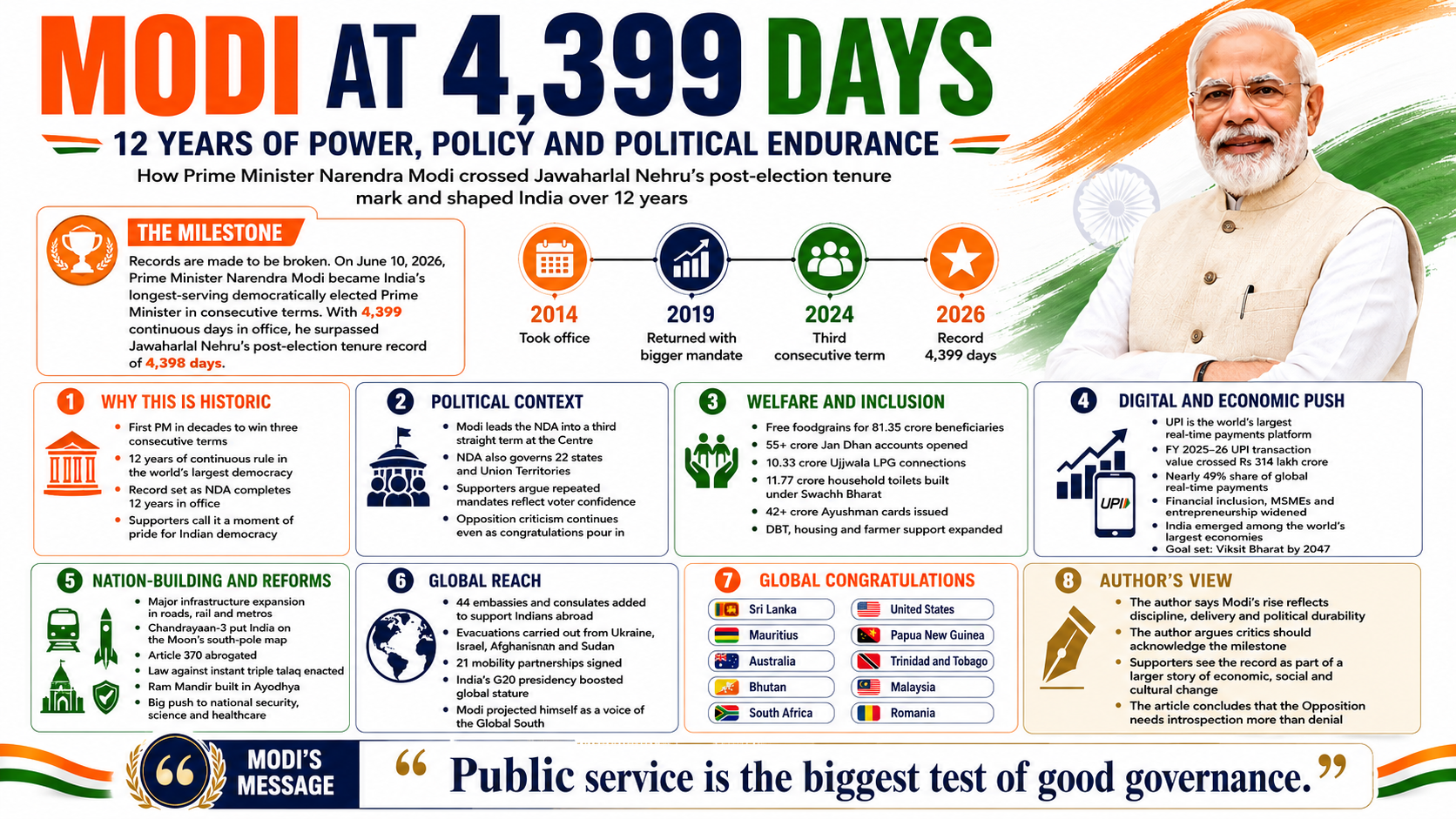
This is a moment of pride for Indian democracy. However, it is ironic that while much of the nation is celebrating the achievement and congratulatory messages are pouring in from across the world, the Opposition alliance led by Rahul Gandhi is criticising and questioning the milestone instead of acknowledging it.
For a vast democracy such as India, the world’s most populous nation, remaining continuously in power for 12 years is no ordinary feat. Only time will tell how many more years Prime Minister Modi will continue to serve the nation and what further milestones he may achieve.
Such success has not come by chance. It is the result of Modi’s unwavering dedication to the nation, his commitment to transforming India into a developed country, and his guiding principles of “Sabka Saath, Sabka Vikas, Sabka Vishwas, Sabka Prayas” — together with all, development for all, trust of all and efforts by all. His supporters frequently highlight his work ethic and continuous engagement in governance, irrespective of holidays, festivals or personal breaks.
The reaction of Rahul Gandhi and sections of the Opposition, according to the author, reflects a political inability to appreciate an achievement that many citizens view as significant. While much of the country marks the occasion positively, Opposition parties continue to criticise the Prime Minister.
The Opposition also overlooks the fact that under Modi’s leadership, the NDA not only secured a third consecutive term at the Centre but also formed governments in 22 states. Voters ultimately make their choices based on performance, and repeated electoral victories suggest that a significant section of the electorate continues to place its confidence in the BJP and the NDA.
Critics of Modi, the author argues, should also reflect on the record of previous governments. At the time of Independence, India’s economy was larger than China’s. Today, China is the world’s second-largest economy, while India has grown significantly in recent years and is now among the world’s largest economies. The author credits the Modi government with accelerating economic growth and pursuing the goal of making India a developed nation by 2047, the centenary year of Independence.
The article further contrasts historical decisions associated with Jawaharlal Nehru with what it describes as Modi’s development-driven approach. It credits the current government with strengthening India’s global standing, reducing poverty, and implementing major economic, social and cultural reforms.
Among the achievements highlighted by supporters of the Modi government are:
● Expansion of social welfare programmes
● The digital revolution and widespread adoption of UPI payments
● The Pradhan Mantri Jan Dhan Yojana and financial inclusion initiatives
● Direct Benefit Transfer systems
● The opening of hundreds of millions of bank accounts
● Growth of MSMEs and entrepreneurship
● Ayushman Bharat healthcare coverage for millions of beneficiaries
● Construction of more than 110 million household toilets
● Distribution of free LPG connections to millions of households
● Rapid expansion of renewable energy
● The success of the Chandrayaan-3 mission, including the first landing near the Moon’s south pole
● India’s rise as one of the world’s largest economies
● Abrogation of Article 370
● Legislation against instant triple talaq
● Major investments in infrastructure, national security, science, technology and healthcare
● Construction of the Ram Mandir in Ayodhya
According to the author, these achievements have been made possible by a clear vision and a determined commitment to national development.
The article concludes that unless the Opposition objectively evaluates these developments and engages in introspection, it will continue to face electoral setbacks while blaming institutions such as the Election Commission and other constitutional bodies.