
New Delhi:
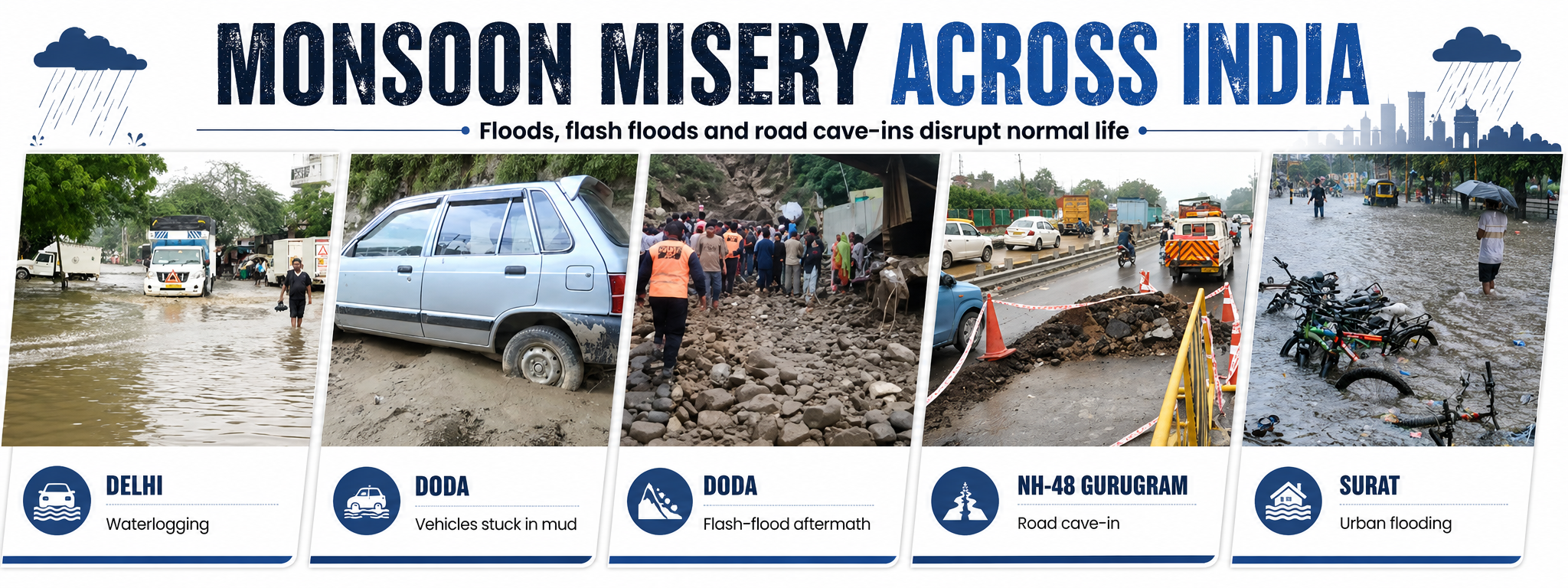
In Delhi, the familiar monsoon script played out once again. From Saket and Khanpur to Tigri, Swarup Nagar, East Patel Nagar, Greater Kailash-II, Dwarka and parts of Noida, rainwater filled roads, slowed vehicles and made walking difficult for residents. At Kushak Road in Swarup Nagar, stagnant muddy water and overflowing sewers left stretches virtually unusable, while visuals showed schoolgirls wading through flooded streets.
News X travelled across rain-hit locations in the capital, where residents said the problem returned every year despite repeated assurances. In Khanpur and Tigri, deep potholes hidden under rainwater made driving dangerous, while near the Badarpur-Mehrauli border, slush, broken roads and traffic bottlenecks added to commuter misery.
The disruption extended to Delhi airport, where airlines including Air India, IndiGo and Akasa Air advised passengers to leave early and check flight status as intermittent showers continued.
Gurugram witnessed severe waterlogging and massive traffic snarls, prompting police to advise corporate offices and private establishments to allow employees to work from home wherever possible. Traffic crawled on NH-48 after a road cave-in near Narsinghpur, while visuals showed SUVs stuck in roadside pits and a bus stranded on a damaged stretch. Police urged commuters to avoid unnecessary travel and use alternative routes.
The IMD issued a yellow alert for Delhi, Noida and Gurugram, forecasting more rain, thunderstorms, lightning and gusty winds over the next five days.
In Gujarat, Surat bore the brunt of the deluge, with several parts of the city submerged after continuous rainfall. Roads disappeared under floodwater, vehicles were stranded, and residents in some areas were forced to use boats. Visuals showed buses, trucks and cars more than halfway submerged, while a police officer was seen wading through shoulder-deep water.
NDRF teams evacuated 85 people, including 22 children, from Sriram Nagar Society in Surat. The IMD issued a red alert for several Gujarat districts, including Surat, Bharuch, Navsari, Valsad, Vadodara, Tapi and Amreli, warning of heavy rain, lightning, thunderstorms and gusty winds. Four people were reported dead in Surat in monsoon-related incidents.
Union Home Minister Amit Shah spoke to Gujarat Chief Minister Bhupendra Patel, Maharashtra Chief Minister Devendra Fadnavis and Jammu and Kashmir Chief Minister Omar Abdullah to assess the situation and assured all possible support from the Centre.
In Maharashtra, Mumbai’s Santacruz observatory recorded 1,017 mm of rain between July 1 and 7, surpassing the city’s entire July rainfall last year. The IMD upgraded its warning for Mumbai, Thane and Raigad to orange alert, while Palghar remained under red alert. Heavy rain also triggered temporary disruption on the Mumbai-Pune Expressway following a landslide. In Satara, four members of a family died of electrocution while reportedly trying to save one another.
In Jammu and Kashmir, flash floods triggered by heavy rainfall caused extensive damage in Doda and Kishtwar districts. Several houses, vehicles and roads were damaged, though no casualties were reported. SDRF teams were deployed for rescue and relief operations, while National Highway 244 was blocked at Premnagar after floodwaters and debris brought traffic to a halt.
Himachal Pradesh also remained on alert, with the IMD forecasting active monsoon conditions for the next five to seven days. Heavy rainfall is likely in Kangra, Kullu, Mandi, Shimla and Sirmaur, raising the risk of landslides, flash floods and rising water levels. The state has received about 27 per cent above-normal rainfall since the onset of monsoon.
PWD Minister Vikramaditya Singh said around 15,000 personnel and 1,600 machines had been deployed to restore road connectivity across Himachal Pradesh. The number of blocked roads had come down from 104 to about 60, with more expected to reopen soon.
In Rajasthan’s Jodhpur, rain brought relief from intense heat but also caused water accumulation on roads, exposing weak drainage infrastructure in parts of the city.
Across states, the rain offered a break from the summer heat but also exposed a recurring monsoon reality: flooded streets, broken roads, stranded vehicles, delayed travel and civic systems struggling to keep pace with the downpour.