
Jakarta:
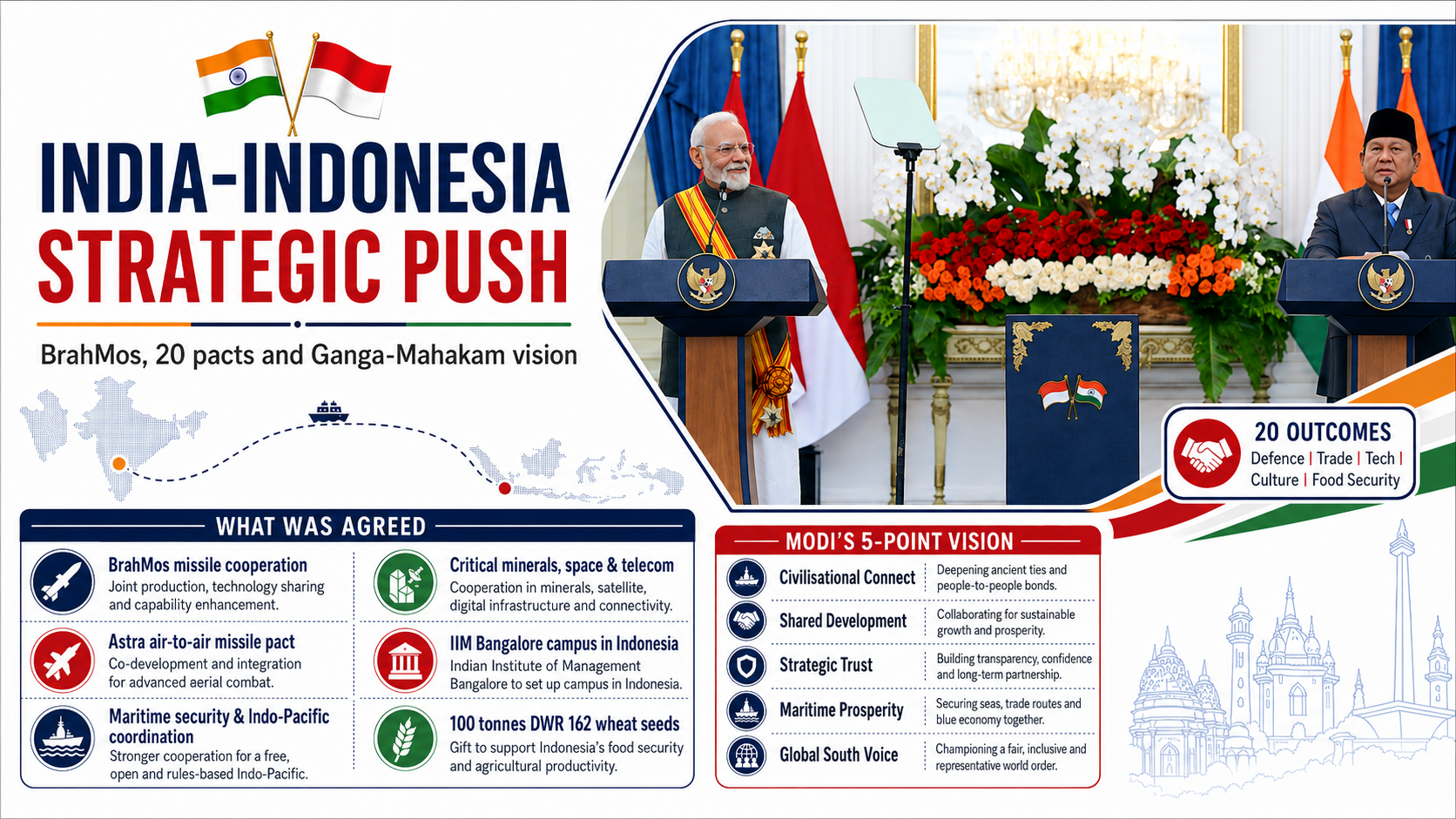
The agreements covered defence, maritime security, critical minerals, space, agriculture, healthcare, disaster management, technology, education and cultural cooperation. Officials said India will supply BrahMos supersonic cruise missiles and Astra air-to-air missiles to Indonesia, marking a significant boost to India’s defence exports and deepening its strategic footprint in Southeast Asia.
The BrahMos system, jointly developed by India and Russia, is among the world’s fastest cruise missiles and can be launched from land, sea and air platforms. The Astra beyond-visual-range air-to-air missile can be integrated with Russian-origin Sukhoi fighter jets operated by the Indonesian Air Force.
Addressing a joint sitting of the Indonesian Parliament, PM Modi unveiled a five-point “Ganga-Mahakam Vision” for India-Indonesia ties, built around civilisational connect, shared development, security and strategic trust, maritime prosperity and the voice of the Global South.
“Like the currents of the Ganga and the Mahakam, our civilisations have been connected for centuries through ideas, faith, trade and culture,” Modi said, adding that the vision would pave the way for peace, prosperity, security and shared progress for future generations.
Calling Indonesia a key partner in the Indo-Pacific, Modi said India backed a free, open, inclusive and rules-based regional order, with ASEAN at the centre of its Act East Policy. He said the two countries would deepen cooperation against terrorism, cyber threats, terror financing, radicalisation and maritime challenges.
The Prime Minister also thanked Indonesia for standing with India after the Pahalgam terror attack and called for urgent reforms of the United Nations Security Council, saying countries such as India and Indonesia deserved greater representation in the evolving global order.
The two sides also extended maritime safety and security cooperation, agreed to deploy an Indonesian liaison officer at the Information Fusion Centre-Indian Ocean Region, and advanced cooperation in rare earths, critical minerals, steel, telecom, digital public infrastructure and space.
India also announced the supply of 100 tonnes of high-quality DWR 162 wheat seeds to Indonesia to support food security. The two countries signed an MoU on agriculture and allied sectors, with plans to share best practices in sustainable farming, agricultural technology, public distribution and nutrition schemes.
In another major outcome, an Indian Institute of Management Bangalore branch campus will be set up at Singhasari Special Economic Zone in Indonesia. The two countries also agreed to commemorate 2027 as the Tagore-Dewantara Year of Cultural and Educational Diplomacy, marking the centenary of Rabindranath Tagore’s visit to Indonesia.
Indonesian President Prabowo Subianto warmly praised PM Modi, describing him as a leader he deeply admired. Speaking at an Indian diaspora event, Prabowo said he had studied and adopted several of Modi’s policies, joking that he was relieved there was “no copyright” on them.
He also spoke of Indonesia’s deep civilisational links with India, noting the influence of Sanskrit on the Indonesian language. In a light-hearted remark, he said a genome sequencing test had shown he had Indian DNA, adding that Indian music made him want to move.
PM Modi, in turn, described Prabowo as “a true friend of India” and said he was overwhelmed by the warmth shown by the Indonesian people. Referring to the popularity of the Bollywood song Kuch Kuch Hota Hai in Indonesia, Modi said that when India and Indonesia move forward together, it leads not just to “kuch kuch” but to “bahut kuch”.
President Prabowo also conferred on PM Modi the Bintang Adipurna of the Republic of Indonesia, the country’s Medal of Honour, in recognition of his role in strengthening India-Indonesia friendship. Modi dedicated the honour to the people of India.