
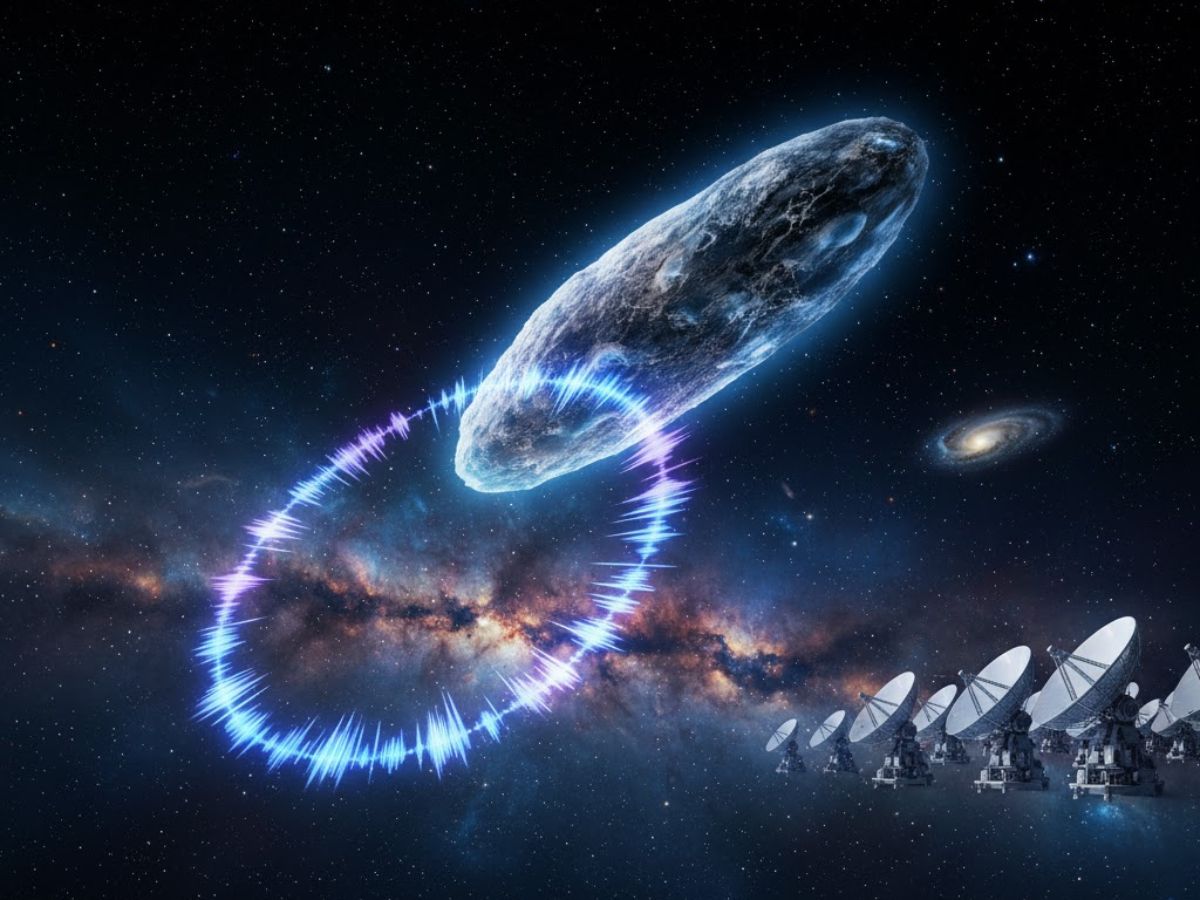
For the first time, the interstellar object 3I/ATLAS has been caught sending out a radio signal—a major scientific milestone. This finding may increase the object’s mystery by connecting it to one of the most controversial signals in space history.
The Historic Detection
The discovery took place on October 24, 2025, thanks to South Africa’s MeerKAT radio telescope. After unsuccessful September attempts, the telescope detected a clear signal as 3I/ATLAS passed by the Sun. The signal wasn’t man-made but natural, showing absorption lines from hydroxyl (OH) molecules—created when sunlight splits water ice. Found at two exact frequencies, this marks the first recorded radio emission from the interstellar object, giving scientists a new way to analyze its composition.
Also Read: FIDE World Cup 2025: World Champion D Gukesh Exits After Defeat to Germany’s Frederik Svane
What Does the Signal Tell Us?
The detected signal is more than just a simple beep. Scientists can learn a great deal by analyzing its properties. Harvard scientist Avi Loeb, who reported the discovery, explained that the signal’s “Doppler shift” reveals the object’s high speed relative to Earth. Furthermore, the data suggests the OH molecules are being shed from the object’s surface at a temperature of approximately -43 degrees Celsius. Researchers can better comprehend the object’s physical characteristics as it moves through our solar system by using this data as a remote thermometer and speedometer.
The Puzzling Nature of 3I/ATLAS
The peculiar nature of 3I/ATLAS, which was first observed on July 1, 2024, has baffled scientists. Unlike most comets, which feature long, glossy tails, this comet has almost no tail. It once produced an optical illusion called a “anti-tail,” which was unexpected. These peculiar symptoms make it a rare and excellent topic for research. Now, the new radio signal offers a vital clue that could help explain what this object really is and where it originated.
A Connection to the Famous “Wow! Signal”?
The new discovery gains even greater significance when linked to a decades-old mystery. In 1977, a powerful, unexplained radio signal was detected by astronomer Jerry R. Ehman, who famously wrote “Wow!” next to the data printout. Intriguingly, Avi Loeb’s calculations show that the arrival direction of 3I/ATLAS coincides within 9 degrees of the original Wow! Signal’s source. Loeb states the random chance for such an alignment is only about 0.6 percent, raising the tantalizing possibility that 3I/ATLAS itself could have been the source of the famous signal nearly 50 years ago.
Also Read: James Watson Dies at 97: The Nobel Laureate Who Discovered DNA’s Double Helix
What Happens Next?
The scientific investigation is far from over. According to Loeb, the current detection is just the beginning. The next major opportunity will occur on March 16, 2026, when 3I/ATLAS passes within 53 million kilometers of Jupiter. NASA’s Juno spacecraft is planned to use its antenna to search for additional radio signals from the object at lower frequencies. If this intergalactic visitor is the answer to one of astronomy’s biggest mysteries, this observation in the future may reveal even more hints.