
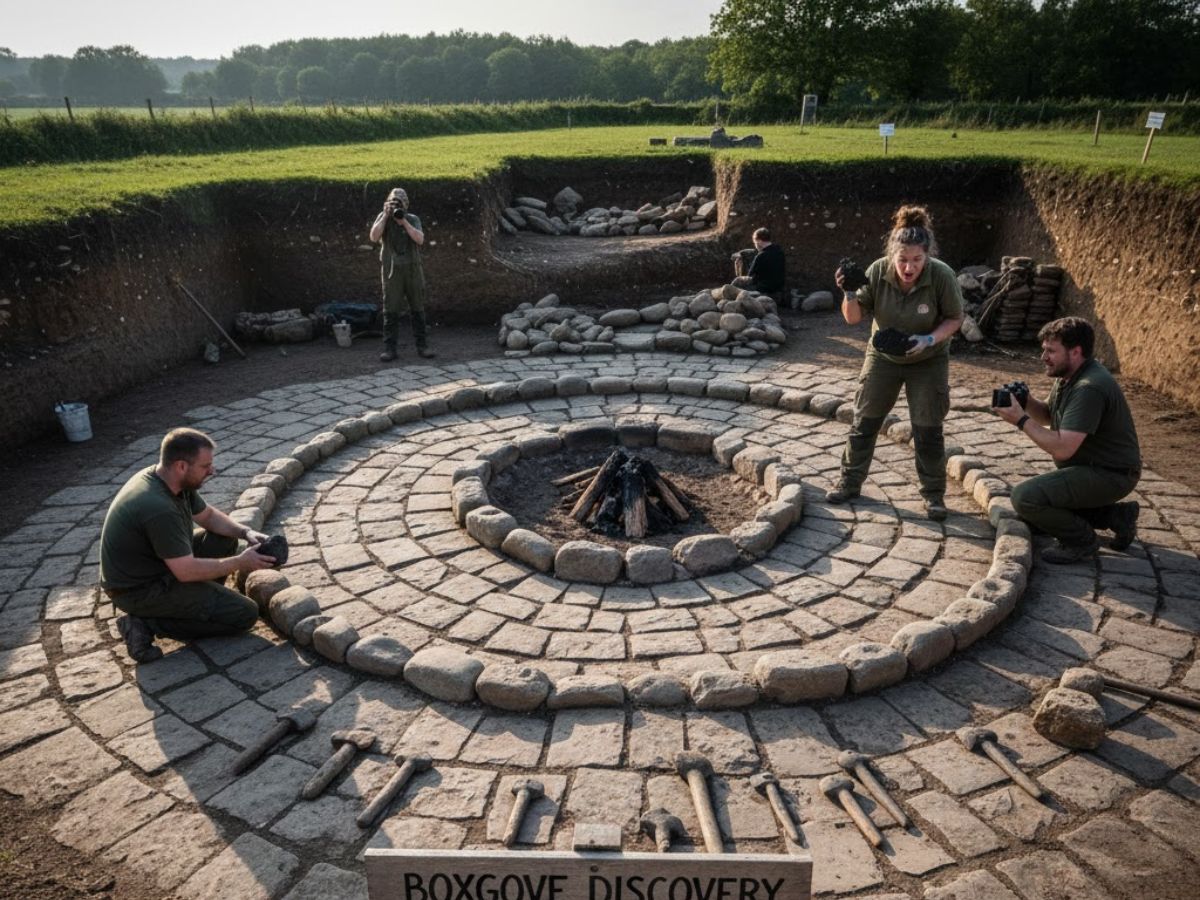
A remarkable discovery in eastern England is rewriting the story of when humans first controlled fire. At Barnham in Suffolk, archaeologists uncovered a 400,000-year-old hearth and what could be the oldest fire-making kit, hinting that early humans used fire far sooner—and as a social gathering point—than previously believed.
What Was Discovered in Barnham Forest?
The dig, led by Professor Nick Ashton and his team, uncovered a remarkably important site hidden just a few meters underground. According to the data, it may have served as a social hub for prehistoric humans in addition to being a campsite.
Key discoveries include:
- A Central Hearth: Evidence of a controlled, human-made fire.
- The “Stone Age Lighter”: Pieces of iron pyrite (fool’s gold) were found alongside flint tools. When flint hits pyrite, it creates sparks, suggesting early humans were deliberately starting fires, not just using natural ones.
- Heat-Altered Flint Tools: Researchers confirmed a controlled fire because the flint pieces display heat-alteration caused by strong, direct flames.
The excavation led by Professor Nick Ashton uncovered a highly significant site just a few meters below the ground. The findings hint that it wasn’t only a campsite but may have been a social gathering spot for early humans.
Also Read: Ranveer Singh’s Dhurandhar Sparks Online Harassment Campaign Against Critics, Says Guild
Why Is This Discovery So Revolutionary?
One important turning point in human evolution is said to be the ability to manage fire. It provided warmth, safety, nutrient-rich cooked food that would have accelerated brain development, and more usable hours per day.
This discovery challenges the established timeline:
Previous Timeline: The earliest widely accepted evidence for the habitual use of fire by humans (hominins) in Europe dated to around 350,000 years ago.
New Timeline: The Barnham site, dated to 400,000 years ago, pushes this critical technological leap back by at least 50,000 years.
Significance: The evidence implies that Homo heidelbergensis, the pre-human species in Britain at the time, already showed strong cognitive skills, long-term planning, and group cooperation earlier than previously believed.
What Does This Tell Us About Early Human Life?
The location vividly depicts communal life over 500,000 years ago. The existence of a central, well-maintained fireplace suggests:
- Social Structure: Gathering around a shared fire required and fostered social rules, communication, and a sense of community.
- Technological Skill: The use of a pyrite-and-flint fire-starting kit represents a significant technological invention, not merely the opportunistic use of wildfire.
- A “Home Base”: It suggests a semi-permanent or repeatedly visited location, indicating less nomadic movement and more complex settlement patterns.
Your Questions Answered: Ancient Fire Discovery FAQs
Q: Who were the humans that made this fire?
A: Homo sapiens were not the residents of Britain 400,000 years ago. They were probably Homo heidelbergensis, a prehistoric ancestor of Neanderthals and possibly modern humans.
Q: How can archaeologists be sure the fire was human-made and not natural?
A: The main evidence is the compact fireplace, its link to human tools and pyrite for making sparks, and flints changed by intense, localized heat rather than the wide burn of a natural fire.
Q: What is the “Barnham Forest” site like today?
A: Located near Thetford in Suffolk, it is now a forested area. The archaeological layer is buried under sediment deposited after the last major ice age, preserved by being sealed for millennia until its recent discovery.
Q: Could this be the “birthplace” of human-controlled fire?
A: It is among the very oldest definitive evidence found to date. However, the “birthplace” was likely in Africa, where human ancestors first evolved. This discovery shows how rapidly and early this technology spread to the northern frontiers of human habitation like prehistoric Britain.
Also Read: Gambling Tax Relief? Fight Continues as Trump Mulls End to Federal Tax on Gambling Wins