
As space emerges as a new frontier of strategic contest, gaps in international law threaten security and peaceful exploration. India must take the lead in forging binding global rules that balance national security with the shared interests of humanity.
The next contest for power may not be on land, in the sea, or in the air. It may occur hundreds of kilometres above the Earth. The difficulty is that while space is becoming more vital for communication, navigation, surveillance, science and finance, the recent geopolitical development of a space arms race is becoming a concern. One country may regard it as a way of protecting itself. Another country may regard it as a security threat. The issue is not just having weapons in space but the uncertain consequences thereafter, leading to suspicion and further proliferation.
A United Nations Institute for Disarmament Research (UNIDIR) study made a substantial inference that the consequences of space weaponisation are far-reaching beyond the players who are involved. It can put the civilian space resources of other nations at risk, which can have direct implications for one’s economy, scientific exploration, navigation and communication, etc. At present, this issue has come into the limelight when the USA recently admitted to deploying counter-orbital satellites in space. Further, anti-satellite missile technology is exhibited by four major nations: the USA, Russia, China and India. In addition, with rapidly progressing technology, there is a regulatory gap in the international conventions. Therefore, this calls for stricter regulation of outer space to keep it open for peaceful exploration and to arrest a future arms race.
The 1967 Outer Space Treaty continues to be the bedrock of space law. It asserts that exploring and using space should benefit all countries. It does not allow any country to claim possession of space. It also specifies that all activity in space has to respect the law. Article IV bans the stationing of weapons and other weapons of mass destruction in orbit. It also restricts actions on planets, moons and other celestial bodies. The treaty does not prohibit conventional military tools that can be employed in space. So, the fundamental problem isn’t that space has no rules.
It’s because the rules haven’t kept up with innovations, creating a legal gap. This issue is already being addressed in the international community through the Conference on Disarmament and the Prevention of an Arms Race in Outer Space (PAROS) process. India supports a multilaterally negotiated, legally enforceable document on PAROS that is acceptable and verifiable. What is important about these meetings is that despite the rapid pace of technology, the problem has been recognised by diplomacy.
However, the gap between accelerating capabilities and the slower process of legal rule-making is widening. This leaves uncertainties about proximity operations, cyber interference, electronic warfare, attribution and traditional anti-satellite weaponry. Challenges that international negotiations are facing, first, the lack of consensus on accepting the definition of “space weapons” because many systems are dual-use, meaning they have multiple purposes. Second, the distinction between militarisation and weaponisation: military satellites have peaceful uses like navigation, unless used destructively as counterorbital satellites to neutralise enemies.
The third challenge is not merely agreeing on what should be prohibited; it is developing credible mechanisms to determine whether states are complying. The repercussions are not a matter of strategy, but of ethics too. Outer space is for all humanity, not for a few powerful nations. When two superpowers conflict, even countries not participating can become collateral damage. If a counterspace assault destroys a satellite or creates space debris, the damage can ripple into navigation, communications, farming, weather prediction, and emergency response. And why should a country that had no role in the battle nonetheless bear the fallout from someone’s military move? No nation’s national security justifies creating threats in common space. Space debris makes this problem very clear.
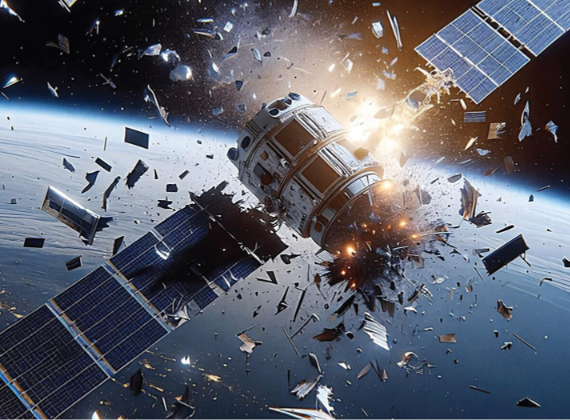
Destructive antisatellite tests can produce fragments. Fragments travel at high velocities and threaten civilian space objects too. The situation shows why debrisgenerating antisatellite activity should become a priority for international regulation. A nation may wish to destroy one satellite. However, the same nation cannot control the consequences of the debris created by the action of destroying a satellite. The risk is an externality shared by all space users. The policy response should therefore be layered rather than symbolic. First, the current Outer Space Treaty system needs to be made stronger by creating a legally binding agreement called PAROS.
This agreement should deal with weapons and tools that can be used for both peaceful and harmful purposes. Next, a complete ban on any planned ASAT tests that create space debris on purpose. Third, there is a need for rules about moving close to other spacecraft, communicating with others about incidents, finding out who is responsible and other standard space protocols. Some countries can take steps to be more open and trust each other while they keep working on rules that everyone must follow. India can play a larger diplomatic role in this process. In 2019, India proved the potential to destroy satellites in orbit with Mission Shakti, establishing that India has a space-security capability. India is also simultaneously working toward keeping the space environment safe and clean.
The government has initiated initiatives like the Debris Free Space Mission. As a major spacefaring country and a key voice for the Global South, India can act as a connector between old space powers and new space players. It can lead a global campaign for peaceful exploration of space in future using its voice on platforms like BRICS and SCO, etc. The objective should not be to deny legitimate security needs, but to ensure that strategic competition does not undermine universal access and long-term sustainability. The next legal challenge may extend to nearby celestial bodies, as superpowers race for a civilian nuclear reactor on the Moon by 2030. However, this should not prematurely be characterised as a weapon. The more important question is how international law will govern strategically significant dual-use infrastructure before competition becomes entrenched. Rules are easier to establish before a crisis than after one. The question facing humanity is therefore no longer whether outer space will have strategic importance but whether states will allow strategic competition to determine the rules, or collectively establish them before competition becomes irreversible.
Girish M is an independent policy researcher based in Mysuru, Karnataka. Certified in Public Policy Analysis by the London School of Economics (LSE) and in Public Policy skills through the Research Analysis and Advisory Hub (RAAH) think tank. His research interests include Indian foreign policy, geopolitics and strategic affairs, constitutional governance, public policy, and contemporary social issues.
*Janvi Singhi is an Independent Policy researcher based in Hyderabad. She has a Master’s degree in Political Science and has authored research papers and opinion articles on Foreign Policy, geo-economics and Strategic Affairs.