
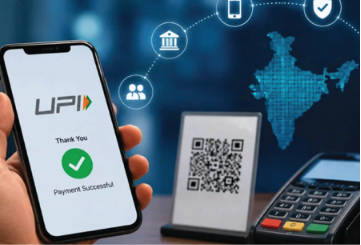
Since 2016, every small payment in India have been made almost entirely in hassle-free manner and daily transactions in India became much easier through UPI. But on September 15th the National Payments Corporation of India (NPCI) issued a notification which mentioned that large UPI large merchant payments are no longer free in India widely sparking a debate over its impact on real world businesses. Suppose, early one morning you go to a tea shop, ask for the QR code and you pay for your tea. Everything till here is fine, no fee, no extra payment nothing. This will not change. But the moment you walk into a showroom and buy a refrigerator for Rs 35,000, scan the QR code, something changes. The showroom pays 0.4%. That is Rs 140 as Merchant Discount Rate (MDR). The customer pays nothing extra. This is the UPI framework, effective from October 15. It is simpler than the debate around it suggests, if we look at it closely MDR is not something absolutely new in the market, it is an existing framework in globally recognized systems like Mastercard, Visa and other payment system. What’s different is that UPI’s scale means far more people are now looking closely at a mechanism that was previously confined to a narrower segment of the economy. It is concerning because UPI is being used for smallest transaction taking place in India, it would affect daily activity of consumers.
The framework
NPCI has announced a Merchant Discount Rate (MDR) of 0.4% for transactions amounting to more than Rs 2,000 made using the UPI and capped at Rs 300 per transaction. Payments between individuals are still free of charge, no matter the quantity. And all payments made to merchants up to Rs 2,000 are free. Under the Person-to-Person-Merchant (P2PM) category, small merchants like street vendors, neighbourhood shops will continue to pay zero MDR, meaning if a small merchant in a nearby general store is earning around Rs 1 lakh per month, it will be paying crore, followed by a hike to Rs 2,210 crore, and then a further increment to Rs 3,631 crore. Unfortunately, free is never free; it always comes with a price. zero additional amount to the banks. For the important sectors which include the railways, telecom, insurance, fuel, agricultural inputs – a flat Rs 5 applies to transactions above Rs 2,000. For capital market transactions, the MDR is 0.02%, capped at Rs 300. The new MDR framework does not apply to credit card linked UPI payments or pre-sanctioned credit lines. The MDR for automated recurring payments via UPI AutoPay is also zero. Around 96 percent of merchant transactions will be unaffected as they are either under Rs 2,000 or covered by the small merchant exemption, according to government estimates. MDR is neither a tax by the government nor an NPCI charge. It is spread across the banks, payment service providers, and UPI application providers. This revenue is intended to sustain the existing ecosystem of payment banks and the servers; it would help in securing the network and cloud infrastructure. If we look at it closely, this money will sooner or later go back to the ecosystem.
Why now?
UPI has been free for six years. All the charges were paid by the government. As per the data and reports available on Press Information Bureau (PIB), an incentive scheme has been running since FY 2021-22 with allocation of Rs 1,389 The UPI network handles more than 24 billion transactions per month with a transaction value of Rs 29.82 trillion. Someone must pay for servers, cybersecurity, the extension to more rural areas where the connectivity is weak and people are still dependent on cash for their small payments. According to PhonePe’s CEO Sameer Nigam, the payments industry has been taking massive losses over the past six years, India was one of the few countries out of over 200 countries that did not have any MDRs at all. Paytm’s Vijay Shekhar Sharma described the framework as a “Robin Hood approach” funded by those who do make highvalue payments and it is free for the small merchants and ordinary consumers. Former Infosys board member Mohandas Pai made the infrastructure side of the argument, saying that during the peaks in transaction volumes, UPI has 15 to 30 percent failure rates. The IT infrastructure must be upgraded, as it is expected to reach 50 billion transactions in 2 years compared to the current 24 billion. “Who’s going to pay for that upgrade?” UPI was initially launched to improve small transaction payments handsfree Representational Image. and it’s still being used for that purpose, and for small transactions up to Rs 2000, it’s completely free of cost and even for transactions exceeding Rs 2000, payments made by consumers are free of cost, it is a matter between the merchant and the payment banks when it comes to MDR.
The pushback?
The Retailers Association of India (RAI) remains unconvinced. “This charge, if it is, could set back years of efforts on digital payments adoption for India’s smallest retailers,” said CEO Kumar Rajagopalan. His calculations are simple: about 3% of turnover is normally the net profit of most retailers. A 0.4% MDR removes about a sixth of that profit. Small merchants are now likely to think whether to accept cash or UPI payments, particularly as a significant percentage of transactions are above Rs 2,000 during the festive season, RAI has said. The worry is that cash which is a untraceable and does not drive any GST reporting, it becomes the path of least resistance. Ashneer Grover, the former Bharat Pe co-founder, called it “just tax collection”. He cited NPCI’s own financials and said that cash held by NPCI is Rs 6,119 crore, while its pre-tax operating profit was Rs 1,900 crore, why was there a need for a levy when the system is already profitable? He also brought up the cost of running UPI with the cost of the cash infrastructure in India which stands at Rs 30,500 crore per year for cash logistics and ATMs, and said that if the focus is on optimisation, it’s better in the digital space. He further claimed in a news debate by Times Network that in the United States, where retailer profit margins average around is 35%, a 2% charge is comparatively easy to absorb but in India that margin is relatively less, about 17-18%, merchants are in a far less favourable position to pay extra. Nithin Kamath of Zerodha, who raised another concern, stated that the framework does not seem to be economically viable and MDR is probably inevitable when it comes to investing and broking, where the customer moves money without trading.
What it means?
The merchant now has to pay Rs 40 to make a UPI payment of Rs 10,000. The amount of debit card payment, at the ceiling rate of the RBI, could be up to Rs 90. The cost of the credit card payment may be anywhere between Rs 150 and Rs 250. By far, UPI is the most affordable digital payment method for merchants. The tea shop owner will not pay at all. General store will not pay anything extra. The autorickshaw man won’t pay. The customer will not make any additional payment. The showroom will pay Rs 140 on a Rs 35,000 refrigerator. The insurance company pays Rs 5 on a Rs 2,000 premium. The investor of a mutual fund will have to pay 0.02%. The alternative was not a better system. The other solution was a system which would not expand, couldn’t be upgraded, couldn’t reach the last village. A system which would eventually be paid by everyone, for it would have been incapable of charging anyone. The government has opted for a different route. It has requested the big to pay so the small may be free. The Tea shop owner will retain his Rs 20. That is the test of a good policy. The people who need protection do not even know they are being protected.
*Dr. Sadaf Fahim, Assistant Professor of Law, Author and Co-Director, Centre for Artificial Intelligence and Technology Law, Chanakya National Law University, Patna, and Adhiraj Sahgal, a second-year B.A. LL.B. student at the National University of Study and Research in Law, Ranchi.