
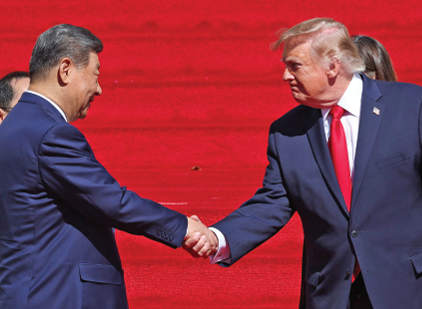
The importance of the summit held by Donald Trump and Xi Jinping on 24 September in Washington is not restricted to the issue of tariffs alone. The meeting came against the backdrop of negotiations over the continuation of the US-China trade truce, rare-earth supplies, artificial intelligence, technology and other sources of economic and strategic tension. The summit did not resolve these underlying disputes; instead, Washington and Beijing extended their trade truce while leaving several difficult questions for further negotiations. However, the most relevant question for India is what will happen when the two biggest powers learn to deal with their rivalry without resolving it.
This distinction is important for India. A long-running US-China rivalry offers strategic opportunities for New Delhi from China+1 manufacturing and technology collaboration to a bigger place for it in the Indo-Pacific. But the summit demonstrated that Washington and Beijing can compartmentalize their rivalry and negotiate selectively. Xi himself described the objective as building a relationship of “strategic stability” in which cooperation can continue, competition is kept within limits and differences are managed. So, India cannot outsource its strategic leverage to US-China competition. Its strategic autonomy will increasingly depend on whether it can convert the opportunities created by that rivalry into capabilities of its own.
One of the main vulnerabilities is asymmetric interdependence. The rare-earth dispute shows how much economic dependence can be turned into a form of geoeconomic strategy. The role of China in the field of rare-earth mining, processing and production provides it with a strong bargaining power which cannot be easily offset by the use of tariffs.
India has already seen the threat and allocated ₹7,280 crore to create 6,000 tonnes per year of integrated rare-earth permanent magnet manufacturing capacity. However, the greater challenge is presented by the requirement of midstream capacity; the July report by the government stated that the country imports 100% of its requirements of sintered NdFeB permanent magnets as it lacks the industry-wide facilities for the processes of oxide-to-metal conversion, alloy production, and magnet manufacturing.
This exposes a wider principle: resources become leverage only when they are embedded in capabilities. Geological reserves without processing, processing without manufacturing and manufacturing without globally competitive firms cannot provide strategic bargaining power. For India, the objective must be to build complete value chains rather than simply acquire strategic resources.
The second type of vulnerability could be technological. AI and advanced semiconductors are increasingly located at the crossroads of economic competition and national security issues. Washington and Beijing have also begun creating channels for dialogue on AI safety even as their broader technological competition continues. Xi called for AI to remain under human control, while US officials have pushed for mechanisms to manage risks and maintain technological advantages. Yet the meeting did not resolve the broader technology competition.
For India, this signifies the need to achieve more than just being a place for investment. The aim must be to achieve standard-setting capability through domestic technologies, semiconductor ecosystems, research networks and involvement in global policy processes. Otherwise, India risks becoming a rule-taker in technologies that will shape its economic and strategic choices.
The third vulnerability is with respect to China+1. India has benefited from multinational firms seeking to diversify production because geopolitical and trade risks made excessive dependence on China less attractive. However, any US-China rapprochement might diminish the geopolitical risk premium. Because of that, the recent studies have made it possible to argue that this reduction of geopolitical risks in China might lead to the weakening of some incentives towards applying the China+1 approach.
This does not indicate that China+1 will disappear. China’s manufacturing capabilities, supply chains, and infrastructure cannot be reproduced instantly. Likewise, concerns regarding technology use and concentration of supply chains will not disappear just because of one summit. The more important lesson for India is that the nation must be competitive even if China becomes less geopolitically costly. That requires addressing the structural constraints that geopolitics can temporarily conceal—logistics costs, supplier depth, energy reliability, skills, regulatory predictability and domestic value addition.
Strategically, there are more ramifications. India’s significance to the US cannot be based only on its usefulness in countering China. This is because if the US wants to reach some economic or strategic goals through negotiations with China, the value of other partners in terms of bargaining decreases. India has the opportunity to act without a formal alliance commitment, yet it should not expect the strategic priorities of another power to constantly match its own.
This is why the summit should push India beyond the binary of alignment versus non-alignment. The relevant question is what India can put on the negotiating table.
A large market is a source of power only when it has manufacturing capabilities. Mineral reserves can be a source of power only when they can be processed by India. Maritime geography can be a source of power only when it is backed up by naval capabilities, logistics, ports, and resilient underwater infrastructure. Defense partnerships can be a source of power only when they expand indigenous production rather than create more reliance on outside countries.
This is where the idea of strategic autonomy should have a concrete basis as well. Autonomy is not simply the ability to maintain relationships with competing powers. It is the capacity to preserve choices when those powers change their own calculations.
As a result, the Trump–Xi meeting may put India in an apparent paradox. On one hand, greater stability in US-China relations could reduce tariff escalation and supply disruptions and provide some stability to the global economy. On the other hand, if Washington and Beijing increasingly manage their rivalry through selective bargains, the strategic value India derives from their opposition could decline. The emerging order may therefore be one in which the two powers cooperate in some areas while continuing to compete in others.
India should, therefore, be prepared for both possibilities. If the rivalry escalates, India must be able to handle supply disruptions and coercion. If the rivalry is increasingly managed through selective bargains, it must possess enough economic, technological and strategic capability to make independent decisions and resist unfavourable arrangements. The strategic test is whether India can convert geopolitical opportunity into durable leverage, so that when Washington and Beijing negotiate, India has something consequential of its own to negotiate with.
*Janvi Singhi is a Research Associate at the Organization for Threat Assessment and Peacebuilding (OTAP), Asia-Pacific Bureau, and a Gold Medalist in International Relations based in Hyderabad.