
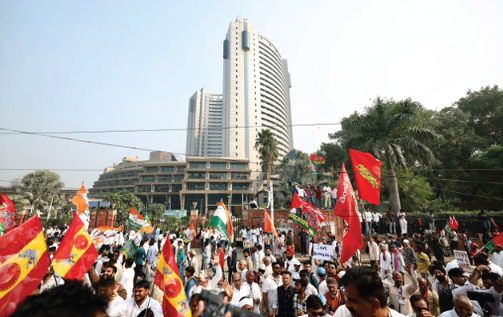
The quality of an opposition is measured not merely by its ability to organise demonstrations, raise slogans or challenge the government, but also by its understanding of constitutional institutions and its willingness to offer constructive alternatives. Unfortunately, the November 1 protest organised by the Congress led INDIA bloc against the Special Intensive Revision (SIR) of electoral rolls raises serious questions about the nature and direction of India’s contemporary opposition politics.
What makes the episode particularly interesting is the attention it received beyond India’s borders. While reading Pakistan’s Dawn newspaper on November 2, I came across its coverage of the previous day’s INDIA bloc demonstration in New Delhi. Among the newspaper’s India-related headlines was the opposition’s protest against the voter-list revision exercise. The report also stated: “Members of Hindu-nationalist BJP have long alleged that large numbers of undocumented Muslim migrants from neighbouring Bangladesh have fraudulently entered India’s electoral rolls.”
One may disagree with the editorial framing of a Pakistani newspaper, but the larger question deserves attention: why has an internal democratic and electoral dispute in India become a subject of such prominent coverage in Pakistan? More importantly, what does this say about the political messaging of an opposition alliance that claims to defend the Constitution and democratic institutions?
The problem is not that the opposition protested. Protest is an indispensable component of democracy. The problem is whether the opposition is demonstrating constitutional responsibility alongside its political resistance. What exactly is SIR? Perhaps the first question opposition leaders should answer is whether they have adequately explained the exercise they are protesting against.
SIR stands for Special Intensive Revision. It is an electoral-roll verification exercise undertaken by the Election Commission of India to ensure that voter lists are accurate, updated and inclusive. Its purpose is to identify eligible voters, include those who have been left out, correct inaccurate entries and remove duplicate or otherwise ineligible registrations. This is not an exercise invented by the present government.
The Election Commission derives its constitutional authority over elections from Article 324 of the Constitution, while Section 21(3) of the Representation of the People Act, 1950, expressly empowers it to direct a special revision of electoral rolls, with reasons recorded. The statutory provision is quite clear on this point. Therefore, describing SIR itself as unconstitutional or treating every attempt to revise electoral rolls as an assault on democracy is an intellectually weak argument.
The constitutional validity of the authority to conduct a special revision and the manner in which a particular revision is implemented are two different questions. They should not be deliberately conflated. India cannot afford to have electoral rolls treated as permanently immune from scrutiny. Democracy rests on the principle of one eligible citizen, one vote. An inaccurate electoral roll, whether through the inclusion of ineligible persons or the exclusion of legitimate voters, undermines that principle. Periodic verification is therefore not inherently anti-democratic; it is an essential administrative responsibility.
Indeed, the Election Commission has Commission’s position that the revision was intended to remove duplicate and ineligible entries and that wrongly deleted voters could seek re-enrolment.
The opposition has every right to question the methodology, demand transparency and highlight instances where genuine voters may have been wrongly excluded. If people have lost their names from electoral rolls despite being eligible, their grievances deserve immediate attention. Such cases cannot be dismissed as political propaganda.
Reuters reported that a protester at Sunday’s rally claimed that four members of her family had been wrongly removed from the electoral roll. The report also noted the Election These concerns deserve institutional examination rather than political dismissal. The Election Commission must ensure that verification procedures are transparent, that citizens receive adequate opportunities to establish their eligibility and that genuine errors are corrected promptly.
No administrative exercise should leave an eligible Indian citizen helplessly struggling to exercise a fundamental democratic entitlement. But this is precisely where the INDIA bloc’s political approach deserves scrutiny. Instead of limiting its campaign to specific procedural shortcomings, evidence of wrongful deletion and constructive recommendations, the alliance has made the resignation of Chief Election Commissioner Gyanesh Kumar a central political demand.
Rahul Gandhi and other opposition leaders have repeatedly accused the Election Commission of facilitating electoral manipulation. At Sunday’s rally, Gandhi went as far as describing the alleged voter-roll exercise as treason. The coverage in Dawn is worth examining, not because a Pakistani newspaper’s reporting should determine India’s domestic political choices, but because it illustrates how India’s internal political confrontations can acquire an international dimension.
Should Indian political parties be indifferent to how their domestic political battles are presented internationally? Certainly not. The opposition is free to challenge the government, but it must also recognise that its words and actions can influence perceptions of India’s democratic institutions beyond its borders. There is something particularly contradictory about political leaders holding the Constitution in their hands while demanding the removal of a constitutional authority through street demonstrations, without first demonstrating their allegations through appropriate institutional mechanisms.
Carrying a copy of the Constitution is not the same as understanding its provisions. Constitutional patriotism requires more than symbolic gestures; it requires respect for institutional procedures, legal distinctions and democratic responsibilities. India needs a strong and responsible opposition that scrutinises the government while respecting constitutional institutions.
The Election Commission must be questioned whenever credible irregularities arise, but every administrative exercise cannot automatically become a constitutional crisis. Electoral integrity demands both the inclusion of eligible voters and the removal of ineligible entries through transparency and due process. The Constitution belongs to the people, not political parties. It must be understood and defended, not merely displayed at political rallies.
*Diganta Chakraborty is Jagran Josh Awardee 2023, A columnist and writer, Authored five books;