
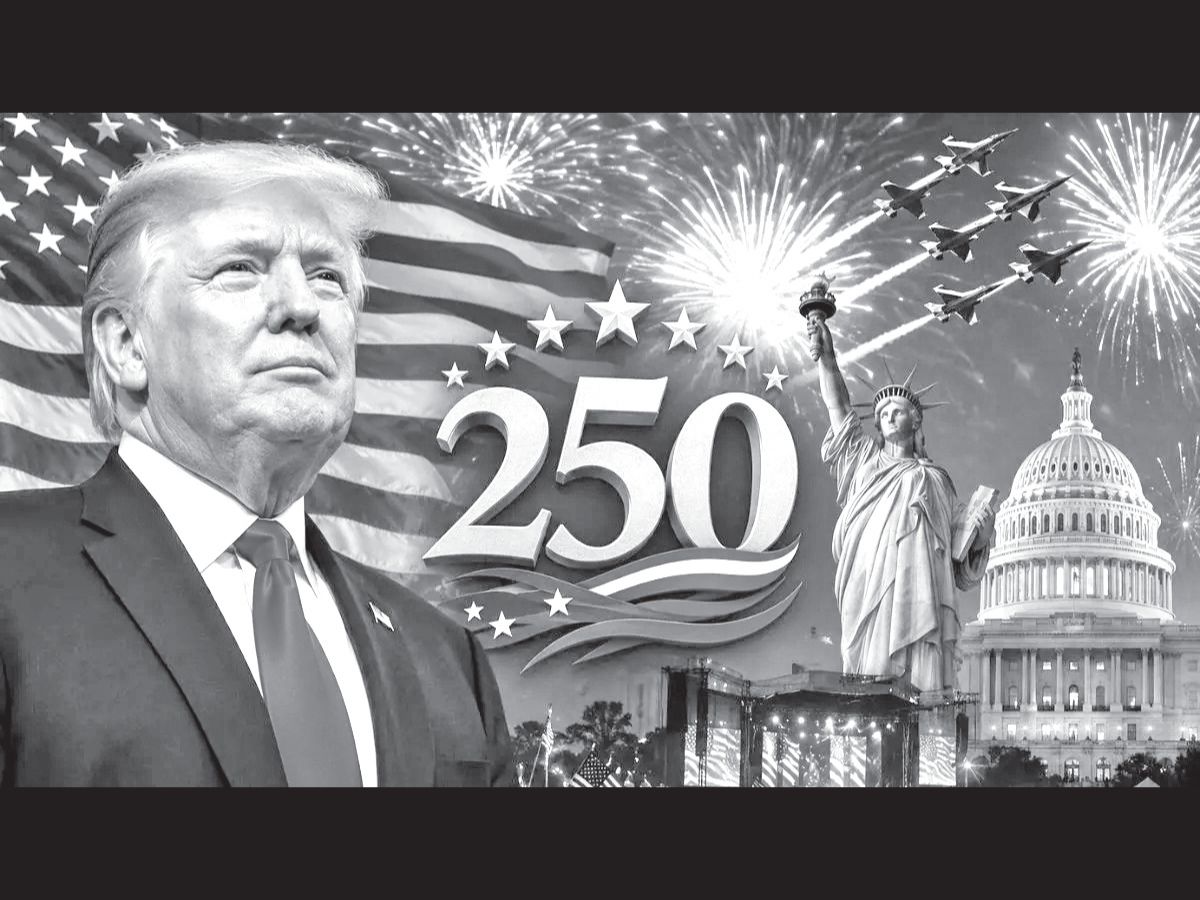
There may be no important a foreign country that has had so much impact on India than America? Well, that is since post World War II after 1945, for that overall period to now. While that may be true, but should Indians hold off even the most minor of festive fireworks with the US , celebrating what Donald Trump in his July 4th speech, saying there in no greater a country, or so exceptional one than America? And how exceptional has that been for India and the Global South for those two and a half centuries, retrospectively, not just last year or about recently? What about India’s efforts and solid contributions to make the US better, but US silence on this during such festivities? However, a balanced retrospective is also required during this year to help better understand what impact the US has had on India over the centuries, not only in recent years, which might help the country further guide a realistic set of policies towards what some identify as an awkward, if not reckless hegemon at times. But America has not always been so in the longer and broader historical examination and evaluation. Not to forget those who do not take history into account, sufficiently and objectively rather than just look at and operate primarily on yesterday’s sensational news, are sometimes condemned to repeat past suffering, or not to have as best a strategic vision to go forward. So what has America meant to India over the last two centuries and a half? But also what has been India’s positive impacts on America? An important question firstly, will India, as well be learned from by the US beyond the self-congratulatory recognition in these “High Five” of the US through the anniversary year? Will there be a critical understanding of needs to better cooperate in America through conference and workship panels to fashion a more sane world order, borrowing on the greatest of Nobel prize winning presidents, for example, That also means not walking over the Global South, including India and respecting America’s founders call for freedom and not interfering abroad. In the farewell speech of the first US president, George Washington, some argue the father of the nation in ridding British imperialism, he believed that entangling America in conflicts abroad compromised US national sovereignty. In President Donald Trump’s speech to the National Press Club on the matter, following on this history of the founding fathers’ views, he largely agreed with Washington. “In this speech, which set the foundational tone for his first term, Trump explained that the United States must stop getting involved in overseas conflicts and in countries ‘that we know not of’..’or that we shouldn’t be in.’ “ So, Indians have a gravitational pull to such sentiments. This is especially so under Prime Minister Narendra Modi who would likely see such views as “celebratory” worth in looking at the history of the US and how it could and should impact global peace and for India and the region?
If such from history had been better learned by a number of US administrations, India, the overall Global South and the world might have seen more development and less killing of the innocents, including huge numbers of children – a thought for a fourth of July speech? Even US president Eisenhower in his own farewell speech referred to potential excesses by the US military complex, which while formidable in defence against bad actors, equals altogether the combined firepower of the.next several countries’ militaries, combined. While that may be an excess, but with the US in the Quad sends a strong signal as Trump stated that bad actors attacking India would also have to face this massive US military. That is if Trump were to hold to his promise made recently at the G7 to Modi in front of media cameras. Sadly, though, the volatility or flip flopping of some US administrations on key strategic commitments, be it to Gulf countries, South Korea or South Vietnam or even possibly to the Shah of Iran, for example have not always held up. India, of course, knows of this but America has not always learned its wise history lessons given by some US presidents, including that President Trump gave on non-interventiom, then were seemingly forgotten with attacks on Venezuela, Iran and likely Cuba to come? Empire overreaching by the UK is also a lesson, one of which India gave a thorough lesson to the UK, even humbling PM Winston Churchill who though was seriously thinking of UK major interventions to keep India as colony but was warned about overstepping important boundaries of India, the new emerging state. Clearl,y before the end of the second World War, Britain mattered more than any other country to India though Russia provided support after World War I to the independence movements. And significant weaponry and various cooperation to New Delhi that cannot be discounted when sovereign India was especially on its initial legs while the British Empire was on its way out around the end of World War I in 1918. But London was tenacious to keep control with what it saw as the subcontinent being the “Jewel in the Crown “.
And a US president, key figure in establishing the League of Nations, like President Woodrow Wilson showed little interest in the decolonization movement as he saw it as counterproductive to offend a still powerful England. It could be though fairly well stated for india that for most of American history for Washington, India hardly mattered nor setting it free. From Wikipedia, “India was not consequential to America politically or geopolitically before World War II. Because India was a colony of the British Empire, diplomatic, strategic, and political interactions between the two countries were practically nonexistent.” However, while there was no direct reference significantly to the freedom provisions in the US constitution,it seems by the Indian liberation movement, it did indirectly eventually have an effect in America. A number of US senators raised their voices to push Britain to give independence to India. America, then ascending over the UK in global power, post WW II had to be respected, especially with the war taking steam out of Britain. As well, the US news reports coming out of Indiia grew US popular sympathy of protest movements led by Mahatma Gandhi, seen as heroic. And speaking of Gandhi he was inspired by the American philosopher Henry David Thoreau and his concepts of civil disobedience. Interestingly, in turn Dr Martin Luther King Jr, leader against Black segregation in America in the 1960s was inspired by the non-voilent concepts behind Gandhi’s successful efforts to get England out of India. If King had not been so inspired by Gandhi, his followers might have taken a different path of burning down cities extensively as what had happened in Detroit and even might have led a civil war. One could then argue through Gandhi, to a degree that India saved America from turning into a social ‘hellhole”, which might have been even exposed to long years of urban guerilla warfare by groups like the Black Panthers? So how about celebrating that in 250th Anniversary, well, say fora say at universities in India or say at Harvard if not Oxford. India and America have had, of course many successes together especially under Mr. Modi’s tenure. It is just too bad that the teachings of Gandhi and Mr Modi-led interconnected ones, on peace, justice and sovereignty have not been celebrated enough in certain Washington quarters. While for most of the two centuries, America once a colony protesting UK imperialism had been largely indifferent to India and Britain’s confiscation of India, times have changed. America needs to better recognize, this growing powerhouse with Indian holistic values of worth and India’s many positive contributions, culturally,as well. They include yoga, spirituality, focus on Global South stabilization, advancing green development among the poor, multipolarity and making wider friendships. And of course the Indian diaspora and Indian multinationals contributions to technological developmenrs. Thus, where possible, India and the US should join hands in some form of two way celebration of this anniversary, without being totally indifferent to finding ways to meet dangerous challenges an differences ahead.
Peter Dash writes on geopolitics, extensively, especially on India. He was a researcher at Harvard and teaches.