
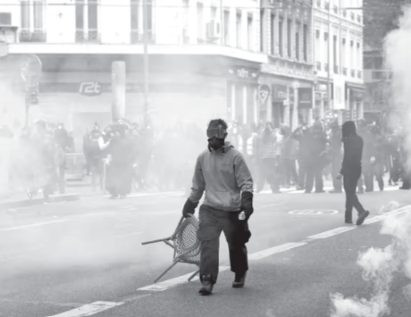
Public discontent is witnessed on the streets of Europe. From France, Italy and Belgium to Spain, Portugal and Albania, people are taking to the streets to register their discontent over rising cost of living, housing insecurity, educational institutions, public services and political accountability. Though all the demonstrations differ in their immediate triggers, they reveal a common anxiety: the growing gap between expectations of citizens and their experiences in daily life. The question therefore simply is not about why Europeans are protesting rather what are the inherent causes of discontent.
Sluggish economic growth, insecure employment and various fiscal constraints have restrained the upward mobility. For younger Europeans, having a higher education no longer guarantees financial independence, secure employment or access to home ownership. Thus, the problem is not simply about economic under performance rather any progress is not translating into better quality of life.
When citizens start believing that no amount of hard work guarantees their security the frustration starts developing leading to a crisis of political legitimacy. Rising cost of living has intensified that discontent. Housing has become a particularly contentious point in Spain and Portugal where rising rents and property prices have made independent living a distant dream. What was once a normal milestone of adulthood to secure a home and establish a family is becoming a distant prospect for many new adults.
Housing thus here is not a market concern but it is a question of dignity, social mobility and citizenship. Europe’s protest must also be seen in realms of a global gen-Z Awakening. These protests can be better understood within the wider wave of youth mobilisation we have witnessed in Nepal, Bangladesh. Though the circumstances of all protests are different, there are recurring concerns about corruption, economic exclusion, unresponsive institutions and most importantly an uncertain future.
Digital platforms connect beyond national borders. Such platforms allow people to share experiences, draw inspirations and mobilise rapidly. Yet these European protests should not be mistaken for a single, centrally coordinated Gen Z revolution. Their demands and political contexts remain distinct; the broader significance lies in generational challenge to traditional social contract. Young people are encouraged to acquire education, work hard and participate in democratic institutions and despite doing all that, whether these will ensure delivery of security promised to the previous generation is questioned. There is also a Defence welfare dilemma emerging in Europe.
Europe’s geopolitical environment has been changing. Russia’s war against Ukraine. US’ insistence on increasing defence spendings has created a security dilemma. For Europe’s budgets are diverted towards increasing defence spending accompanied by geopolitical uncertainties leading to price rise specially rising fuel price. Students and workers protesting against under-funded institutions question why strategic ambitions are preferred over immediate socio-economic needs. Europe’s challenge here is to strengthen security without undermining the social foundations on which its democratic resilience depends.
Another reason that can be seen leading to present crises is Europe’s ageing population and the generational bargain. Demographic pressures further complicate the dilemma. Europe is facing an aging population which increases pressure on economic resources through increased spending on pension, health care, whereas the younger generation is struggling to have affordable housing and there are concerns about their future entitlements. Despite these shared anxieties, the ongoing protests in Europe do not represent one homogenous political movement. The French pro world is also raising questions about foreign interference and political polarisation.
External actors may exploit existing divisions through misleading narratives but saying that they have caused or organised the unrest will also be misleading. The government must distinguish between genuine grievances and peaceful dissent from violence and vandalism. Treating all protestors as a threat may further fuel the mobilisation. test began as a student protest later carried by trade unions, yellow vest protestors. Spain and Portugal have seen housing affordability as the central issue, while Belgium is protesting for educational reforms and against austerity.
In Albania it is centered on corruption and accountability issues. These differences matter, as similar economic measures can generate demands for distribution and stronger welfare protection in one country but nationalism and anti establishment in another. Political institutions and national histories decide how public anger is expressed. The protest around the These Europe’s protests ultimately expose a tension between democratic institutions. It shows the distance between the political promises and the lived reality. The answer does not lie in tougher policing or dismissing the protest.
Nor these problems can be resolved through spending promises alone. It requires addressing the structural causes which we have discussed. Economies have to flourish and should be resilient to geopolitical pressure. Europe has to increase its defence commitments without compromising the socio-economic needs of people. Europe also has to find some solution to its age dilemma, either by increasing birth rate or having more immigrants but the second one is quite controversial to even suggest as it attracts its own set of problems. And of course the gen-Z way of expressing their discontent must be addressed maturely by genX and millennial leaders.
Here, the European Union also must understand its role that its credibility does not depend only on economic integration and geopolitical influence but also on everyday experience of its citizens. The real test of democracy is not whether its streets remain silent but it lies in the resilience of its institutions whether they can respond and reform or not. Europe’s future will depend not only on its ability to compete globally and defending its borders but on whether its citizens can continue to believe in the system and its promise of the future that is worth investing in.
*Dr. Simran Chhabra, Asst Professor, Shri Guru Gobind Singh College of Commerce, University of Delhi, PhD- Centre for European Studies, JNU.