
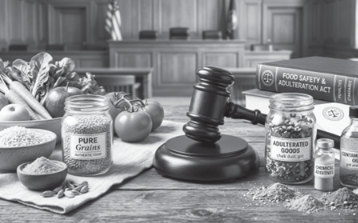
If someone broke into your home tonight and stole your money, you would call the police. If an intruder contaminated your drinking water, you would demand an immediate arrest. Yet when an invisible hand replaces the milk meant for your child with chalk and urea, or stretches your daily cooking oil with industrial tallow, no alarm goes off.
We simply swallow it. Food adulteration is the only criminal racket where the victim unknowingly consumes the evidence. There is a thief inside every Indian kitchen, but he does not pick locks or carry away silver. He quietly skims nutrition from our staples, replaces it with cheap chemical proxies, and forces us to finance our own slow poisoning.
Milk cut with untreated water and detergent; golden honey stretched with synthetic sugar syrups; bright red chilli loaded with brick powder and carcinogenic dyes; and turmeric bulked out with lead chromate. This is not casual commercial malpractice. It is cold-blooded, slow-motion violence committed for the sake of profit margins.
Every morning, millions of Indian households gather around what they believe is a nourishing meal. We obsess over calorie counts, track glycaemic indices, and scan labels for added sugar, oblivious to a far uglier question: is the substance on our plates even food at all? The true disaster of adulteration is that it rarely announces itself with a dramatic emergency. It does not hit like acute food poisoning with immediate cramps and fever.
Instead, chemical adulterants wage an invisible war of attrition. Synthetic colours, heavy metals, and adulterated fats circulate quietly through bloodstreams, depositing toxins into the liver, kidneys, and gut. In growing children, this chemical fraud robs them of bone density and cognitive capacity that can never be restored. In adults, it manifests as chronic inflammation, fatty liver disease, and premature organ failure.
Long before it claims a life, however, adulteration executes a quiet financial robbery. A sick child forces a parent to forfeit daily wages. Chronic illness brings an exhausting, endless cycle of private clinic visits, blood panels, scans, and pharmacy bills. Adulteration quietly pulls off an insidious trick: it diverts an honest family’s grocery budget straight into a swollen healthcare budget. India’s regulatory apparatus is not entirely idle.
Over a recent three-year window, official government records indicate that food safety authorities analysed more than 5.18 lakh samples across states, levying over 88,000 penalties. Yet those numbers hide a scandalous reality: out of all those thousands of offences, there were just 3,614 convictions. When the odds of seeing the inside of a jail cell hover below one percent, a minor financial fine ceases to be a deterrent.
It simply becomes an ordinary overhead, a petty tax on cheating that crooked manufacturers cheerfully build into their balance sheets. We cannot police our way out of this crisis with ritualistic festive-season crackdowns. Raiding sweet shops, the night before Diwali and parading seized khoya on local television is pure theatre, not public health governance. We need a decisive leap from reactive firefighting to predictive deterrence.
The analytical tools to break this cycle already exist. High-density consumer markets, vulnerable commodity corridors, and habitual offenders can be tracked using digital supply-chain surveillance. Portable, rapid test kits need to be placed not just in highend laboratories, but in local mandis, milk booths, and wholesale markets. When foul play is proven, retribution must be catastrophic.
Repeat adulterators should not walk away with a nominal fine; their licences must be revoked, assets frozen, and criminal charges pressed under stringent penal statutes. Crucially, ordinary citizens cannot be expected to become amateur chemists, testing mustard oil on cotton swabs or dropping iodine into milk before breakfast. Food purity is not an individual domestic chore; it is an irreducible obligation of the state.
Consumers deserve transparent QR-code batch traceability and seamless grievance mechanisms that lead to investigations rather than automated ticket closures. At the same time, this battle cannot be won by bankrupting honest small businesses. India’s lakhs of rural dairies, neighbourhood oil expellers, and local flour mills operate on razor-thin margins. If safety norms simply become crushing compliances that only multi-billion-rupee conglomerates can survive, we will only kill local livelihoods while driving genuine producers underground.
The state must provide accessible, subsidised testing infrastructure and practical training so safety becomes standard practice, not an unattainable corporate privilege. India proved through the Jal Jeevan Mission that when a national crisis is met with sustained political will, transparent targets, dedicated capital, and mass accountability, deep-rooted rot can be cleared away. Clean food demands that exact same fury.
Purity cannot remain an elite luxury sold at a three hundred-percent markup in organic aisles, to those wealthy enough to purchase peace of mind. It must be the baseline entitlement of every citizen. We tutor our children from infancy never to take food from strangers. Yet every evening, we invite a faceless syndicate into our homes, hand over our hard earned wages, and set their toxic chemical experiments on the dinner table.
No society can medicate its way out of an intentionally poisoned food supply. If the state cannot protect what goes into our pots and pans, it matters truly little what else it protects. The thief has had his fill. It is time we locked the kitchen door.
*The writer is a bilingual author with five published titles to his credit.