
Weak private-sector job creation and an overstretched public sector are pushing J&K’s most qualified graduates towards cities outside the Union Territory, entrenching a slow but steady brain drain.
Historically, the exodus from Jammu and Kashmir has been tied to displacement, violence, or insecurity, but today a different kind of exodus is happening: educated and skilled young individuals are leaving the Union Territory in search of jobs and a more stable future. The problem is simple. Jammu and Kashmir is producing graduates much faster than its economy is able to sustain their aspirations. When decent jobs are unavailable at home, leaving increasingly becomes the most attractive option.
Education Employment gap
The young individuals tend to have a problem after having qualified. They either work outside their preferred domain, accept a job much below their credentials, or spend years preparing for entrance tests as no other option is appealing. For a graduate from Udhampur, Kathua, Rajouri, Jammu or Srinagar, it’s quite straightforward.
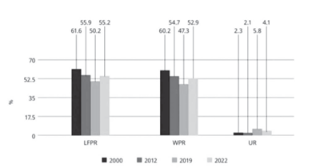
If one’s desired job is not available locally, they have to migrate to Chandigarh, Delhi-NCR, Punjab, or Bengaluru. The situation is reflected in the official statistics. As per the Periodic Labour Force Survey (PLFS) of the National Statistical Office (NSO), the unemployment rate of Jammu and Kashmir for people of age 15-59 was 6.7 % in 2024-25, whereas the national average was 3.5%.
This demonstrates the challenge of converting educational qualifications into employment. Youth unemployment is a more serious problem. As per Baseline Survey Report 2024-25 under Mission YUVA (Yuva Udyami Vikas Abhiyan), based on PLFS 2023-24 data, the level of youth unemployment in Jammu and Kashmir (J&K) is 17.4 percent as against 10.2 percent at national level. Particularly, women have to face a high degree of discrepancies as urban female unemployment is 28.6 percent.
The differences in terms of regions are significant too. For instance, Rajouri has 9.3 percent unemployment and Anantnag has 8.7 percent in comparison to 3.3 percent in Jammu and 5.9 percent in Srinagar. Samba has the lowest figure of 3 percent. For young people who have spent years getting a degree believing they would get stable employment, low prospects of attaining the needed job can be very discouraging. What begins as a temporary move for employment can become permanent once a person builds a career, professional network and independent life elsewhere.
Overreliance on government jobs
The weakness of private sector employment has another consequence: an extraordinary dependence on government recruitment, seen as stable against private work widely perceived as contractual and poorly paid. A postgraduate in J&K Enforcement Directorate had found out that candidates were allegedly charged anything between Rs 1.5 million and Rs 3 million for the leaked paper.
Weighs limited options: preparing for Jammu and Kashmir Services Selection Board (JKSSB) or Jammu and Kashmir Public Service Commission (JKPSC) exams, attempting banking exams, teaching, accepting a low-paying private post, starting a small enterprise, or leaving the Union Territory. It is thus too simplistic to say J&K’s youth merely “want government jobs.” Too few alternative pathways exist into stable, professional employment.
Fiscal constraints on recruitment
This dependence becomes more alarming when recruitment itself is slow, inconsistent or opaque. According to an RTI response from JKSSB, it received approximately 1.37 million applications in 2020 for just 15,429 posts. This implies a significant competition. The police sub-inspector exam conducted by JKSSB in 2022 for 1,200 posts was also marred by a leak.
The Such incidents bring another dimension to the problem of joblessness. It is not simply that there are not enough jobs available. For some of the youth, the route to getting jobs also remains unclear.For instance, a PhD holder from the University of Kashmir, is reported to be looking for jobs in Pune and Qatar after failing to find suitable opportunities at home
Policy recommendations
First, J&K must stop treating government recruitment as the principal youth-employment strategy because the public sector does not have the fiscal capacity to absorb every educated young person. Second, private sectors must diversify those parts of its economy where stable jobs can be created.
Options such as tourism, horticulture, arts and crafts, food processing, and IT-enabled services should be explored, but the real goal is to create a source of steady employment rather than just announce new projects and enterprises. Third, universities need to become employment-generating institutions in their own capacity, through structured apprenticeships, industry partnerships and incubation support.
Fourth, government recruitment is necessary to have orderly recruitment and recruitment calendars. JKSSB is notorious for delays, too many applications and one of its exams being impugned. Lastly, economic schemes should be evaluated by whether they generate sustained, skilled employment, not merely by investment announcements or enterprise counts.
As said by Nelson Mandela, “Education is the most powerful weapon which one can use to change the world.” J&K’s educated youth can help change the region, but they need opportunities, support, and hope. A young person should leave J&K because they choose to, not because they feel they have no future there.
*Kanav Sharma is a Public Policy Researcher from Jammu & Kashmir