
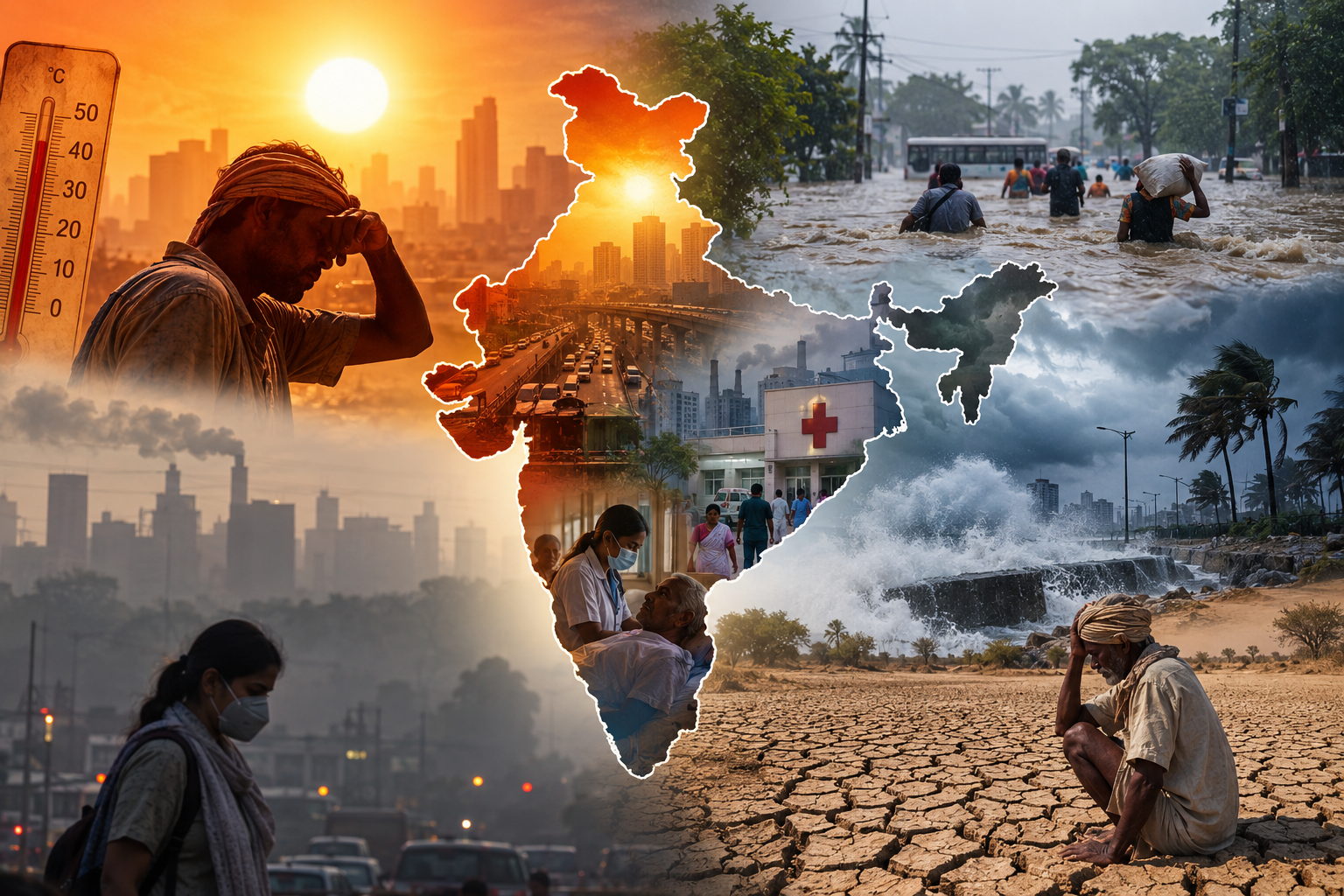
India’s climate crisis is also a health crisis, but the country’s adaptation response still focuses too heavily on managing emergencies after they arrive rather than reducing the conditions that make people vulnerable in the first place. Heatwaves, floods, droughts, storms, air pollution and changing patterns of infectious disease are no longer distant projections. They are increasingly affecting incomes, food and water security, hospital capacity and the everyday health of communities across the country.
The scale of the challenge is visible in the recent pattern of extreme events. In 2025, major disruptions from floods, heatwaves and storms were reported on 331 of the first 334 days of the year, with at least 2,760 recorded fatalities. The figures are likely to understate the full health burden, because deaths and illnesses linked to heat, pollution, disrupted care and lost livelihoods are not consistently identified in official data. The Lancet Countdown’s India projections have also warned that a world 2°C warmer could bring an additional 129,000 heat-related deaths each year among older adults alone.
These numbers should change how climate adaptation is understood. The question is not simply whether India can issue earlier warnings or move patients into hospitals during a heatwave, but whether public health systems, cities, workplaces and local administrations are being redesigned for a more unstable climate.
India has developed heat action plans, early-warning systems, public advisories and disastermanagement protocols, and these are important steps. Yet their implementation remains uneven, and many plans still operate as seasonal checklists rather than as instruments for long-term health protection.
The evidence on heat action plans is instructive. An assessment of 37 plans found that only two included vulnerability assessments capable of identifying localised risk, while only 11 discussed sources of funding and none clearly established the legal basis of their authority. Without information about where vulnerable people live, without resources to implement measures and without clear institutional responsibility, a plan can describe action without enabling it.
Heat action plans need to become part of urban planning, public health administration and labour protection, rather than remain documents activated only when temperatures cross a threshold. Heat-related illness extends well beyond recorded cases of heatstroke, because prolonged exposure can aggravate cardiovascular and respiratory conditions, affect kidney function, increase risks during pregnancy and reduce the ability of outdoor workers to earn a living.
Hot nights offer little physiological relief, while poorly ventilated homes, crowded settlements and unreliable electricity leave many people exposed for longer periods. The health consequences of heat are therefore shaped not only by meteorological readings, but also by income, housing, occupation, age, gender and access to medical care.
India’s public-health system must respond to this wider risk profile. Primary health centres and district hospitals need protocols for recognising heat-related illness, maintaining essential medicines and managing sudden increases in patient demand. Health workers require training to identify risks among older persons, infants, pregnant women, people with chronic illnesses and workers exposed to heat for long hours.
Weather information should be connected with hospital admissions, mortality data and local disease patterns, so that authorities can identify emerging health burdens rather than wait for a crisis to become visible through overcrowded hospitals.
A stronger health-data architecture is also necessary, because India has made progress in digitising surveillance, but climate-sensitive illness remains difficult to measure because mortality and morbidity records are incomplete, clinical coding is inconsistent and much of the private health sector is not integrated into public surveillance.
Private providers account for a substantial share of inpatient care, yet there is no sufficiently standardised system through which anonymised data on heat-related illness, climatesensitive infections and pollution-linked conditions can be shared with public authorities. The coming Census will also be important because outdated demographic baselines make it harder to identify changing patterns of exposure and vulnerability.
Data, however, is useful only when it can guide local decisions. India’s heat thresholds are largely based on environmental readings, while the health burden also depends on humidity, night-time temperatures, indoor exposure, housing materials, occupation and access to water and cooling.
A more useful adaptation system would combine meteorological information with local evidence on hospital admissions, mortality, housing, livelihoods and social protection. Such evidence would help authorities direct resources towards specific settlements and occupations instead of relying on broad categories such as “the elderly” or “outdoor workers” without identifying where the highest risks are concentrated.
Urban planning must consequently become part of health protection. Concrete surfaces, inadequate tree cover, traffic congestion and poorly planned construction intensify heat, while informal settlements often lack water, sanitation, ventilation and reliable electricity.
Heat action plans will remain limited unless they are connected to cool roofs, shaded public spaces, drinking-water access, climate-sensitive building standards, public transport and affordable housing. These are not merely environmental improvements; they determine whether people can avoid dangerous exposure before they require medical care.
The protection of workers must receive similar institutional attention because construction workers, agricultural labourers, street vendors, delivery workers and sanitation staff are exposed to extreme heat while having limited control over their working hours or conditions. Employers and public authorities should provide shaded rest areas, drinking water, adjusted work schedules, protective equipment and access to medical assistance.
Labour regulations should recognise that climate exposure can reduce productivity and income before it produces a hospital admission, while social protection should help households cope when extreme weather interrupts work.
The rural health agenda must address a related chain of risks, since heat, drought, irregular rainfall and crop loss can affect nutrition, income and mental health while long distances from health facilities delay treatment. Climate-resilient primary healthcare must therefore be linked to water security, agricultural extension, nutrition programmes and social protection.
Adaptation cannot be reduced to emergency relief after a flood or heatwave; it must reduce the vulnerability that turns a climate shock into prolonged illness, debt or displacement.
The National Action Plan for Climate Change and Human Health and the National Programme on Climate Change and Human Health created a foundation for institutional action through state plans, surveillance and workforce training. Their limited salience within the health system and inadequate financing, however, have prevented them from becoming a central national health programme.
Climate and health cannot remain the responsibility of an ancillary unit while other health programmes continue to operate in separate disease-specific silos. Heat, air pollution, infectious disease, nutrition and mental health increasingly overlap, and the health system must be organised accordingly.
The question is also one of fiscal federalism, because local governments are expected to implement much of the adaptation response, but they often lack predictable funds and administrative authority. Heatwaves are not adequately integrated into existing disaster-finance arrangements, and many local plans do not identify the resources required for implementation.
The Centre should expand funding for the national climate-health programme and ensure that future Finance Commission arrangements include dedicated climate-health outcomes within health grants and disaster-management allocations. State governments and municipalities need predictable, flexible resources to design measures suited to their own climates, settlements and vulnerable populations.
Climate-resilient health systems will also require stronger infrastructure and a better-prepared workforce. Hospitals must be able to maintain power, water, medicines and essential services during floods, heatwaves and supply disruptions. Medical, nursing and allied-health curricula should include climatehealth competencies, while community health workers can be trained to monitor high-risk neighbourhoods and intervene early.
Climate considerations should be integrated into maternal and child health, non-communicable disease care, mentalhealth services, nutrition and water-and-sanitation programmes, rather than confined to one specialised initiative.
Citizens have a role in this agenda, but responsibility cannot be shifted from institutions to households that lack safe housing, reliable electricity or financial security. Following heat advisories, conserving water, checking on vulnerable neighbours and seeking early care can reduce risks, while public awareness can strengthen demand for better services.
These actions become meaningful when governments provide the infrastructure and information necessary for people to act on them.
India’s adaptation strategy will remain inadequate if it continues to treat climaterelated illness as an episodic consequence of extreme weather. The country needs a sequence of reforms that begins with reliable and open data, converts that data into local assessments of vulnerability and uses the evidence to redesign health facilities, public services, workplaces and urban settlements.
This is not a call for another plan without funding or authority; it is a demand that climate adaptation be incorporated into the ordinary work of governance.
The climate crisis is testing whether India can move from relief to prevention and from isolated programmes to integrated public health. A health agenda for climate adaptation must protect people before they reach hospitals, strengthen the institutions that serve them and direct resources towards those least able to withstand climate shocks.
India will be better prepared for a warming world only when climate resilience becomes a core measure of public health, development and social justice.
The author is a Public Policy Scholar pursuing an M.A. in Public Policy and Governance at Ambedkar University