
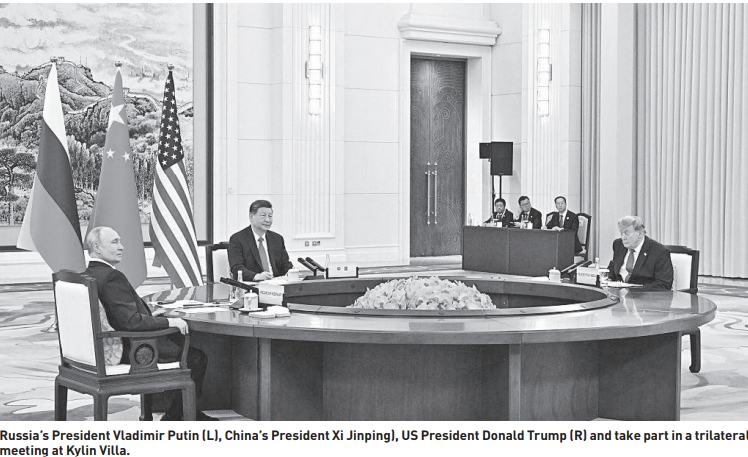
It was the chilling winter of 1945 with WW II still raging when Roosevelt, Churchill and Stalin met at Yalta to decide the future global order and spheres of influence. The ghost of Yalta resurfaced on 19th December 2026 at Shaenzhen with the rendezvous of Trump, Xi and Putin.
At Manila, Trump called Modi a very tough man at the first Quad leaders’ summit during his second term. Forty-eight hours later, in Shenzhen, he sat down with Xi and Putin for the first-ever trilateral among the leaders of the USA, China and Russia. The same Trump ridiculed the trilateral among Modi, Xi and Putin in 2025. India was in the room in Manila, but not in Shenzhen. This sums up the troubled waters New Delhi must now navigate.
Yet Shenzhen may not be the Yalta reimagined. Around 90 minutes produced merely a short, fourpoint Declaration toward Peace pledging to initiate a dialogue on nuclear-risk reduction, pursue UNO reform and something on refined petroleum products alongside the so-called abuse of jurisdiction by the ICJ etc; no treaty, no timetable, no mention of Ukraine or Iran, a declaration about peace yet leaving the wars which most directly threaten peace, unaddressed.
However, for India, enough food for thought; first, a US-China thaw, however tactical, dilutes the focus Washington places on India as a counterweight indicating American alignment is not a permanent strategic asset; it must be earned and made too critical to replace. Second, evolution of Russia-China axis; Russia’s presence at the summit strengthened Moscow’s claim to great-power status even as its economy remains in shambles. A Russia, more dependent on Beijing, is a reluctant partner for India. Third, the declaration’s emphasis on UN reform, state consent and official immunity indicates might is right theory; caution for India whose neighbourhood includes an expansionist China, unsettled Himalayan frontier and perennial cross-border terrorism.
That Shenzhen could not produce a binding document, is not the underlying danger; it is the idea that global order can be redrafted by the threesome with else everyone forced to adjust. Yet this triangle may be inherently unstable. Washington wants Moscow snatched away from Beijing; Beijing wants Washington out of Asia; Moscow desires a freer hand in Ukraine and sanctions-relief. It is a triangle of mutual suspicion where India may fit in as the fourth pole, provided it builds the capabilities which make it indispensable.
Morning shows the day what Manila week emphasized. The Quad announced cooperation on maritime surveillance, cybersecurity, counterterrorism, artificial intelligence and critical minerals; India hosting the first Quad Business Leaders’ Forum in early 2027 at Mumbai; announcement of Indo-Japan agreement on Japan using India’s missile-firing ranges closely followed. Simultaneously, New Delhi chairs BRICS this year. A multi-alignment in theory; it is time to give it practical shape.
Start with defence, where self-reliance is likely paying off. Annual defence production touched a record ₹1.78 lakh crore in 2025-26, roughly four times the 2013-14 level. Defence exports surged to ₹38,424 crore. Nations making their own weapons do not lean on foreign capitals in a crisis. Yet the unfinished agenda is clear: advanced semiconductors, high-end sensors, aero-engines, propulsion and a much deeper role for MSMEs with startups, in a sector where PSEs still dominate. India must treat defence manufacturing not as employment programme, but as a tool for strategic autonomy. Every imported critical component is a potential veto by another capital.
Choking of Strait of Hormuz, the route for almost 40 per cent of India’s oil imports, taught a hard lesson this year. A nation that imports nearly 90 per cent of its crude cannot run its energy security on waivers issued abroad. The Shenzhen declaration’s promise to expand refined petroleum supplies may offer short-term comfort, but it also underlines the problem: India’s energy security remains hostage to decisions made elsewhere. The solution is optionality.
The government has been on the job. The SHANTI Act, 2025 ended six decades of state monopoly over civil nuclear power, which allows private firms to build and run reactors, towards a target of 100 GW by 2047 from under 09 GW today. Non-fossil sources now make up over half of installed power capacity. The Green Hydrogen Mission, expanded strategic reserves and a crude basket spread across the Gulf, Russia, the Americas and Africa complete the picture. Energy sovereignty does not mean autarky. It means never having to beg.
If oil was the twentieth century’s choke-point, rare earths are the twentyfirst’s. India’s dependence on China for imports of critical minerals and rareearth permanent magnets is nearly absolute. Yet of late, India has assembled a serious policy stack; the National Critical Mineral Mission, targeting about 1,200 exploration projects by 2030-31, 46 criticalmineral blocks auctioned across six tranches, KABIL acquiring assets abroad, the Rare Earth Permanent Magnet scheme, customsduty relief on critical minerals, restriction on exports of battery scrap and Rare Earth Corridors in Odisha, Kerala, Andhra Pradesh and Tamil Nadu. The weak link is the midstream: refining, separation and processing. Sans this, ore excavated in Odisha will still travel to China to become a magnet.
Quad partnerships can bring capital and technology, but the refineries must be on Indian soil.
Strategic autonomy is not neutrality. It is the capacity to choose which rests on a capable state. Mining clearances which take years, land acquisition which stalls reactors, procurement files that outlive the technology they buy and inter-ministerial conflicts which delay strategic projects; all hollow out sovereignty from within. A Sashakt Bharat needs a civil service trained for strategic delivery, with Mission Karmayogi building domain capability in energy, minerals and technology diplomacy, and institutions which think in decades rather than budget cycles. India requires efficient, faster and mission-driven state.
Viksit Bharat 2047 is not merely an economic target. It is a geopolitical insurance policy. A $30-trillion India with energy sovereignty, own magnets, a mature defence-manufacturing base and credible delivery pipeline, does not need to request a seat at Yalta. The table will be laid around it.
Shenzhen has been more of a showmanship than substance. Yet it reminds India that superpowers will always meet, bargain and exclude at their convenience. India’s question is not if it is invited to every table but whether it is strong enough that no decision can be made without its presence.
The answer is to build the Bharat no triangle can square.
Dr. Amitabh Ranjan is Vice Chairman, PanIIT Alumni India is Registrar IIPA.