
There have been significant flaws in the way history has been written in our country. History has been distorted and presented in a manner that contradicts the truth. It is an irony that, even after independence, India’s history as taught in the curriculum fell victim to this distortion. Having been both a teacher and a researcher, I discovered many bitter truths when I delved deep into history. Schools began teaching that “Akbar the Great” was the ideal, based solely on the accounts of court historians. When I had the opportunity to serve as Rajasthan’s Education Minister, I initiated a change, introducing the teaching of “Maharana Pratap the Great” instead. We substantiated through facts in our textbooks that Maharana Pratap permanently drove the Mughals out of Mewar following the battles of Haldighati and, subsequently, Dewair. Those who question Maharana Pratap’s victory should realize that court historians often engaged in panegyrics rather than recording historical events accurately. They fabricated tales and indulged in flights of fancy to please the rulers of the time. It is a historical fact that Akbar knew Maharana Pratap could never be defeated in a direct confrontation. Even court historians acknowledged this; hence, they never denied Pratap’s valor. The reality is that Akbar wanted Maharana Pratap captured and killed during the Battle of Haldighati, thereby eliminating the sole source of opposition to his rule across Hindustan. That is why he appointed Raja Man Singh of Amer as the commander and sent him to capture Pratap. Despite facing a massive Mughal army with a much smaller force, Maharana Pratap displayed indomitable courage and won the Battle of Haldighati.
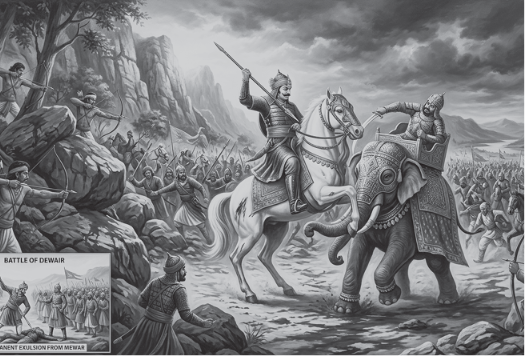
If we look at historical events, the Battle of Haldighati took place on June 18, 1576. The Mughal army was led by Raja Man Singh (I) of Amer on behalf of Akbar. Maharana Pratap himself stood firm in the battle alongside his brother Shakti Singh, Hakim Khan Suri, and others. The Mughal army numbered around one hundred thousand, whereas Maharana Pratap had only twenty to twenty-five thousand soldiers. Knowing that defeating the Mughals with such a small force would not be easy, the Maharana resorted to guerrilla warfare and strategic maneuvering. Amidst the narrow passes of Haldighati, he employed tactics to surround, confuse, and intimidate the Mughals while launching surprise attacks. A major source of strength for the Maharana was his contingent of Bhil warriors—fighters skilled in launching ambushes from the cover of trees, rugged valleys, rocky terrain, and hills. With their support, Maharana Pratap encircled and attacked the vast Mughal army, causing their ranks to crumble quickly. The entire battlefield of Haldighati was drenched in blood; it was as if a river of blood were flowing. For this reason, the area is still known today as RaktTalai (the Pool of Blood). Maharana Pratap’s horse, Chetak, also played a pivotal role in the Battle of Haldighati; his contribution was marked by immense courage, loyalty, and historical significance. Some historical accounts suggest that Chetak wore an elephant mask on his face to confuse the elephants in the Mughal army. At one critical moment, displaying indomitable courage, Chetak planted his front hooves on the trunk of the Mughal commander Raja Man Singh’s elephant, enabling Maharana Pratap to strike directly at Man Singh. During this maneuver, one of Chetak’s legs was severely slashed by a sword attached to the elephant’s trunk. Maharana Pratap struck Man Singh with all his might, copper-plate grants for an entire year—an act only a truly sovereign king could perform. Historical records also reveal that Akbar was furious with his generals after failing to subjugate Maharana Pratap, despite deploying a massive army. In his anger, he barred his commanders—most notably Raja Man Singh and Asaf Khan— from entering his court.
but Man Singh survived thanks to his armor. Chetak was critically wounded in the battle. Despite being critically wounded and left with only three functional legs, Chetak demonstrated unwavering loyalty by keeping his master safe before finally succumbing to his injuries. The momentum of the attack by Maharana Pratap’s army was so fierce that Mughal soldiers fled for their lives, retreating 10–15 kilometers to the other bank of the Banas River. Later, in a meticulously planned move on the occasion of Vijayadashami, Maharana Pratap launched a decisive assault on the Mughal forces at Dewair, permanently driving the Mughals out of Mewar. During this battle, Amar Singh struck the Mughal commander with such tremendous force that his spear pierced through the commander and drove deep into the ground. At the Battle of Dewair, a Mughal army of 36,000 soldiers surrendered to Maharana Pratap and Amar Singh. This is a historical fact. It is further evidenced by the fact that, following the victory, Maharana Pratap distributed land and alms via The Battle of Haldighati was decisive. It was in this battle that Maharana Pratap made the Mughals realize they could never subjugate him. He instilled a fear among the Mughal troops that fighting the Maharana meant certain bloodshed. I believe the Battle of Haldighati stands as a saga of unparalleled glory, not just for Rajasthan but for the entire history of India. In this battle, Maharana Pratap did not merely display indomitable courage, valor, and prowess; through astute strategic insight, he also paved the way for Mewar’s enduring independence.
*(Special feature on the 450th anniversary of the Battle of Haldighati)
*The author is Speaker, Rajasthan Legislative Assembly.