
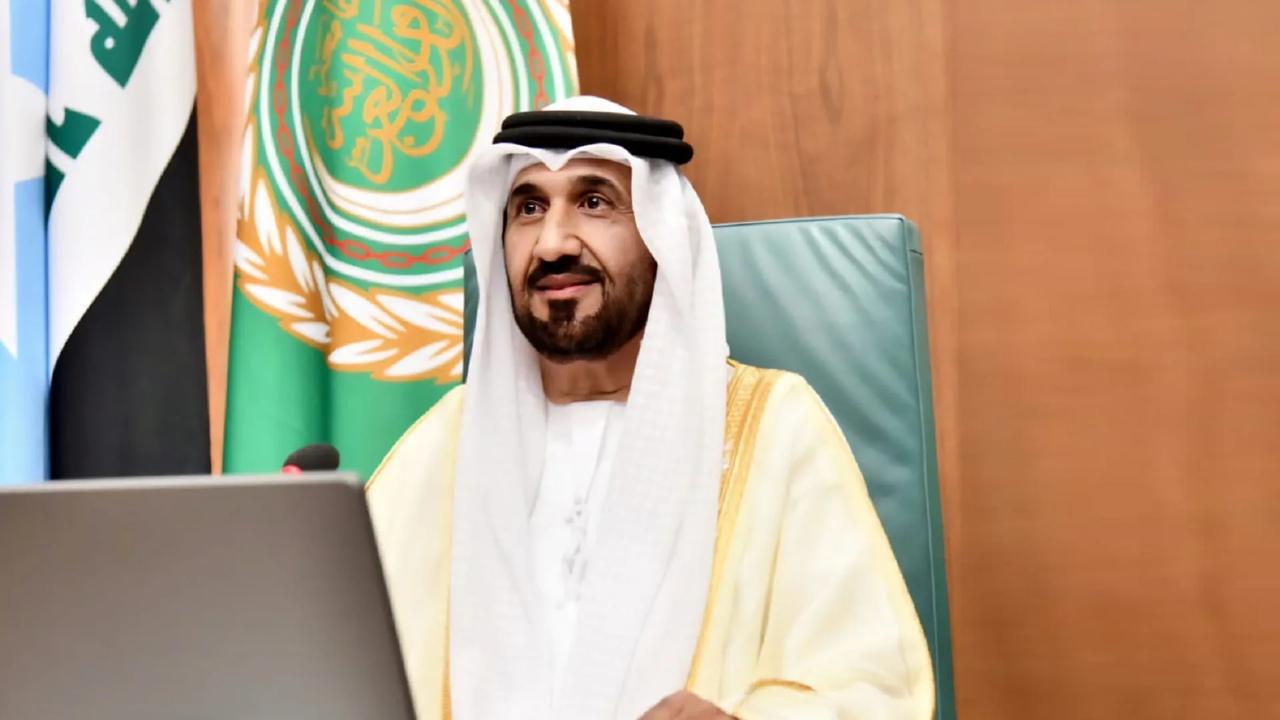
When Mohammed Ahmed Al Yamahi assumed the presidency of the Arab Parliament in October 2024, he inherited a vital institution at a critical juncture. The Emir of the Alyammahi tribe, whose journey through the military, parliamentary, and civic institutions of the UAE spans nearly three decades, took the helm at a moment when the Arab world is increasingly asserting itself not merely as a theatre of global politics, but as an indispensable mediator in international conflicts.
Already a member of the UAE’s Federal National Council (FNC) since 2015, part of the Arab Parliament since 2016, and involved in the Global Council for Tolerance and Peace since 2017, Al Yahamhi also serves as Chairman of the Arab Parliament’s Committee on Palestine, Chairman of the Health and Environmental Affairs Committee of the FNC, and Head of the FNC Group in the Arab Parliament, reflecting his multi-layered involvement in
governance and diplomacy. His election as President of the Arab Parliament followed his earlier role as Vice President and member of several key committees, including Foreign and Political Affairs and National Security.
A graduate of military science from Zayed II Military College in the UAE, Al Yamahi’s elevation represents more than a routine transition in parliamentary leadership. It signals the rise of a distinctly Arab approach to diplomacy — one that draws upon deep-rooted values of
mediation and consensus, now reframed for a multipolar world order.
The new Arab diplomatic doctrine
The Arab world’s emergence as a diplomatic powerhouse has been years in the making, but recent developments have accelerated its trajectory. Al Yamahi has been quick to recognise and articulate this shift. Just months into his tenure, he praised the UAE’s successful mediation in facilitating the 10th prisoner exchange between Russia and Ukraine in 2024, describing it as evidence of “a global peace approach”.
This is no mere rhetoric. The UAE’s discreet, consensus-driven diplomacy has achieved remarkable results. This includes the largest prisoner-of-war exchange between Russia and Ukraine as well as critical agreements on humanitarian corridors.
Meanwhile, another Arab player in Qatar has emerged as an indispensable intermediary in some of the world’s most tense conflicts — from brokering the 2020 US-Taliban agreement to negotiating hostage releases in Gaza.
In 2023, Saudi Arabia also brought together warring factions with the Treaty of Jeddah, in an effort to end the Sudanese Civil War.
What distinguishes this Arab approach from traditional Western mediation is its emphasis on long-term relationship building over quick fixes. These nations view conflict resolution not as a singular event but as the cultivation of an understanding among former adversaries. As Al Yamahi has emphasised in his speeches, this demands the deployment of “all means of parliamentary diplomacy”.
Al Yahamhi’s own experience in the UAE Armed Forces, where he served as Commander of the Administration Platoon, Supervisory Officer, and Head of the Administration Department, as well as his leadership roles in the Presidential Guard — including Commander of the Command Company and Director of the Guard Commander’s Office — has shaped his disciplined, strategic approach to negotiation and conflict management.
The approach is yielding results. During its 2022-2023 tenure on the UN Security Council, the UAE positioned itself as a “bridge builder” between the Global North and South, demonstrating that national interest can be subtly served through altruism. In an era where trust is declining in traditional mediators, this ‘positive’ mediation style has proven particularly effective.
The Global South connection
Al Yamahi’s vision for the Arab Parliament extends beyond traditional mediation, to encompass technological advancement and good governance. In February 2025, he expressed a vision to localise AI in Arab countries, aided by governments, academia, and the private sector. He also noted that this endeavour would be backed by a robust legal and legislative framework to ensure a balance between technological creativity and ethical responsibility.
This creates natural synergies with India. The world’s largest democracy offers a compelling counter to the binary between Western liberal democracy and authoritarian governance. With its Panchayat Raj system dating back millennia, India demonstrates how democratic institutions can coexist with indigenous governance and deep cultural traditions. It is also the gateway to exercising influence in the Global South.
India’s approach to democracy is particularly well-suited to collaboration with Arab states. Rather than imposing institutional models, India emphasises practical capacity-building through its Election Commission, which has trained thousands of officials from Africa and
Asia on electoral and parliamentary systems.
For Arab states seeking to expand democratic participation while preserving core religious and cultural identities, India offers a template of pluralistic governance that respects sovereignty and local contexts. The country’s promotion of Digital Public Infrastructure (DPI) during its G20 presidency, where governance and welfare are balanced without undermining tradition, particularly resonates with Al Yamahi’s vision of technological democratisation.
Women’s participation and cultural authenticity
Despite persistent challenges, Indian women have achieved significant representation at state and local levels through reservation systems and grassroots mobilisation, all while navigating diverse religious and cultural contexts. This makes women’s political participation another
ideal area for Indo-Arab cooperation.
The Arab Parliament under Al Yamahi has the opportunity to draw on India’s experience in creating pathways for women’s political engagement that honour cultural specificity. This is not about wholesale adoption of Western feminist frameworks, but rather about facilitating indigenous processes of empowerment. India’s constitutional guarantee of women’s reservation in local governance bodies (Panchayati Raj institutions) demonstrates how legal frameworks can accelerate representation while respecting traditional social structures.
Al Yamahi has similarly presided over committees within the Federal National Council that advance social equity and community engagement, including his leadership of the Social Affairs, Labour, Population and Human Resources Committee and his membership in the Islamic Affairs, Endowments and Public Utilities Committee. These experiences reinforce his belief that governance reform must evolve within the contours of cultural identity.
The UAE, Al Yamahi’s home country, has made significant strides in women’s political and economic participation while maintaining its cultural identity. The UAE’s successful mediation efforts, often involving female diplomats and officials, demonstrate that cultural authenticity and progressive governance need not be in tension.
The geopolitical imperative
Al Yamahi’s tenure comes at a moment of profound geopolitical realignment. The Palestinian question remains central to Arab political consciousness, and the Arab Parliament under his leadership has reaffirmed its commitment to “achieving a just and comprehensive peace in
the region” through the establishment of an independent Palestinian state with East Jerusalem as its capital.
Al Yamahi’s chairmanship of the Arab Parliament’s Committee on Palestine underscores his deep engagement with this issue, and his previous service as Chairman of the Arab Parliament’s Committee on Administrative Irregularities and Member of the Defense, Interior and Foreign Affairs Committee in the FNC reflects his long-standing dedication to institutional integrity and regional security.
Yet the challenges facing the Arab world extend far beyond the Israeli-Palestinian conflict. Climate change, technological disruption, economic diversification, and regional security threats demand coordinated responses. The Arab Parliament’s role as a unifying voice becomes increasingly critical as traditional alliances fracture and new power centres emerge.
India’s positioning makes it an ideal partner in this landscape. As a democracy with strong relationships across the Middle East — from the UAE to Saudi Arabia to Iran — India can facilitate dialogue without the baggage of colonial history or great power competition. Its balanced approach during the Russia-Ukraine conflict and its leadership on Global South issues have enhanced its credibility as an honest broker.
Moreover, India’s civilisational narrative — projecting itself as the “mother of democracy” rooted in ancient traditions — resonates with Arab societies’ own emphasis on deep historical and cultural foundations. This shared emphasis on civilisational continuity provides a basis
for cooperation that transcends transactional relationships.
Building the future
As Al Yamahi steers the Arab Parliament through its fourth legislative term, he faces the delicate task of balancing tradition and transformation. His emphasis on “autonomous Arab solutions that preserve national unity” while engaging with global parliamentary forums reflects an understanding that the Arab world must chart its own course while remaining engaged with international institutions.
The convergence of Arab diplomatic innovation and Indian democratic experience represents an underexplored frontier in Global South cooperation. As both regions seek to assert their voices in a fragmenting global order, their collaboration could offer a third way — one that champions cultural authenticity, promotes inclusive governance, and prioritises patient relationship-building over imposed solutions.
In Mohammed Ahmed Al Yamahi, the Arab world has a leader positioned to advance this vision. His background bridging military command, parliamentary work, tolerance initiatives, and now pan-Arab leadership equips him to navigate the complex terrain ahead. Whether he
succeeds in expanding the Arab Parliament’s influence and fostering meaningful democratic deepening while respecting cultural boundaries will help determine not only the region’s trajectory but also the viability of alternative models of governance in the Global South.