
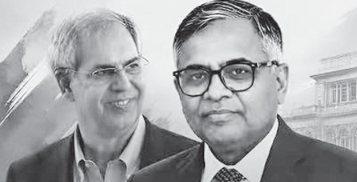
Every dynasty has a death that changes everything. In Game of Thrones, Robert Baratheon’s fall shattered the fragile peace and sent the Great Houses scrambling for the Iron Throne. In the House of Tata, a similar turning point came with the passing of Sir Ratan Naval Tata in October 2024. Like a king’s death in Westeros, the departure of the Tata patriarch left a question of succession and power: who truly commands the Tata empire? For a while, the throne seemed secure. N. Chandrasekaran, Chairman since 2017, sat upon it with the quiet authority of a ruler few expected to be challenged.
Then, on 12th August, 2026, came the twist nobody expected: Chandrasekaran told the Tata Sons board that he would not seek reappointment when his term expires on 20th February 2027. The King seemed to abdicate the throne. But thrones, whether corporate or fictional, are rarely surrendered so easily. The Nomination and Remuneration Committee of Tata Sons met on 3rd September, 2026 and, in a scene straight out of the Small Council’s chamber, unanimously asked him to reconsider his decision, citing his stewardship of the group and its larger interests while contravening the Selection Committee requirement as set out in the Articles of Association (AOA) of Tata Sons on the ground of frozen Sir Ratan Tata Trust (one of the two trusts that cumulatively forms the Tata Trusts).
On 17th September, 2016, the board approved Chandrasekaran’s reappointment by a majority vote of 4:1 after he agreed to reconsider his August decision. The King had announced his departure; the Council refused to let the succession proceed. As on today, he will rule for another five years until 2032. Yet no throne is won so easily without costs, this one exposed the fault line running beneath the House of Tatas. The reappointment of Chandrasekaran came accompanied by the dissent of Tata Trusts Chairman, Noel Naval Tata who solely voted against the resolution. If Ratan Tata was the departed patriarch and Chandrasekaran is the King, then Noel Tata plays the role of Tywin Lannister in this saga.
He is not a claimant to the throne himself as he cannot be Chairman of both Tata Trusts and Tata Sons simultaneously according to Tata Sons AoA, but he is a powerful and influential institutional voice whose House cannot simply be overruled by a show of hands. Noel Tata went further, describing the reappointment itself as illegal, a declaration that turned a governance disagreement into open dispute between the Small Council and the Great House that sits behind it. Tata Trusts is the major house since it holds majority 66% stake Tata Sons, the closest thing this story has to House Lannister i.e., wealthy, entrenched, and unwilling to be a passive spectator to who occupies the throne it helped build. And what about succession, the question that haunts every Great House? Jon Snow never asked to be relevant to the politics of Westeros, yet he became the unresolved answer to “who comes next.” Tata Sons has no named Jon Snow today and that is precisely the point.
The August announcement briefly opened a search for the future successor but then the September reversal closed it again, at least for the next five years, but the underlying question of who eventually inherits the chairmanship remains exactly as unanswered as it was before the drama began. If the fight over the throne was the whole story, it would already be dramatic enough. But it isn’t, beyond the Wall a different force has been moving and quiet swiftly than anyone imagined, someone who is indifferent to Houses, votes, or dynastic loyalty. In Westeros, the Night King represented a threat that no internal power struggle could out-argue. For Tata Sons that role is being played by the Reserve Bank of India.
The RBI classified Tata Sons as an Upper Layer NBFC under its revised Scale Based Regulation for NBFCs on 6th August, 2026, given standalone assets exceeding Rs 1 lakh crore as of 31st March, 2026. Entities in that category face a listing obligation, and Tata Sons had spent two years trying to escape it by seeking to surrender its core investment company registration after repaying substantial debt. That door has now closed since RBI rejected Tata Sons’ application to surrender its Core Investment Company registration, in a decision conveyed to it by letter dated 11th September, 2026, bringing its stock market listing firmly back on the mainstream. The central bank has also filed a caveat petition since then in the Bombay High Court, a clear indication that RBI has confirmed its stance and the path towards enforcement in form of Tata Sons listing has grown more likely then ever.
The rules governing the realm, in other words, are being rewritten from outside irrespective of who sits on the throne within. What began in August as a straightforward question of whether the chairman stay or go has now become by late September a story with the scale of a Westeros succession crisis, a King persuaded back onto his throne, a Great House publicly dissenting, an heir apparent still unnamed, and an external force compelling change regardless of who wins the internal contest. The Houses may keep fighting over the Iron Throne. The throne itself, it turns out, is no longer entirely theirs to define.
*Bharat Chandnani is a student, Penultimate Year of B.B.A. LL.B. (Hons.), 5-Year Integrated Course, Kirit P. Mehta School of Law, NMIMS, Mumbai Dr. Anwesha Ghosh is Assistant Professor of Law, Kirit P. Mehta School of Law, NMIMS, Mumbai