
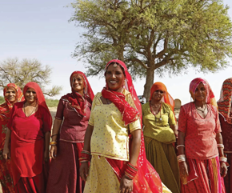
Rural development is not only about roads and buildings. It is about better livelihoods, housing, water, digital access, employment and stronger village institutions. The path to Rajasthan’s development runs through its villages. Better crops, higher incomes for farmers and livestock owners, good roads, drinking water, permanent houses, employment opportunities and access to modern services are all important indicators of rural progress. In a state as large and geographically diverse as Rajasthan, strong villages are essential for balanced and inclusive development. Under the leadership of Chief Minister Bhajan Lal Sharma, the state government has been focusing on rural development through a combination of infrastructure, employment, housing, water, digital services, education, livelihoods and social security. The objective is to ensure that development reaches rural families in a coordinated manner. The Rajasthan government has allocated Rs 33,419 crore for the rural development sector in the 2026-27 state budget. The allocation covers several areas, including Panchayati Raj institutions, rural employment, the Pradhan Mantri Awas Yojana Gramin, water conservation, rural livelihoods, sanitation and irrigation. The scale of the allocation reflects the importance being given to rural areas.
Better roads, Better opportunities
Connectivity remains one of the most important requirements for village development. A good road does much more than connect a village to a town. It helps farmers take their produce to markets, allows children to reach schools, improves access to hospitals and creates opportunities for small businesses and employment. Through programmes such as the Atal Pragati Path and Pradhan Mantri Gram Sadak Yojana, efforts are being made to improve road connectivity across rural Rajasthan. Timely completion and quality monitoring of these projects are important to ensure that the investment creates lasting benefits. For rural families, better roads can mean lower transportation costs, easier access to government services and quicker movement of agricultural produce. In this sense, rural road construction is also an investment in the village economy.
Bringing digital services to villages
Digital connectivity is becoming an important part of rural development. Atal Gyan Kendras are being developed at Panchayat headquarters to provide villagers with access to computers, high-speed internet, e-libraries and employment oriented training. The state is working to establish these centres at 14,403 Panchayat headquarters, with hundreds already completed. These centres can become important spaces for rural youth preparing for competitive examinations, pursuing online courses or looking for employment opportunities. They can also help villagers access digital government services without having to travel to cities. By bringing technology closer to rural communities, the initiative can help reduce the digital gap between villages and urban areas.
A permanent Home for rural families
Housing is another important part of rural development. Under the Pradhan Mantri Awas Yojana-Gramin, the government is focusing on providing pucca houses to eligible rural families. A provision of Rs 5,472 crore has been made for the scheme in the 202627 budget, with a target of constructing 3 lakh rural houses. A permanent house provides more than shelter. It gives families greater security and dignity and creates a safer environment for for families.
The SVAMITVA scheme is helping address this issue through dronebased surveys and the preparation of ownership records. In Rajasthan, more than 15.70 lakh ownership cards have been distributed. These documents provide rural families with formal recognition of their property and can help reduce disputes. Proper property records can also make it easier for families to establish ownership before financial institutions. In this way, documentation can become an important tool for economic empowerment. women and children. For economically weaker families, housing can also provide a stronger foundation for improving their overall living conditions.
Giving villagers ownership rights
For many years, lack of proper documentation of property in rural inhabited areas has created difficulties water security for rural rajastHan Water remains one of the biggest challenges for Rajasthan, particularly because of its geographical conditions. Rural development cannot be sustained without reliable water resources. The 2026-27 budget includes provisions for the Chief Minister’s Water SelfReliance Campaign and the watershed component of the Pradhan Mantri Krishi Sinchayee Yojana. The focus is on conserving rainwater, improving groundwater recharge and supporting agriculture. Water conservation can have a direct impact on rural incomes. Better water availability can support farming, livestock and other livelihood activities. When water initiatives are combined with irrigation, electricity, roads and access to agricultural markets, their benefits can extend across the rural economy.
Employment Beyond traditional labour
Employment is central to improving the economic condition of rural families. Rural employment programmes can provide immediate income while also creating useful assets such as ponds, roads and water conservation structures. At the same time, rural development needs to move beyond wage-based employment. Skill development, digital training and entrepreneurship can give young people more options. The employment-oriented training proposed through Atal Gyan Kendras can help rural youth develop skills relevant to changing job markets. Access to digital services and online learning can also allow young people to explore opportunities without immediately having to migrate to cities.
Strong panchayats, stronger villages
Panchayati Raj institutions are at the centre of village level development. Effective Panchayats can understand local requirements and help ensure that government schemes are implemented according to the needs of individual villages. The state budget provides resources to Panchayati Raj institutions through the State Finance Commission and Central Finance Commission. Along with financial support, Panchayats need transparency, accountability and administrative capacity. Village development is most effective when local institutions and residents participate in deciding priorities. This can help ensure that public resources are directed towards the issues that matter most to individual communities.
Reaching the last village
Rajasthan’s size and geographical diversity make rural development a major administrative challenge. The needs of desert villages can be different from those of tribal areas, border villages or remote hamlets. Therefore, implementation is as important as financial allocation. Projects need to be completed on time, construction quality must be maintained, payments should not be unnecessarily delayed and benefits should reach the people for whom schemes are intended. Field monitoring and accountability are essential for ensuring that development does not remain limited to government records but creates visible improvements on the ground.
Villages are the foundation of Rajasthan’s growth
The most important change in Rajasthan’s rural development approach is the effort to connect different areas of development. Roads are being linked with markets and employment, housing with dignity, water with agriculture, Panchayats with local governance and digital centres with skills and employment. Rajasthan’s cities may drive economic growth, but its villages remain the foundation of the state’s development. Strong infrastructure, better livelihoods, secure housing, water availability, digital access and employment opportunities can help rural families become more self-reliant. The real measure of rural development will ultimately be whether a farmer earns more, whether a young person can find opportunities, whether a family has a secure home, and whether essential services reach even the most remote village. A prosperous Rajasthan, therefore, will depend not only on the growth of its cities but also on the strength, resilience and self-reliance of its villages.
*The author is Union Minister of State for Agriculture