
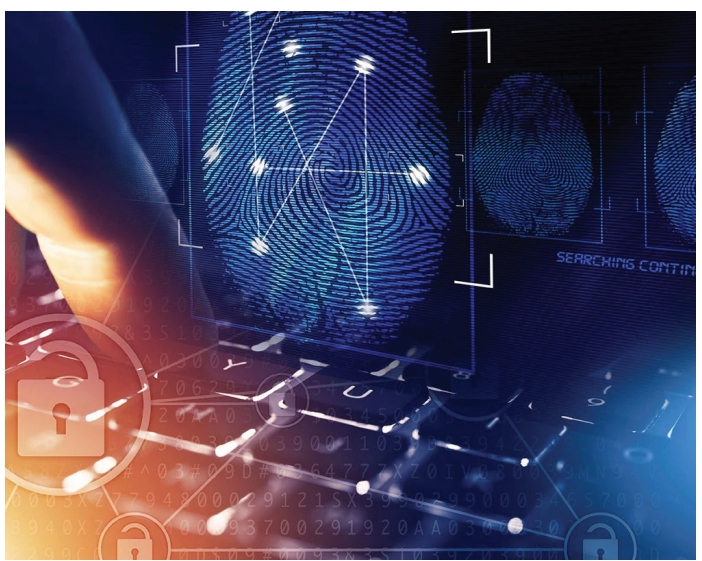
The transformation of crime from the physical world to the digital environment has created a new category of offender—the Digital Thief. Unlike the traditional thief who may leave fingerprints, footprints, weapons, or other physical traces at a crime scene, a digital thief can operate remotely, conceal identity through multiple technological layers, and steal information without physically entering the victim’s premises. Passwords, banking credentials, identity documents, personal photographs, intellectual property, confidential business information and digital financial assets have all become potential targets.
At first glance, fingerprinting appears to belong exclusively to traditional forensic investigation. However, advances in biometric authentication, digital forensics and forensic identification have created important connections between fingerprints and cybercrime investigation. Fingerprints can operate both as a means of authentication and as forensic evidence. A fingerprint may help identify a person who accessed a device, while a digital fingerprint or device fingerprint can assist investigators in associating online activity with a particular device or user.
The growing relationship between digital theft and fingerprinting therefore represents an important development in modern forensic science. It also raises difficult questions concerning privacy, reliability, admissibility of electronic evidence and the protection of biometric information.
UNDERSTANDING THE DIGITAL THIEF
A digital thief is an individual or group that unlawfully obtains, uses, alters, destroys or transfers digital information or digital assets. The traditional concept of theft is consequently being challenged by crimes in which the stolen object may not be tangible.
Digital thieves may obtain Banking and payment information, Passwords and authentication credentials, Aadhaar or other identity information, Credit and debit card information, Personal photographs and videos, Business and trade secrets, Cryptocurrency credentials, Government or institutional databases and Confidential communications. Common techniques include phishing, malware, credential theft, identity theft, social engineering, ransomware, spyware, SIM-related fraud and unauthorized access. The digital thief may never meet the victim. In many cases, the offender may also use compromised computers, virtual private networks, proxy servers, stolen identities or other infrastructure to conceal his or her actual identity. This makes digital evidence and forensic identification essential to modern investigation.
FINGERPRINTS AND MOBILE DEVICES
Modern smartphones provide an important intersection between biometric identification and digital evidence. Many smartphones use fingerprint authentication. A user may unlock a device through a registered fingerprint rather than a password or PIN. This creates a potentially significant forensic environment. Suppose investigators recover a smartphone believed to have been used in a cybercrime. The device may contain Communication records, Applications, Browser history, Photographs, Documents, Location information, Authentication information and Evidence of transactions.
The fingerprint authentication system may provide information about access to the device, subject to the applicable technology, legal procedures and evidentiary requirements. However, investigators must distinguish between authentication evidence and proof of authorship. The fact that a device was unlocked using a particular biometric does not necessarily establish that the registered individual committed every subsequent digital act.
BIOMETRIC IDENTITY THEFT
While biometric technology can strengthen authentication, it also creates a serious security problem: biometric information cannot easily be replaced. A password can be changed after compromise. A fingerprint cannot simply be replaced. Digital thieves may target biometric information through:
• Compromised databases;
• Phishing and social engineering;
• Malicious applications;
• Unauthorized access to biometric systems;
•Identity-document fraud; and
• Attacks against authentication infrastructure.
The theft of biometric information can therefore have consequences extending far beyond a conventional password breach. A compromised fingerprint template can potentially become part of a person’s long-term identity-security risk.
FINGERPRINTING IN CYBERCRIME INVESTIGATION
Fingerprint evidence can contribute to cybercrime investigations in several ways. Firstly, a cybercriminal may physically access a computer, server, mobile phone or storage device. Traditional fingerprints recovered from the equipment may establish a connection between a suspect and the physical object. Secondly, in cases involving cybercafés, offices, server rooms or other locations, fingerprint evidence may help investigators determine who physically interacted with relevant equipment. Thirdly, where legally obtained and technically available, records associated with biometric authentication can contribute to an investigation. Fourthly, the greatest value often comes from combining fingerprint evidence with digital evidence. For example: Fingerprint evidence + CCTV + device records + login records + transaction records may provide a stronger evidentiary picture than any individual item considered in isolation.
INDIAN LEGAL FRAMEWORK
India’s legal framework for cybercrime and electronic evidence has evolved significantly. The Information Technology Act, 2000 provides the principal statutory framework addressing several forms of cyber activity, including unauthorized access and damage to computer resources. The Bharatiya Nyaya Sanhita, 2023 (BNS), together with the Bharatiya Nagarik Suraksha Sanhita, 2023 (BNSS) and Bharatiya Sakshya Adhiniyam, 2023 (BSA), forms the principal criminal-law and evidence framework following the replacement of the Indian Penal Code, Code of Criminal Procedure and Indian Evidence Act
The BSA recognizes electronic and digital records within India’s modern evidence framework. This is particularly important because cybercrime investigations frequently depend on records generated by computers, smartphones, servers, applications and digital networks. For forensic investigators, the central challenge is not merely discovering digital evidence but demonstrating its authenticity, integrity, relevance and connection with the alleged offence.
FINGERPRINTS AND ELECTRONIC EVIDENCE
A fingerprint recovered from a physical object and a digital record obtained from a computer are fundamentally different forms of evidence. Fingerprint evidence generally concerns physical identification, whereas electronic evidence may concern:
• Who accessed a system;
• When access occurred;
• From which device;
• What information was accessed;
• What information was transferred; and
• Whether the record has been altered.
A robust investigation should therefore avoid relying on a single technological indicator. For example, if a suspicious transaction occurred from a particular smartphone, investigators may examine the device’s forensic image, application data, network records and authentication history. If physical access is relevant, fingerprint evidence may provide an additional evidentiary link.
Fingerprint evidence, despite its importance, is not infallible. Latent fingerprints may be partial, smudged, distorted, contaminated or insufficient for reliable comparison. Similarly, biometric authentication does not necessarily prove who performed every action after authentication. Consequently, forensic conclusions should be expressed within the limits of the evidence rather than treating technological identification as absolute proof.
PRIVACY AND CONSTITUTIONAL CONCERNS
The expansion of biometric and digital surveillance raises significant privacy questions. Fingerprint databases contain highly sensitive personal information. Unauthorized collection, storage or sharing may create risks of identity theft and surveillance. The Supreme Court of India recognized privacy as a fundamental right in Justice K.S. Puttaswamy (Retd.) v. Union of India (2017). Any state action involving personal information must therefore operate within the constitutional framework governing privacy and legality.
The challenge is to balance two legitimate objectives: effective investigation of cybercrime and protection of individual privacy. Biometric collection should consequently be accompanied by appropriate legal safeguards, purpose limitation, secure storage, access controls and accountability mechanisms.
Dr.S. Krishnan is an Academician and an Experienced Journalist based in Jaipur.
Dr. Garima Dhaka is an Assistant Professor, Department of Law, Vivekananda Global University, Jaipur