
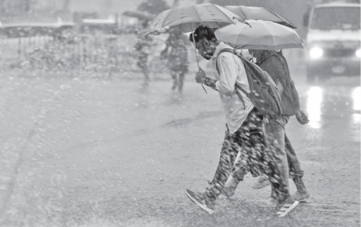
For generations, the arrival of the monsoon has been one of India’s most anticipated annual events. It promises relief from scorching summers, replenishes rivers and reservoirs, and breathes life into fields waiting to be sown. Yet, in recent years, the same monsoon has become a season of anxiety. A few hours of intense rainfall are enough to flood cities, trigger landslides, damage crops and disrupt millions of lives. Ironically, many regions that struggle with floods in July begin worrying about water scarcity only weeks later. The monsoon has not stopped being a blessing, but it has become an increasingly unpredictable one.
Climate change is undoubtedly altering rainfall patterns. Scientists have observed that instead of receiving steady showers over several weeks, many parts of the country are witnessing shorter spells of exceptionally heavy rain followed by long dry periods. However, climate change alone cannot explain why ordinary rainfall often turns into a disaster. The uncomfortable reality is that many of these crises are intensified by human decisions. Wetlands have been filled for construction, lakes have shrunk under encroachments, forests have given way to unchecked development, and natural drainage channels have been blocked. When water has nowhere to go, it inevitably finds its own path.
The cost of ignoring nature
Every monsoon exposes the gap between development and planning. Cities continue to expand, but drainage systems often remain decades old. Buildings rise on floodplains because the land appears attractive for development, only for residents to discover later why those areas were once left untouched. Hill slopes are cut without adequate safeguards, increasing the risk of landslides. Roads are constructed without considering natural water flow, leading to repeated flooding with every spell of heavy rain. Development is essential for a growing economy, but it cannot succeed by ignoring ecological realities. Infrastructure that collapses after every extreme weather event is not a sign of progress; it is evidence of poor planning. Growth becomes meaningful only when it is capable of withstanding the challenges of a changing climate. This is precisely where the idea of sustainable development assumes significance. It reminds us that economic progress and environmental protection are not competing goals but complementary ones. A city that preserves its wetlands, protects its rivers and plans around its natural geography is not slowing development; it is making development more durable.
The law is stronger than its implementation
India is often criticised for environmental degradation, yet it is not a country lacking legal safeguards. The Constitution itself reflects a clear environmental vision. Article 48A directs the State to protect and improve the environment, while Article 51A(g) calls upon every citizen to safeguard natural resources. Over the years, the Supreme Court has interpreted the right to life under Article 21 to include the right to a clean and healthy environment, recognising that environmental security is inseparable from human dignity. Legislation such as the Environment (Protection) Act, 1986, the Water (Prevention and Control of Pollution) Act, 1974, and the Disaster Management Act, 2005, together provide a com-prehensive framework for environmental governance and disaster preparedness. The problem is rarely the absence of law. More often, it is the absence of timely enforcement. Environmental impact assessments sometimes become procedural formalities rather than meaningful scientific exercises. Illegal construction continues in vulnerable areas despite repeated warnings. Regulations are diluted in the name of speedy development, only for the public to bear the cost when disaster strikes. Strong laws can make a difference only when they are implemented consistently and without compromise.
From reacting to preparing
Perhaps the biggest lesson every monsoon teaches us is that prevention is always less expensive than recovery. Governments routinely spend enormous sums on relief, compensation and rebuilding after floods, while far less attention is given to measures that could reduce the damage in the first place. Environmental law offers valuable guidance through the precautionary principle, which encourages preventive action even when scientific certainty is incomplete. In practical terms, this means restoring wetlands before they disappear, strengthening drainage systems before they fail and restricting construction in high-risk areas before lives are endangered. Waiting for disasters to confirm what experts have already warned us about is both costly and avoidable. Equally important is the public trust doctrine, under which natural resources such as rivers, forests, lakes and wetlands are held by the State in trust for present and future generations. These ecosystems are not empty spaces waiting to be developed; they are natural infrastructure that protects communities from floods, stores groundwater and supports biodiversity. Losing them weakens our resilience long before the first storm arrives.
Resilience begins long before the first rainfall
Building climate resilience is not the responsibility of governments alone. Urban planners, engineers, businesses, farmers and citizens all have a role to play. Cities need to map and preserve natural drainage networks instead of building over them. Rainwater harvesting should become a practical necessity rather than a box to be ticked during construction approvals. Farmers require timely weather information, efficient irrigation systems and support to adopt climate resilient agricultural practices. Investments in early warning systems, better forecasting and emergency preparedness can significantly reduce the loss of life during extreme weather events. Community participation is equally important. Local residents often possess valuable knowledge about flood-prone areas, changing rainfall patterns and traditional methods of water conservation. Their experience should inform planning rather than be overlooked. Climate resilience is strongest when policies are shaped not only by experts but also by the people who live with these challenges every year.
The monsoon will always remain central to India’s economy, culture and identity. What has changed is the environment in which it now arrives. Climate change may continue to make rainfall more erratic, but the scale of its impact will depend largely on the choices we make today. Protecting wetlands, enforcing environmental laws, investing in resilient infrastructure and respecting ecological limits are no longer environmental luxuries; they are essential investments in public safety and sustainable development. The true measure of preparedness will not be how efficiently we respond after the next flood, but how wisely we act before the clouds gather. If every monsoon reminds us of nature’s power, it should also remind us of our responsibility. Resilience is not built during disasters. It is built in the decisions taken long before the rain begins.
*Romil Aryan, Assistant Professor of Law, Vignan Institute of Law, VFSTR, Guntur, Andhra Pradesh.
*Dr. Partha Sarothi Rakshit, Director, Vignan Institute of Law, VFSTR, Guntur, Andhra Pradesh.