
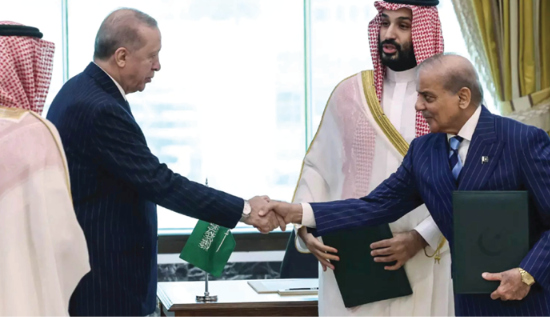
In August 2026, Saudi Arabia, Turkey and Pakistan signed the Mecca Pact and boisterously declared that “an attack on one would be an attack on all”. Pakistan’s military publicists, never content to leave a sacrament unscored, even released a seven minute anthem called ONE SHIELD. Three flags. One heart. Serious analysts and think tanks were prompt to dismiss this entire messaging as pure comedy, even before the ink had dried out on the paper. Husain Haqqani, the former Pakistani ambassador to United States, who has watched this movie from both Islamabad and Washington, without wasting any breath, described the pact as “more symbolic than substantive.” In an increasingly intertwined and interdependant world, the concept of a shared common enemy, was always going to be challenge to demonstrate as a credible deterrent.
He further summarised “It will not be the ‘Muslim NATO’ some people are talking about.” Five weeks into the formal signing of the pact, the Houthis tested this on paper defence pact, that hawks like Haqqani had already marked and dismissed. Missiles and drones hit southern Saudi cities and critical energy infrastructure. The lack of a military response compounded with the constant deflection and patronising commentary from Turkey and Pakistan raised questions about the practical effectiveness and credibility of the Mecca Joint Defence Agreement. The Atlantic subsequently reported that the Houthi attacks had put the value of the Mecca Alliance into doubt, noting that neither Islamabad nor Ankara had shown an inclination to assist Saudi Arabia despite the optics of Saudi being pounded by brutal attacks.
Even after Houthi ragtag militias in flip-flop, looking more like a street posse than an army, delivered chilling, brutal strikes on Saudi Arabia and exposed the limits of a far richer, better-trained, better-armed force and its new alliances, Islamabad’s language stayed theatrical. Defence Minister Khawaja Asif declared there was “no ambiguity” about the pact’s sanctity and that Pakistan would stand with the Kingdom “practically.” The army spokesman vowed to go to “any extent… physically.” Then the punchline finally arrived. The Foreign Office said the agreement was still being “firmed up,” that operationalising it was premature, and that no formal Saudi request had even been received to intervene, while the pounding on Saudi Arabia continued. The comedy of narratives had only just begun. Anyone with an iota of understanding of how global diplomacy works would know that alliances of this kind are not switched on by loudspeaker.
The requests and SOS for help always sounded is private. The public only hears the action, or in this case the silence. Paksitan’s ISPR has been working overtime to make the choreography look like jurisprudence for domestic messaging completely insulated from international humiliation. Sushant Sareen, Senior Research Fellow at the ORF, saw the gag coming in August, much before the first Houthi wave made it obvious. Now when the Houthis went after Saudi infrastructure, he asks “Where is the Mecca pact? What have they done about it?” The Pakistanis, he said, had produced “that Punjabi barakh” to speak very loudly, boast about everything, and then done the traditional follow-up, which is nothing. NATO had a hyperpower at its centre. “Who is the hyperpower out here?” Erdoğan wanting the part does not cast him in it. By mid-September, the joke had ripened. Turkey’s line was that parliament had not ratified, thus nothing doing until October.
Fine, said Sareen, grant the Turks their disingenuity. “But what about the Pakis? They signed a bilateral strategic mutual defence agreement last year. How long are they going to take? 20, 30 years before they ratify something?” Pakistan already had JF17s and a brigade on Saudi soil. “They haven’t done anything with it.” His verdict was not a subtle one. He summed up this pact as a stillborn agreement whose main yield from the Pakistani perspective was “to extract money from Saudi Arabia.” On X he put it in the register the establishment actually understands: “The Pakis were celebrating like they had won the world after the pact was signed. Where are they? Have they ditched the Saudis once again?” Rawalpindi, to score domestic legitimacy, sold this stillborn Mecca Pact at home as extra insurance against New Delhi. A Saudi-Turkish shadow over the next crisis. If a drone near the Kaaba does not trip the wire, an Indian battery in the desert or the Pir Panjal will not either. And thus, The Mecca Pact provides a vital lesson to nations like Saudi Arabia to choose friends and allies intelligently and never to mistake a communiqué for a coalition.
The deeper map is the one Haqqani named and Sareen keeps redrawing. There is no common enemy. Pakistan cannot fight Iran’s Yemeni proxy while auditioning as Washington’s useful intermediary with Iran and subject itself to Iranian aggression on its long 909km border. It cannot open a Red Sea front while the western front with Afghanistan remains hot and the eastern front with India remains the organising principle of its entire military cosmology. Saudi Arabia, running helter-skelter diplomatically, drew the adult conclusion. It finally asked Beijing to lean on Tehran to leash the Houthis. China, which buys the oil and needs the lanes, quietly did so. That is the week’s real alliance news. Trump and Washington’s restraint is the one part that is not the farce. The United States is already on an Iran front. Interceptors are not infinite. Trump has midterms in November and a pump price that does not improve when oil thrives above a USD$100. MBS asked for strikes, to which Trump said no and rightfully offered intelligence instead.
Sareen’s latest assessment this week puts the timing on the table. Iran using the Houthis as a second front, Trump holding back, while November midterms sitting in the calculation. Iran’s goal is simple. Raise the price of intransigence at the pump in September to hold credible leverage for conversations in November. Whether that is Tehran’s design or merely Tehran’s luck, the incentive is rhythmic. In August, Sareen was blunter still about the product Pakistan is actually selling. The economy, he said, is “in something worse than a toilet.” After Operation Sindoor the army “got their butts kicked” and then pretended otherwise. What it has left to offer Riyadh is manpower as a cheap mercenary service, because it has nothing else. A desperate Pakistan is not a quieter one. The generals’ temptation, when the house is on fire, is to point at India and call it a unifying spark. Mecca was supposed to make that spark more expensive for Delhi. Now, this still born policy is cheaper to ignore. Social media has already filed the episode under grandstand. The crueller jokes tell the Saudis they should choose friends with the same care they choose interceptors. Haqqani said there was no shared enemy. Sareen said there was no hyperpower. The Houthis, who cannot finance a music video, now sit on a strait that moves the world’s oil. America declined to be the spare battalion in somebody else’s liturgy. China made the call that mattered. Pakistan is left with a globally exposed reputation for unreliability, and an India problem the pact was meant to complicate. It has done the reverse.
*Adit Kothari is a political commentator and founding member of the Indic Society,