
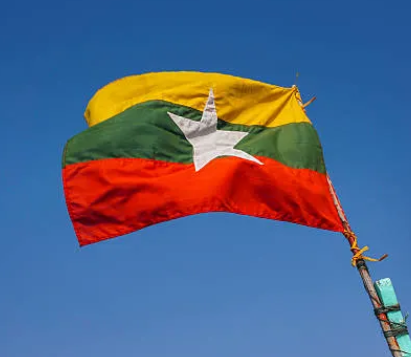
The year 2026 marked a period of political transition in Myanmar with the elections held in December 2025-January 2026. The civilian government was established with Min Hlaing claiming the presidency for himself and since then have been trying to legitmise his political takeover. While the past five years have been spent trying to convert battlefield weaknesses into political legitimacy. Yet these years have witnessed an evolving battlefield in Myanmar. Recent weeks report increasing airstrikes and offensives in many regions and cases of forced conscription. While the war continues, the military backed government is also pursuing separate peace talks with selected armed groups. Internationally, the government is pushing for legitimacy and acceptance with numerous state visits. What is also interesting to note is that in the past few weeks the United States administration has held rounds of talks with the present government.
A transition designed to be controlled
The elections in the beginning of the year established the rule of the USDP party in the country, and last month, the USDP held its fourth party congress. They re-elected U Khin Yi, who is also Speaker of the lower house, as chairman. There are reports that the President has now formally UN’s IIMM reported that it is prioritising investigations into ‘double-tap’ strikes, which return to a target to hit rescuers. ACLED figures suggest above 100,000 deaths across all sides since 2021. Though most figures are compiled from resistancelinked or third-party monitors and cannot be independently verified, the numbers reflect a complicated reality. Further, the present government rejects the framing, and describes its opponents as terrorists, and thereby justifies attacks on power lines, hospitals and roads to them. As a result, civilians suffer in both accounts. joined the party and that retired officers of the old guard retain the executive committee. The Parliament also reconvened for its third regular session (22-23 September). Talks are even on for conducting by-elections in early 2027. While each of these events suggest that normalisation is under way and the Min Hlaing government is consolidating political power. But in reality, these arrangements have ensured that the military remains embedded in the system forever.
Though the armed forces have recovered some ground, the local monitors quoted by independent media describe that hold as precarious. In Rakhine, the Arakan Army controls all but three of the state’s seventeen townships and saw fighting resume around Kyaukphyu in mid-August after a brief lull. Similarly, the military offensive in Ayeyarwady aimed to reclaim positions on the Pathein-Monywa highway. In northern Kachin, the Kachin Independence Army has been pushing toward Khaunglanhpu since early July. The military’s answer leans on air power, and increasingly on drones and helicopters. The recent
Another serious concern is the loss of troops. Reports from various states suggest that there have been incidents of forced conscriptions. But the Home Ministry denied these allegations at the recent parliament session. The Ministry told parliament that recruitments were done under the People’s Military Service Law and denied allegations of unlawful conscription in Khamti. Whatever the truth of individual cases, a force that must draw on young men at this scale is like managing a war rather than winning.
Ad-hoc PeAce MeAsures
The government’s 100day peace initiative (April to July) was presented as an invitation to all armed groups. In practice, it did result in a bilateral meeting with groups that were already willing to negotiate, i.e. the PSLF/TNLA, NCA signatories led by the RCSS, the Lahu Democratic Union, and now the MNDAA, whose delegation has reportedly visited Nay Pyi Taw for the first time. With agendas such as trade gates, ceasefire adherence, suppression of scams and narcotics, and, in a few cases, under greater Chinese influence. Even the recently concluded meetings with NCA-signatory groups in Yangon on 30 September and, on 10 October, the government signed a cooperation commitment with the Shanni National Unity Council.
But what is missing is that the forces that are leading the war against the military are absent. The Arakan Army, the KIA, the KNU, the Chin resistance, the Karenni forces and the NUG’s People’s Defence Forces have not joined the table. The Steering Council for the Emergence of a Federal Democratic Union, formed in March, told the ASEAN special envoy in July 2026 that it saw no genuine commitment from the government as they declined to meet its representatives. What is also concerning is that, even after five years the opposition is not unified either. For instance, the Brotherhood Alliance that launched Operation 1027 has been fractured. Therefore, Naypyitaw’s strategy to divide and disaggregate is quite clear. It peels off groups where China has leverage and lets the rest fight on divided. This works for the north and east, where Beijing’s economic interests dominate. But where this strategy doesn’t work is the western region.
Amidst all this, the central authority in Myanmar is running a campaign for recognition. After successful visits to India and China in June 2026, the President visited Laos. Then in August he was in Bangkok, Moscow and Minsk. Thailand’s shift matters most for the region. Prime Minister Anutin Charnvirakul urged ASEAN to reconsider isolating Naypyitaw and then received the President with full honours. Thai interests in scams, narcotics, refugees and border trade are real. Recently, Min Hlaing two-day visit to Malaysia on 7-8 October, was his fifth to an ASEAN member state since taking office, after Laos, Thailand, Vietnam and Cambodia. Malaysian Prime Minister Anwar Ibrahim also said Malaysia would do whatever is possible to bring Myanmar fully back into ASEAN. What is also noteworthy is that the visit followed the return of 1,476 detainees on Myanmar Navy ships.
Myanmar’s foreign ministry has also said that no new ASEAN special envoy is needed once the current one’s term ends and has urged the bloc to retire its Five-Point Consensus. And to seek full integration, the President launched an ASEAN Affairs on 15 October. However, the Philippines, the current chair, has not agreed yet. There has also been institutional pushback. The Southeast Asia National Human Rights Institutions Forum expelled the governmentcontrolled Myanmar National Human Rights Commission effective 19 October, stripping it of the 2027 rotating chair and barring it from the forum’s 23rd annual conference. Finally at the UN, the current government wants Aung Thurein to replace Kyaw Moe Tun in next month’s Credentials Committee meeting which is expected to arrive at a decision.
To conclude, an honest assessment is that Myanmar is entering a phase of stabilised instability, with a government strong enough to survive, but too weak to prevail, and increasingly adept at turning survival into diplomatic capital. While the political consolidation will continue, the peace will be partial. Even the bilateral deals in the north, backed by Beijing, may hold but the west and the Bamar heartland will not settle without a political offer on federalism and the military’s role that the government has not yet made. And to gain legitimacy, there will be more state visits, business forums and observer invitations in times to come. But what needs a close attention now is ASEAN’s incremental drift and the UN credentials decision. Managed elections and selective talks may produce a facade of normalcy, but not everlasting peace. That will require the government to talk to EAOs in active conflict to plan for the long-term peace plan.
Dr Cchavi Vasisht is Associate Fellow, Chintan Research Foundation.