
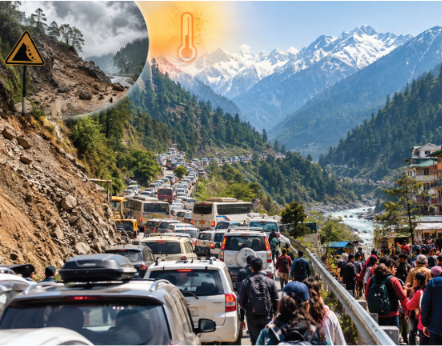
The three-day long weekend around Gandhi Jayanti turned India’s most popular hill and pilgrimage destinations into a warning about the limits of unplanned tourism at a time when climate change is already intensifying heat, rainfall, landslides and pressure on fragile ecosystems. Traffic remained trapped for hours on routes to Manali, Shimla and Mussoorie, while a reported seven kilometre queue between Joshimath and Marwari slowed movement towards Badrinath and Hemkund Sahib.
Similar congestion was reported in Rishikesh and other destinations as tourists and pilgrims converged on the hills. The immediate response was to deploy more traffic personnel and issue route advisories, but the deeper question is whether India’s tourist infrastructure can withstand a climate-stressed future in which extreme weather and rising visitor numbers are exerting pressure at the same time. The climate crisis makes this problem more urgent.
Rising temperatures, erratic rainfall, landslides, floods, droughts, coastal erosion and changing snowfall patterns are altering the geography and seasonality of travel. At the same time, the destinations most attractive to tourists are often ecological systems with limited carrying capacity. A hill town cannot indefinitely absorb more vehicles, hotels and visitors merely because demand continues to rise. A beach destination cannot treat stronger cyclones, coastal flooding and water stress as occasional disruptions.
The National Strategy for Sustainable Tourism recognises that tourism is both affected by and contributes to climate change, and tourism policy must therefore move from the simple promotion of visitor numbers to the management of climate risk and ecological limits. India’s tourism economy is important for employment, local enterprise and regional development, and the objective cannot be to restrict travel indiscriminately. The concern is that the current model concentrates visitors in a few places during a few holiday periods, while infrastructure remains designed for a smaller and more predictable flow.
The result is visible in roads that become parking lots, public spaces that become unmanageable, hotels that compete for scarce water and waste systems that cannot cope with the seasonal volume. The burden is carried not only by tourists, but also by residents, emergency services and local businesses that depend on the destination throughout the year. The Himalayas illustrate the contradiction particularly clearly. The region is attracting more visitors even as it faces warming temperatures, changing snowfall, glacial retreat, landslides and intense rainfall.
Tourism infrastructure is often built on fragile slopes and narrow valleys where roads, drainage systems and emergency access are already inadequate. When a long weekend brings thousands of additional vehicles into such corridors, congestion is not merely inconvenient; it can delay ambulances, obstruct evacuation and increase the risk of accidents during extreme weather. The same pressure also intensifies construction, groundwater extraction and waste generation in places where local ecosystems recover slowly. The climate impact is not confined to mountain destinations. Coastal tourism faces stronger cyclones, erosion, sea-level rise and damage to roads, hotels, beaches and public utilities.
Cities such as Mumbai, Goa and parts of coastal Odisha must plan for tourism alongside flooding, heat and water stress. Inland destinations are also exposed, as prolonged heat can make outdoor attractions unsafe during traditional peak seasons, while erratic rainfall can disrupt festivals, transport and local livelihoods. Climate change is therefore changing not only where tourists travel, but also when travel is safe, affordable and environmentally viable. This changing geography requires better information before new tourism projects are approved.
Carrying capacity assessments should account for water availability, sewage treatment, solid waste management, road access, emergency services, biodiversity and climate hazards rather than focus only on the number of hotel rooms a destination can add. Environmental impact assessments for tourism infrastructure must examine cumulative pressure from roads, hotels, parking facilities, adventure activities and pilgrimage facilities. A project-by-project approach cannot capture the combined effect of thousands of visitors arriving at the same time in a fragile valley or coastal belt.
The recent weekend rush also shows why visitor management cannot be left to traffic police. Destinations with narrow roads and limited services should use advance registration, parking controls, shuttle systems and timed entry during peak periods. Digital permits can help authorities monitor numbers, but technology should support a publicly accountable carrying-capacity policy rather than become a substitute for one. Where demand regularly exceeds ecological and infrastructural limits, governments will have to regulate access, stagger visitor flows and direct investment towards less-pressured destinations.
India can also learn from Bhutan’s high-value, low volume approach, although its model cannot simply be copied across a country of India’s size and diversity. A destination-specific fee, collected transparently and invested in water systems, waste management, conservation, public transport and local services, could help ensure that tourism contributes to the costs it imposes. Such a fee should not become an arbitrary barrier to domestic travel or a way of excluding ordinary visitors. Its purpose should be to finance the infrastructure needed to keep destinations liveable, while ensuring that local communities receive a visible share of tourism revenue.
The most effective climate policy for tourism may often be infrastructure policy. Hotels and homestays should be required to use water efficiently, segregate waste, treat sewage and disclose basic environmental performance. New construction should follow local hazard maps and climate-resilient building standards. Renewable energy, rainwater harvesting, decentralised wastewater treatment and efficient cooling can reduce pressure on public systems, but they must be accompanied by enforcement.
A destination cannot claim to be sustainable merely because some hotels install solar panels while its rivers carry untreated sewage and its roads remain vulnerable to landslides. platforms and tourism companies should provide accurate information about carrying capacity, weather risks, route closures and responsible conduct instead of treating every destination as endlessly available for consumption. India’s tourism policy must now recognise that climate resilience and tourism growth are not separate objectives.
A destination damaged by floods, deprived of water, overwhelmed by waste or cut off by landslides cannot remain economically successful merely because visitor numbers are high. The measure of success should include the safety of residents and tourists, the health of local ecosystems, the reliability of public services and the share of tourism income retained by host communities. Transport deserves similar attention because the long-weekend rush demonstrates the limits of car-dependent tourism. Rail connections, shared mobility, park-and-ride facilities and reliable local buses can reduce the number of private vehicles entering hill towns and pilgrimage corridors.
Tourist operators should be encouraged to bundle public transport, local guides and off-season itineraries rather than depend on high volume weekend traffic. Off-season tourism can distribute income more evenly across the year, but it must not be promoted blindly in periods of high climate risk or ecological recovery. Local communities must have a meaningful role in deciding how tourism expands. Residents understand water shortages, seasonal hazards, waste problems and changes in local weather before these concerns appear in official reports. Local governments therefore need the authority and resources to regulate construction, enforce waste rules, set parking and visitor limits and retain a share of tourism revenue.
Community participation should not be reduced to consultation after major projects have already been approved. It must influence the basic question of how much tourism a place can safely accommodate. Tourists, too, have responsibilities, although individual behaviour cannot compensate for weak regulation. Visitors can avoid littering, conserve water, use shared transport, respect local restrictions and choose businesses that employ local people and follow environmental standards. More importantly, travel
The Gandhi Jayanti weekend has shown what happens when demand is concentrated in destinations that were never designed for such simultaneous pressure. India need not choose between tourism and environmental protection, but it must abandon the assumption that more visitors automatically represent better tourism. A climate-sensitive tourism policy would regulate numbers where necessary, invest in resilient infrastructure, spread travel across seasons and destinations, and make visitors and businesses contribute to the ecological costs of travel. Without that shift, the country’s tourism boom will increasingly consume the landscapes on which it depends.
*Amrendra Pratap Singh is a Public Policy Scholar pursuing an M.A. in Public Policy and Governance at Ambedkar University