
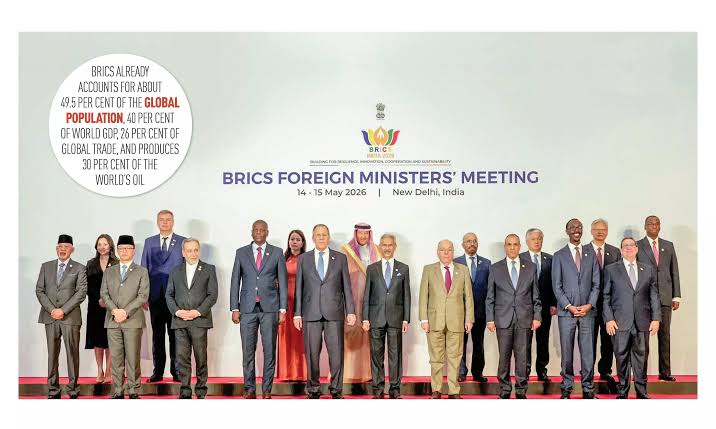
India recently hosted Russian President Vladimir Putin, Chinese President Xi Jinping, Iranian President Masoud Pezeshkian, and other leaders at Bharat Mandapam for the 18th BRICS Summit. Two decades after the idea was first conceived, BRICS has grown into a formidable global bloc, representing nearly half the world’s population and around 40 percent of global economic output. These developments make the Summit more than simply a meeting of Global South leaders.
They also make it an important point of reference for assessing the future direction of the grouping. Held under India’s leadership with the theme “Building for Resilience, Innovation, Cooperation and Sustainability,” the summit brought together eleven full members and ten partner countries and other outreach invitees and heads of international organisations. It outlined the priorities of an expanding BRICS across political and security, economic and financial, and cultural cooperation, while reiterating the commitment to a more multipolar global order. The New Delhi Summit was significant not only for demonstrating the expanding scope of BRICS economic cooperation, but also for offering insight into how the grouping is responding to an increasingly shifting global order.
India’s engagement with BRICS reflects one of the central features of Prime Minister Narendra Modi’s proactive foreign policy, particularly the pursuit of strategic autonomy in an increasingly contested global order. It says a great deal about how New Delhi has successfully learned how to work through a world that refuses to sort itself into geopolitical binaries. At the intersection of economic diplomacy, geopolitical hedging, and India’s long-held aspirations of becoming a key global power, BRICS membership allows India to engage with emerging institutions while keeping other avenues of strategic engagement with other major countries open.
Modi’s strategic Balancing act
As BRICS marks another year with India at its helm, New Delhi’s approach to the bloc reveals a foreign policy built on calculated balance rather than allegiance to any particular side. This is the essence of its strategy of multi-alignment, driven by national interests and the practical realities India faces. As a founding member, India has never viewed BRICS as an alternative to the existing global institutions. Rather, it has used BRICS as leverage to secure a greater voice within them, from the IMF and the World Bank to the United Nations (UN).
The economic incentives are also significant, including access to new markets, energy security through members such as Russia, Iran and the UAE, and financing options through the BRICS’ Shanghai-based New Development Bank (NDB), reducing India’s dependence on Western capital flows. But India is walking a tightrope between competing imperatives. It sits within BRICS alongside Russia and China while simultaneously deepening ties with Washington through the Quadrilateral Security Dialogue (Quad) and the I2U2 grouping of India, Israel, the United States and the UAE. This balancing act was particularly visible during the Ukraine war, when India continued buying Russian oil even as its partnership with the US expanded, despite then-President Donald Trump’s threat to impose severe tariffs on Indian goods.
Why the Bloc still Matters to New Delhi
India’s reasons for joining BRICS are easy to understand. It gives India greater room to shape debates on global governance, development finance, trade, technology and the interests of the Global South. For years, BRICS nations have consistently demanded that developing countries get a fairer say in the Western monopolised institutions like the IMF and the World Bank, and they keep pushing for changes to the UN Security Council too. The bloc can also serve as a diplomatic “pre-negotiation” space, allowing India to build coalitions and positions ahead of negotiations in wider multilateral forums, while giving it greater diplomatic room on contentious global issues.
There is also a simple, practical reason for India’s involvement. Growing trade among BRICS countries and the expansion of the grouping have increased India’s access to new markets, investment opportunities and cooperation in multiple areas. The inclusion of major energy-producing countries such as Russia, Iran, Saudi Arabia and the United Arab Emirates is particularly relevant to India’s energy security and growing demand for oil, as it creates opportunities to deepen economic and energy partnerships within a broader multilateral framework. India’s ambitious strategic project in Iran’s Chabahar Port illustrates this wider strategic value. The project is very important for connectivity, particularly by linking India with Iran, Afghanistan, and the wider Central Asian region. However, it faces major uncertainty following the US-Israeli invasion on Iran in February this year coupled with expiration of the US sanctions waiver in April.
The Shanghai-based BRICS’ New Development Bank (NDB) adds another important layer by providing an additional source of development financing that makes India a stronger negotiator on the diplomatic table to gain more favourable terms. Since Russia, Iran, and the UAE are all part of the group, energy security becomes a shared BRICS benefit instead of a string of separate deals. India’s growing presence at Iran’s Chabahar Port, for example, is about connectivity and strategy as much as energy, and it partly exists because BRICS gives that relationship a wider platform to rest on. The NDB adds another layer, not because it will soon replace Western lenders, but because having a second source of development funding quietly makes India a stronger negotiator everywhere else.
The art of not choosing sides
India’s BRICS membership does not exist in isolation, because none of the above happens in isolation from New Delhi’s other bonhomie with capitalist countries. India is pursuing an effectively multi-aligned foreign policy. It works closely with the US, Japan, and Australia through the Quad; maintains deep defence and technology ties; continues to purchase discounted Russian crude and military hardware; and simultaneously revives its relationship with Iran. All of this unfolds even as India remains part of a grouping that the West, and particularly the Trump administration, views with deep suspicion.
This is not indecision but deliberate multi-alignment and commendable strategic autonomy, working across competing alliances rather than choosing one, and engaging partners issue by issue keeping the nation’s interests in mind. However, this strategy also creates challenges for India within BRICS. Russia pushes aggressive alternatives to Western financial mechanisms, while India prefers BRICS to be read as ‘non-Western’ rather than ‘anti-Western’. An explicitly ‘anti-Western’ bloc would damage India’s long standing bilateral relations with Washington and Europe, and undermine the very strategy that makes its foreign policy more robust.
The China Dilemma
China is the trickiest factor in India’s BRICS puzzle. China’s economic strength and extensive engagement across the Global South give it considerable influence within BRICS, raising Indian concerns that the grouping could increasingly reflect Beijing’s priorities. India faces significant strategic, structural, and economic challenges from China’s rapid growth, especially from state-backed rise in artificial intelligence (AI) technology.
Yet the forum also keeps dialogue open, as shown by the Modi-Xi meeting on the sidelines of the New Delhi summit, their third since 2024, which hinted at a measured rapprochement. India has therefore sought to strengthen relationships with other BRICS members and build broader coalitions that can prevent the organisation from becoming overly China-centric. The expansion of BRICS presents both opportunities and challenges in this regard. While new members increase the grouping’s economic and diplomatic reach, they can also make consensus more difficult and provide India with additional partners.
At the same time, BRICS provides an institutional platform for India and China to maintain dialogue despite their unresolved border dispute along the LAC and wider geopolitical contestation. The Modi-Xi meeting at the 2024 Kazan Summit, coming after years of frosty relations after the 2020 Galwan Valley deadly clash incident, demonstrated this value by creating space to discuss border stability and broader bilateral relations.
Beyond the Summit: India’s diplomatic outreach
The thawing of relations between India-China relations added an important dimension to the BRICS process, demonstrating that the grouping can provide a channel for dialogue even when relations between member countries remain hostile. BRICS provides India with a wider and meaningful platform to pursue its diplomatic objective among the comity of nations for economic ties, and a link to the Global South nations.
India has increasingly used major multilateral forums not simply to participate in deliberations but to pursue bilateral engagements and build broader diplomatic and economic support while maintaining fluid multipolarity. This approach defines Modi’s foreign policy broad vision since 2014 to steer the nation towards a policy framework of Atmanirbhar Bharat, envisioned by Prime Minister himself. The broad objective is to exploit such platforms to gain breakthroughs and advance issues important to India, including greater representation in global institutions and its longstanding demand for permanent membership of the United Nations Security Council (UNSC).
Challenges ahead
India’s BRICS strategy reflects the wider trajectory of its pragmatic foreign policy from traditional non-alignment toward something more flexible of multialignment in the emerging geopolitical realities. India will have to balance its engagement with Russia and China within BRICS against its burgeoning strategic, economic and technological partnerships with the US, Europe, Japan and other Western partners.
The Modi Government seeks more influence inside global institutions without tying itself to any particular geopolitical faction. The challenge ahead is for India to leverage BRICS to advance its interests and preserve strategic autonomy, while ensuring that divergent interests within the grouping do not limit its wider foreign policy options. India’s challenge is not to dominate BRICS but to help shape its course as the bloc expands and becomes more diverse.
It is also not going to replace the Bretton Woods system of finance any time soon, predicting the dollar’s imminent collapse is getting ahead of the evidence. It must build consensus among members with diverse interests while preventing BRICS from becoming either an explicitly anti-Western alliance or a China-dominated platform. The outcome will reveal less about BRICS itself and more about whether a rising power can navigate a fragmented world order without being forced to choose sides.
*The author is a Professor at Nelson Mandela Centre for Peace and Conflict Resolution (NMCPCR) and Director of Centre for Distance and Open Education (CDOE), Jamia Millia Islamia, New Delhi)