
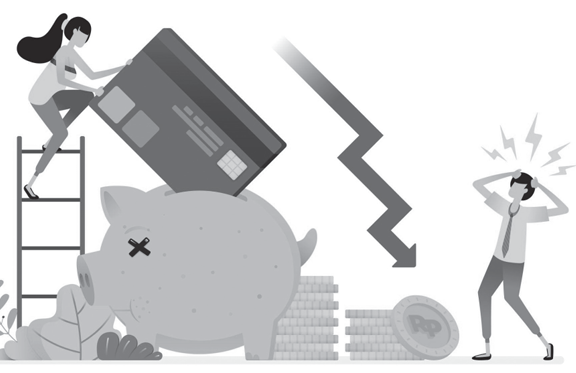
India’s shoppers have never had more access to credit. Yet the growth of instalments, personal loans and unsecured borrowing raises an uncomfortable question about the foundations of the country’s consumption boom.
India’s consumption boom has a curious feature. The new car is visible, the latest smartphone is visible, the holiday photographs are visible. The monthly instalments financing them are less so. Behind the expanding market for consumer goods lies a quieter development: households are increasingly using future earnings to sustain present consumption. The question is whether India’s consumer is becoming wealthier or merely more indebted. Consumption financed by rising incomes creates durable demand. Borrowing can mimic prosperity while leaving households with less to spend later. India’s challenge is to ensure credit strengthens household finances.
THE SHIFT FROM ASSETS TO INSTALMENTS
India’s household debt reached 45.5 per cent of GDP in September 2025, up from 41.3 per cent six months earlier and above its five-year average of 42.9 per cent. More significantly, non-housing retail loans rose from 54.9 per cent to 58.4 per cent of household borrowings between March 2025 and March 2026. CRIF High Mark’s March 2026 lending report puts outstanding gold loans at ₹18.6 lakh crore, up 50.4 per cent over the previous year. Personal loans stood at ₹16.5 lakh crore, growing 12.9 per cent. Consumer-durable loans increased by 20.8 per cent.
Credit is increasingly available beyond traditional housing and vehicle finance. Gold loans can finance agriculture, businesses or emergencies. Rising gold prices have increased the value against which households can borrow. Personal loans may consolidate expensive debt or meet urgent expenses. The concern is that consumption-related borrowing is becoming a more important driver of household credit than asset creation.
BUYING TODAY, PAYING TOMORROW
Digital lending has changed household credit. Loans once requiring a bank visit, paperwork and waiting can now be sanctioned by phone. Credit cards, instant personal loans and buy-now-pay-later products have narrowed the gap between wanting something and paying for it. Lenders assess borrowers quickly; borrowers may take longer to understand the cumulative burden.
India’s consumption boom may be masking a troubling shift: families are spending tomorrow’s earnings today. Credit is fuelling demand, but quietly eroding the financial security that sustains lasting prosperity. Income stability, savings and access to financial assets. The distribution of debt matters as much as its total size.
Surance. The RBI reports that the share of higher-rated borrowers, classified as prime and above, has increased in both the number of borrowers and the value of outstanding loans. This suggests that much of the expansion in credit is reaching borrowers with stronger repayment profiles. The banking system is not facing an immediate household-debt crisis.
This matters particularly for younger workers. Salaries may be rising, but so are commitments to rent, education, transport and lifestyle purchases. Manageable instalments can combine into a substantial monthly obligation. A job interruption or income reduction can expose a budget built around continuous borrowing.
The warning signs are clearest in smaller-ticket lending. According to data reported by The Indian Express, delinquencies in personal loans below ₹50,000 reached 6.4 per cent in March 2026, with fintech lenders accounting for 56.8 per cent of the segment. The share of over-leveraged consumers in the credit-active population rose from 5 per cent in FY2017 to 18 per cent in FY2024, before easing to 15 per cent in FY2026.
The Crux study raises a broader concern: when households increasingly finance consumption with tomorrow’s income, the consequences extend beyond loan defaults. Debt repayments squeeze savings, reduce future purchasing power, leave families exposed to income shocks and make consumption increasingly dependent on continued access to credit.
These figures identify a vulnerable segment. Small-ticket borrowers often have limited financial buffers, and repeated digital borrowing makes multiple obligations harder to assess. A borrower who pays every instalment on time may still have little for savings, healthcare or emergencies. Financial stress begins before a loan becomes a nonperforming asset.
GOOD CREDIT SCORES, FRAGILE HOUSEHOLDS
India’s aggregate household balance sheet offers reasBut aggregate credit quality can conceal individual vulnerability. A household with property, deposits and investments can carry debt more comfortably than one whose salary is already committed to monthly repayments. National averages conceal differences in repayment and wealth creation are different tests.
A household may service loans regularly while drawing down savings. It may have a good credit score but little for a medical emergency, a child’s education or retirement. Loan performance captures repayment discipline, not necessarily financial well-being. Default rates alone cannot measure household credit quality.
A loan book can remain healthy as borrowers lose financial flexibility. The cost appears when households cut discretionary spending, postpone investments or depend on fresh borrowing. This also weakens household resilience long before payments are missed.
THE CONSUMPTION MULTIPLIER HAS A LIMIT
Private consumption is one of the principal drivers of India’s economic growth. It supports retail, automobiles, housing, consumer durables and services. Rising credit can deepen this market by allowing households to bring forward purchases and acquire assets that would otherwise remain beyond reach. Financial inclusion and responsible lending can therefore strengthen economic activity.
The problem arises when borrowing substitutes for income growth. Every rupee spent servicing debt is unavailable for another purchase, a financial investment or an emergency. If household earnings fail to keep pace with repayment obligations, today’s consumption creates a claim on tomorrow’s demand.
Businesses invest expecting consumers to keep buying. When consumption increasingly depends on fresh credit, demand becomes more sensitive to interest rates, lending standards and employment. A credit slowdown can hit retail sales even when underlying demand remains.
The distinction is between credit that expands future earning capacity and credit that merely advances expenditure. Housing and education loans can improve a household’s long-term financial position. Business loans can generate income and employment. Borrowing for routine consumption may be necessary at times, but it cannot indefinitely compensate for weak earnings.
THE WAGE GAP BEHIND THE CREDIT BOOM
India needs a deeper consumption market, and responsible borrowing is part of that ambition. But lenders must assess a borrower’s total repayment obligations rather than treat every loan application in isolation. Digital platforms should disclose the full cost of credit and make repayment schedules transparent. Credit bureaus must help identify multiple borrowing across lenders. Regulators should pay particular attention to small-ticket unsecured lending and borrowers with limited financial buffers.
The larger responsibility lies with the economy itself. Sustainable consumption requires better-paying jobs, more productive employment and stronger household incomes. Expanding access to loans cannot substitute for these outcomes. If wages and employment fail to grow sufficiently, credit can temporarily support demand while increasing future repayment obligations.
India’s consumption story should therefore be judged by more than retail sales, vehicle registrations or credit growth. It should also be judged by whether households are accumulating assets, building savings and improving their ability to absorb financial shocks.
A stronger consumer economy is one in which families can spend because they earn more, not simply because they can borrow more. India’s economic challenge is to ensure credit supplements rising prosperity rather than disguises its absence. Otherwise, today’s consumption boom will simply have borrowed tomorrow’s growth.
Prof. Vikas Singh is a Professor at IIM Nagpur and Visiting Professor at the Indian School of Business (ISB). He teaches and writes on business, policy and India’s economic transformation.