
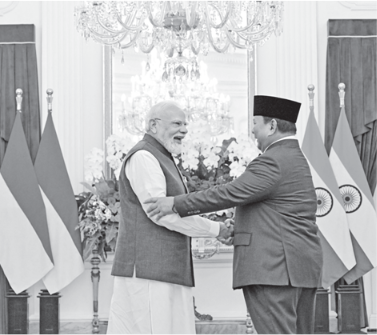
Prime Minister Narendra Modi’s state visit to Indonesia marks one of the most consequential diplomatic engagements in Bharat’s recent outreach to Southeast Asia. While critics often reduce overseas visits to ceremonial photographs and symbolic gestures, the outcomes of this visit demonstrate how strategic diplomacy quietly shapes national power for decades to come. The conferment of Indonesia’s highest civilian honour—the Bintang Adipurna—by Indonesian President Prabowo Subianto is not merely a personal recognition for Prime Minister Modi. It is a tribute to India’s growing stature in the IndoPacific and an acknowledgment of the transformation in India-Indonesia relations under his leadership. Modi dedicated the honour to the 140 crore people of Bharat, reflecting the confidence of a nation that increasingly commands respect on the global stage. Yet, the true significance of the visit lies far beyond the ceremonial award.
A partnership between two indo- pacific giants
Indonesia is no ordinary partner. It is the world’s fourth most populous nation, the largest economy in ASEAN, and home to the world’s largest Muslim majority population. More importantly, its geography places it at the heart of the Indo-Pacific maritime order. Located astride the strategically vital Strait of Malacca, Indonesia occupies one of the world’s most important maritime chokepoints through which a substantial share of global trade—and much of China’s energy imports—passes. For any nation aspiring to play a leading role in the Indo-Pacific, a close strategic partnership with Indonesia is indispensable. The delegation-level talks between Prime Minister Modi and President Prabowo reflected this understanding. Both leaders reviewed the entire spectrum of bilateral relations and expanded cooperation across defence, maritime security, trade, digital technology, health, education, agriculture, manufacturing, critical minerals, emerging technologies and cultural exchanges. The signing of multiple Memorandums of Understanding demonstrates that the relationship has moved decisively beyond goodwill into practical strategic cooperation.
Bharat emerges as a defence exporter
Perhaps the most remarkable outcome is Indonesia’s decision to procure Indian defence systems, including the Astra beyond-visual range air-to-air missile while expanding its acquisition of the Brahmos supersonic cruise missile. For decades, Bharat carried the uncomfortable distinction of being among the world’s largest importers of defence equipment. That narrative is changing rapidly. Operation Sindoor showcased the growing effectiveness of indigenous Indian weapon systems. The confidence generated by Bharat’s operational capabilities has translated into international demand. Indonesia’s decision to purchase Indian missiles reflects not diplomacy alone but confidence in Bharat’s defence technology. This development perfectly aligns with the vision of Atmanirbhar Bharat and reinforces India’s emergence as a credible defence manufacturing hub. Every defence export strengthens India’s strategic partnerships while simultaneously enhancing domestic industrial capability.
Securing the critical minerals of the future
Equally significant is the agreement on critical minerals. Indonesia possesses nearly half of the world’s nickel reserves—a resource essential for electric vehicle batteries and advanced industrial manufacturing. Until now, Chinese companies have exercised overwhelming dominance over nickel processing in Indonesia. India’s investment in nickel, steel, rare-earth magnet manufacturing and associated industries represents a strategic hedge against future supply disruptions. Recent restrictions imposed by China on rareearth exports exposed vulnerabilities in India’s manufacturing ecosystem, particularly the automobile sector. By securing longterm access to these critical resources, Bharat is reducing dependence on monopolistic supply chains while strengthening its own industrial resilience. This is geoeconomics in action—ensuring that future industries remain insulated from geopolitical coercion.
Sabang: The maritime masterstroke
Among all the agreements, the decision to jointly develop Sabang Port may prove to be the most strategically consequential. maritime domain awareness, logistics and naval cooperation. It also complements New Delhi’s broader Indo-Pacific vision based on a free, open, inclusive and rules-based maritime order.
Democratic trust beyond diplomacy
Situated near the entrance to the Strait of Malacca, Sabang occupies one of the most sensitive maritime locations in the Indo-Pacific. Combined with India’s ambitious Great Nicobar infrastructure project located nearby, Sabang provides Bharat with strategic presence at both ends of this vital maritime gateway. The Strait of Malacca carries nearly one-quarter of global maritime trade and remains indispensable for Asian energy security. Control, access and influence in this region will increasingly define the strategic balance of the Indo-Pacific. For years, China has openly acknowledged its “Malacca Dilemma”—its dependence on this vulnerable maritime passage for energy supplies. India’s growing maritime footprint through cooperation with Indonesia strengthens regional stability while enhancing Another understated but symbolically powerful outcome is India’s assistance in developing electronic voting machines suited to Indonesia’s electoral requirements. Few areas are as sensitive for any democracy as the conduct of elections. Indonesia’s willingness to seek Indian expertise reflects deep institutional trust. India’s globally respected experience in conducting elections for hundreds of millions of voters has now become an exportable democratic capability. This represents a new dimension of India’s soft power—sharing governance innovations with fellow de-mocracies.
Knowledge partnership for the future
The decision to establish a branch campus of the Indian Institute of Management (IIM) Bangalore in Jakarta represents another milestone. Educational cooperation has always been a durable pillar of long-term diplomacy. An IIM campus in Indonesia will not merely educate future business leaders but also deepen intellectual, technological and economic integration between the two countries. Such initiatives build constituencies for stronger bilateral relations that endure well beyond political cycles.
Civilisational Roots, Strategic Future
Perhaps the most inspiring aspect of the visit is that it seamlessly combines civilisational continuity with contemporary strategic cooperation. The leaders’ visit to the thousand-year-old Prambanan Temple in Yogyakarta serves as a reminder that India and Indonesia share over two millennia of cultural interaction. The Ramayana continues to be performed in Indonesia, while Garuda—the divine vehicle of Lord Vishnu—remains the country’s national emblem and the name of its national airline. These are not relics of history but living symbols of an enduring civilisational connect that predates modern nation-states. Unlike transactional diplomacy, civilisational relationships possess extraordinary resilience. They provide the cultural foundation upon which modern strategic partnerships can flourish.
Looking Beyond headlines
Infrastructure projects such as Sabang Port will take years to mature. Nickel processing facilities will require sustained investment. Defence partnerships evolve over decades. Educational institutions shape generations. None of these achievements generate instant political headlines. Yet, together they determine where Bharat will stand in 2040—in global supply chains, maritime security, defence exports, technological partnerships and regional influence. This visit demonstrates the evolution of India’s foreign policy from reactive diplomacy to long term strategic statecraft. It strengthens India’s Act East Policy, advances its Indo Pacific vision, expands economic security, reinforces defence self-reliance and revives civilisational partnerships. The world’s largest democracy and the world’s largest Muslim-majority democracy have moved significantly closer—not through rhetoric, but through concrete agreements with lasting strategic consequences. History rarely remembers diplomatic photographs. It remembers the partnerships that altered the strategic balance of regions. Prime Minister Modi’s Indonesia visit may well be remembered as one such defining moment in Bharat’s rise as a leading Indo-Pacific power.
*Shri Siddhartha Dave is an alumnus of United Nations University, Tokyo, an eminent columnist and a former Lok Sabha Research Fellow. He writes on Foreign Affairs and National Security. Author can be reached at siddhartha. dave@ gmail.com