
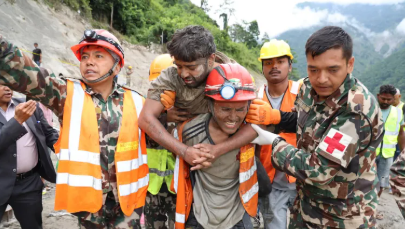
Natural disasters produce two kinds of tragedies. The first is immediate—the loss of human life, destruction of homes and communities, and displacement of survivors. The second is slower and less visible: the inability of families to determine what happened to their missing relatives. In largescale disasters, identifying the dead is not merely an administrative exercise. It is a humanitarian, legal, social and psychological necessity.
The devastating flash floods and associated landslides that struck Nepal in August 2026 have once again demonstrated the importance of forensic science in disaster management. Following the glacier-related disaster and flooding in the Rasuwa and Bhotekoshi River regions, hundreds of bodies were recovered, while thousands of people remained missing. Difficult Himalayan terrain, destroyed roads and bridges, prolonged exposure of bodies to water and mud, and decomposition have made conventional visual identification extremely difficult.
Recent reports indicate that Nepal has increasingly relied upon DNA profiling, fingerprints, photographs, dental records and systematic documentation to idenUnDersTanDing Dna profiling tify victims. The Nepal Police has specifically requested DNA samples from close relatives of missing persons. The situation provides an important case study of how DNA profiling has transformed Disaster Victim Identification (DVI). It also raises broader questions concerning forensic infrastructure, privacy, chain of custody, international cooperation, cultural practices, and the legal framework governing human remains.
The Nepal Disaster and the identification challenge
The August 26, 2026 disaster was triggered by a catastrophic glacier-related event and subsequent flooding along the Nepal-Tibet border. The resulting torrents of water, ice, mud and debris swept through settlements and infrastructure, carrying human remains considerable distances downstream. By early September, Nepal was confronting an enormous victim-identification problem. More than 1,200 deaths had been reported, while thousands remained missing. Some bodies were recovered in severely damaged condition, and in numerous cases visual identification was impossible. The problem was intensified by geography. Remote mountain areas were difficult to access, while damaged roads and bridges delayed recovery. Bodies exposed to water, heat and humidity undergo decomposition rapidly. Facial features may disappear, fingerprints may become unusable, and clothing or personal belongings can be separated from the body. In such circumstances, the traditional question—”Who is this person?”—cannot always be answered by looking at the body. DNA can provide the answer.
Understanding DNA Profiling
DNA, or deoxyribonucleic acid, contains genetic information that is inherited from biological parents. Except in identical twins, an individual’s DNA profile is sufficiently distinctive to provide a powerful means of identification. Forensic DNA profiling does not ordinarily require sequencing a person’s entire genome. Instead, forensic laboratories examine selected genetic markers that are highly variable among individuals. In disaster situations, DNA can be recovered from tissue, bone, teeth, blood or other biological material. Even when a body is badly damaged, certain biological materials may preserve genetic information.
DNA as a Tool of Disaster Victim Identification
International disaster victim identification generally involves four broad stages: examination of the disaster scene, post-mortem examination, collection of ante-mortem information, and reconciliation of the information. Forensic experts collect biological samples from recovered remains. Each sample must be carefully labelled, preserved and linked to the corresponding remains. DNA from relatives provides a reference profile against which unidentified remains can be compared. The relationship between the victim and reference donor is important. A parent-child relationship, for example, provides a strong basis for establishing biological identity. Sibling comparisons can also be useful when closer relatives are unavailable. Nepal’s current procedure reflects this hierarchy by prioritising first-degree relatives and permitting sibling samples when necessary.
DNA and the Nepal police response
The Nepal Police has taken a systematic approach to DNA-based identification. Its official notice calls upon relatives of missing Nepalese and foreign nationals to provide blood samples for DNA testing. First-degree relatives are preferred, followed by siblings where necessary. Relatives living outside Nepal have also been given a mechanism to obtain DNA profiles locally and send them to Nepal Police for comparison.
This is significant for two reasons. First, it recognises that victim identification is not confined to the geographical location of the disaster. Second, it creates an international framework for identifying foreign nationals whose families may be located thousands of kilometres away. The Indian Embassy in Kathmandu has likewise published procedures concerning identification and release of mortal remains of foreign nationals.
These include documentation, photographs, post-mortem examination, formal identification, fingerprint/DNA sampling, verification of identity documents and coordination with diplomatic authorities. Thus, DNA profiling forms part of a larger forensic and administrative chain rather than operating as an isolated laboratory technique.
DNA profiling and human dignity
The importance of DNA profiling extends beyond scientific accuracy. Every unidentified body represents a family that may be living with uncertainty. For relatives, knowing that a loved one has died is devastating, but uncertainty can be psychologically more complex. Families cannot make funeral arrangements, settle inheritance matters, obtain death certificates or complete other legal processes without reliable identification. Identification provides:
• dignity to the deceased;
• certainty to families;
• legal recognition of death;
• opportunities for repatriation;
• culturally appropriate funeral rites;
• assistance in inheritance and insurance matters;
• closure for relatives.
The humanitarian dimension of DNA profiling was particularly visible in Nepal as families gathered at identification centres and hospitals searching for information about missing relatives.
Implications for India
The Nepal disaster also has direct implications for India. India and Nepal share a long border and extensive social, cultural and economic connections. Indian nationals regularly travel to Nepal for tourism, employment, pilgrimage, trekking and business. Consequently, a major disaster in Nepal can quickly become a cross-border forensic and humanitarian challenge. India should therefore strengthen mechanisms for:
• rapid DNA sampling of relatives;
• cross-border forensic cooperation;
• secure transmission of DNA profiles;
• embassy coordination;
• repatriation of mortal remains;
• identification assistance through Indian forensic laboratories.
Recent Indian assistance in Nepal demonstrates the value of regional cooperation during large-scale disasters. Reuters reported that forensic teams from India were involved in assisting Nepal’s response. The broader lesson is that disaster preparedness should not stop at national borders.
From crisis response to forensic reform
The most important lesson from Nepal is that forensic capacity cannot be created after a disaster has already occurred. A modern disaster-management policy must incorporate forensic preparedness before a catastrophe. This means developing:
1. national DVI protocols;
2. trained forensic personnel;
3. mobile forensic laboratories;
4. DNA collection kits;
5. refrigerated body-storage capacity;
6. digital identification systems;
7. secure databases;
8. cross-border cooperation agreements;
9. public communication mechanisms;
10. legal safeguards for genetic information.
Such preparedness transforms forensic science from an emergency reaction into an institutional component of disaster governance.
Future Prospects
The Nepal disaster of 2026 has demonstrated the indispensable role of DNA profiling in modern disaster victim identification. When floods, landslides and glacier-related catastrophes destroy infrastructure and severely damage human remains, visual identification may become impossible. DNA can provide a scientific bridge between unidentified remains and families desperately seeking answers.
Nepal’s decision to collect DNA samples from relatives and preserve forensic information before or alongside emergency burial represents an important step toward systematic victim identification. Yet DNA is not a magic solution. Its effectiveness depends upon trained personnel, laboratories, proper sample collection, chain-ofcustody procedures, reliable ante-mortem information, international cooperation and legal safeguards. The experience also reinforces a fundamental principle: the dead do not lose their dignity because they cannot be immediately identified. Every unidentified body deserves careful documentation and every family deserves a scientifically credible opportunity to know what happened to its loved one. DNA profiling provides one of the strongest tools available to achieve that objective. For Nepal, the present crisis should therefore become more than an emergency response.
It should become a catalyst for building a permanent, internationally compatible disaster victim identification system. For India and other Himalayan countries, it is a reminder that climate-related disasters, mass casualties and cross-border movement require forensic cooperation as much as they require rescue and relief. Ultimately, the value of DNA profiling in disaster management lies not merely in its scientific precision. It restores names to the nameless, identities to the unidentified, and certainty to families living in the painful shadow of disaster.
*Dr. S.Krishnan is an Acadamician and an Experienced Journalist based in Jaipur.
*Ms. Kumkum is a 3rd Year Student of BBALLB (H) in Seedling School of Law and Governance, Jaipur National University, Jaipur.
*Mr. Nagendra is a 3rd Year Student of BBALLB (H) in Seedling School of Law and Governance, Jaipur National University, Jaipur.