
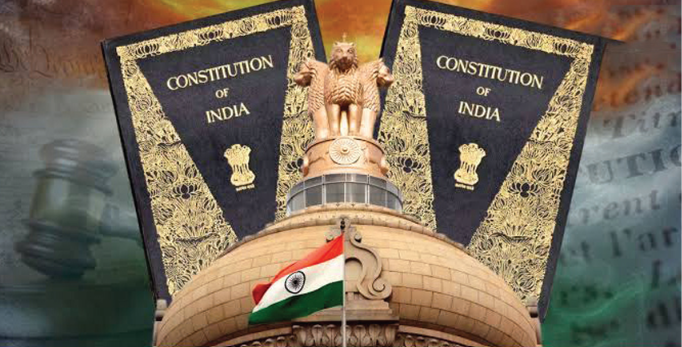
As India marks Constitution Day on November 26, the 11 Fundamental Duties in Article 51A deserve to be read not as a list in Part IVA, but as everyday habits, our kartavya, that help rights work for everyone.
Rights and duties are the two sides of the same coin, meaning no right exists without a corresponding duty. Rights can be defined as interests that are protected by the state, whereas duties refer to obligations of citizens towards the state as well as towards others. The Constitution recognises rights in Part III, under the heading of Fundamental Rights, and duties in Part IVA, under the heading of Fundamental Duties.
The duties were added through the 42nd Amendment in 1976, on the recommendation of the Swaran Singh Committee. The committee proposed eight duties, but the final Amendment included ten, drawing on the constitutions of other countries, including the former Soviet Union. The committee also proposed making the duties enforceable, but Parliament did not accept this recommendation.
The eleventh duty was added by the 86th Constitutional Amendment in 2002, on the suggestion of the Saikia Committee. The same amendment made free elementary education a fundamental right under Article 21A and asked parents and guardians to provide educational opportunities to children between six and fourteen. The purpose of these duties was to make citizens aware of their obligations to the nation and to one another.
What the courts have said
The Supreme Court has engaged with the idea of civic duty for decades. It discussed the duties that citizens owe to the State in Chandra Bhavan Boarding and Lodging v. State of Mysore (1969), well before Parliament added them to the Constitution. In Balaji Raghavan v. Union of India (1995), it held that conferring national awards does not violate equality, as such honours are recognised under Article 51A(j), which calls for the pursuit of excellence. In the landmark M.C. Mehta cases, the courts invoked the duty to protect the environment.
In M.C. Mehta v. Kamal Nath (2000), the Supreme Court read Article 51A(g) together with Article 21 to hold that protecting the environment is the duty of every citizen. In Ranganath Mishra v. Union of India (2003), it asked the Union government to consider seriously the Justice J.S. Verma Committee’s recommendations on spreading awareness of these duties. And in AIIMS Students’ Union v. AIIMS (2001), the court held that fundamental duties, though not enforceable by courts, offer valuable guidance in interpreting constitutional and legal questions. Some legal minds go further.
Senior advocate Fali S. Nariman, in his book You Must Know Your Constitution, suggests that fundamental duties could be enforced through civil suits under Section 9 of the Code of Civil Procedure, 1908, relying on the Supreme Court’s observation in Ganga Bai v. Vijay Kumar (1974) that “a suit for its maintainability requires no authority of law, and it is enough that no statute bars the suit”. These judgments show that the Supreme Court has consistently treated the duties as an important part of the constitutional scheme, and Parliament, too, has enacted many laws that give them effect.
From the courtroom to the classroom
The larger question is how the duties shape the conduct of ordinary citizens. In September 2024, while hearing a public interest petition seeking laws to enforce the duties, the Supreme Court observed that it cannot direct Parliament or State legislatures to enact such laws.
Attorney General R. Venkataramani described their implementation as “a continuing task”. In other words, duties will take root less through courtrooms than through classrooms, campaigns and community life. That is already happening. Take the duty to protect the environment under Article 51A(g). India’s forest and tree cover now stands at 25.17 per cent of its geographical area, according to the India State of Forest Report 2023, up by 1,445 sq km since 2021.
In Swachh Survekshan 2024-25, the Union government’s cleanliness survey, about 14 crore citizens took part across more than 4,500 cities. Young people are at the centre of this effort: some 39 lakh students serve as National Service Scheme volunteers, and the National Cadet Corps, with about 17 lakh cadets, plans to grow to 20 lakh. Civic participation shows the same spirit. Voting is not one of the 11 duties, though the Verma Committee had recommended adding it.
In the 2024 Lok Sabha elections, 64.2 crore people cast their votes. On Constitution Day 2025, Prime Minister Narendra Modi urged citizens to give greater importance to their constitutional duties.
Turning good Will into habit
These figures show goodwill on a vast scale. Yet campaigns tend to rise and fall with the calendar. The Verma Committee, set up in 1998, found that many laws already give effect to the duties, from the Protection of Civil Rights Act, 1955 to the Wildlife (Protection) Act, 1972, and stressed that public office holders should lead by example.
Since November 26 was notified as Constitution Day in 2015, and especially through the Ministry of Law and Justice’s 2019 nationwide campaign on Fundamental Duties, the Union government has worked to build this awareness. Four practical steps could take that effort further.
First, duties can be taught through action rather than memorisation. Schools and colleges could link each duty to a simple activity, such as a cleanliness drive, a visit to a heritage site or a science fair, with a shared promise As Mahatma Gandhi wrote in 1947 to Julian Huxley, then Director-General of UNESCO, “I learnt from my illiterate but wise mother that all rights to be deserved and preserved came from duty well done.” The Constitution gives every Indian rights that are protected by law.
The Fundamental Duties remind citizens that these rights are best protected in a society where people also respect one another, the environment and the nation’s shared heritage. As India works towards Viksit Bharat by 2047, the strength of its democracy will depend not only on what the State does for citizens, but also on what citizens do for one another.
This Constitution Day is a good moment to treat duties not as a burden, but as the everyday practice of citizenship. NSS and NCC units leading the way. Second, the duty under Article 51A(k) could be made more visible. Panchayats and school management committees could remind families of it at the start of each academic year, alongside the child’s right to education under Article 21A.
Third, public institutions can set the tone. Government offices, universities and local bodies could display the 11 duties in Indian languages and report each year on what they have done to promote them. Fourth, India could measure what it values. A periodic survey of how well citizens know and practise their duties, conducted with universities, would show which duties need more attention.
*Komal Karwa is a public policy researcher associated with the Policy, Politics and Governance Foundation (PPGF) and South Asia Monitor. An appointed UGC NEP SAARTHI Ambassador and former Lok Sabha legislative researcher, she is currently a postgraduate scholar in Political Science. Pranav Bajaj is currently a postgraduate student in the Master of Laws (LLM) programme at the Tata Institute of Social Sciences (TISS), Mumbai.