
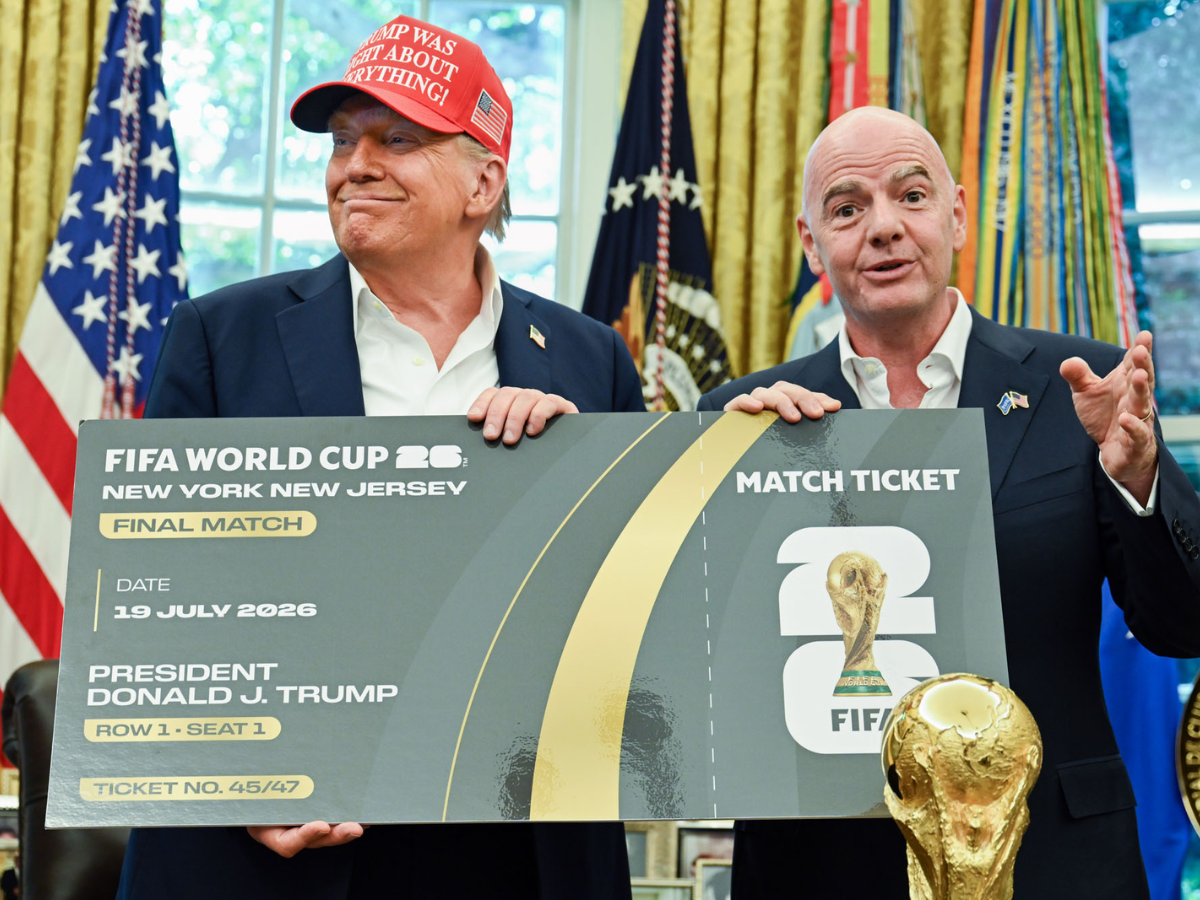
US President Donald Trump has suggested that the matches of the 2026 FIFA World Cup, scheduled in Seattle, could be shifted to another host city if his administration believes there is any security risk. He criticised Seattle’s newly elected mayor Katie Wilson, labeling her a “very liberal/communist mayor,” and said some cities may not be “safe enough” to host such international sports.
Trump said that if there is “any sign of trouble,” he would ask that the matches be shifted elsewhere. He further said the US has “many cities that are number one” and capable of holding the event without any risk.
Why is Seattle targeted in Trump’s Remarks?
Seattle will be hosting six matches in the 2026 World Cup, including high-profile matches, but Trump has long targeted those American cities that he views as having weak law enforcement or liberal governance.
In the most recent statement, he directly connected his concerns to ideology, calling Seattle’s administration too “extreme” and hinting that the city might fail to guarantee the level of security an event of global magnitude would need.
Can Trump Actually Move World Cup Matches From Seattle?
But despite his remarks, the President has no unilateral power to shift World Cup matches. Decisions on venue are bound by FIFA’s hosting contract, agreements with local organizing committees, and months of logistical planning and infrastructure commitments.
Any change will result in immense coordination, approvals, financial recalculations, and operational re-designing. Such a decision traditionally comes from FIFA and not the political leadership.
How Has FIFA Reacted to the Possibility of Venue Changes?
FIFA has said it retains the right to all security and operational decisions. While Trump has said publicly that he believes the event can be safely staged across multiple American cities, FIFA’s leadership has said match locations were selected after extensive feasibility studies, infrastructure reviews, and city bids.
Internal discussions have suggested that overturning those selections would be highly impractical, especially given the scale of the 2026 World Cup-the first to feature 48 teams and the first to be co-hosted by three countries.
What Is Seattle’s Response to Trump’s Comments?
Seattle city officials have dismissed the notion that matches would be moved, citing the city’s extensive preparations, security coordination, and declining crime statistics.
The local organising committee has expressed confidence in hosting a successful tournament, pointing to strong community support, stadium readiness, and robust planning with federal and state agencies.
Could this affect wider FIFA World Cup 2026 Planning?
Any attempt to move matches around would lead to serious logistical and financial problems, given that host cities have made very substantial investments in preparations and infrastructure, and have planned extensively for hospitality.
Relocation of games might also include diplomatic tensions between organizers of events and government bodies on issues related to political interference in international sporting events.
Is It Likely That FIFA World Cup 2026 Matches Will Be Moved?
For all the headlines generated by Trump’s statements, experts widely believe that this is unlikely: the contractual and operational – let alone financial – barriers are enormous, and the tournament is deep into planning phases.
Nevertheless, Trump’s comments underscore the increasing connections between sport, security, and politics, raising new questions over how much influence political leaders should have over major world events.