
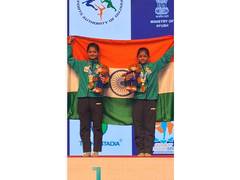
Ahmedabad (Gujarat) [India], June 12 (ANI): India’s dominance at the inaugural World Yogasana Championships here this week eloquently reflected in the medal tally, but perhaps the most encouraging takeaway for the host nation was a clutch of ‘kids’ who have the potential to keep the tri-colour fluttering for years to come. Meet the would-be Gen Z of Indian yogasana.
While India finished the world championships with a staggering 102 gold medals, nearly half of them came from the country’s youngest competitors. India’s junior and sub-junior athletes contributed 46 gold medals, underlining the strength of the grassroots yogasana ecosystem, according to a release.
Fronting the face of future India were 14-year-old Ishika Guchhait of Delhi and 12-year-old Sanwita Banerjee of Durgapur (West Bengal), whose gold-medal-winning performance in the sub-Junior girls’ rhythmic pair event caught the attention of many.
Competing against athletes from other 78 countries, the young duo displayed a level of composure, synchronisation and technical excellence that belied their age. Their success was not merely another medal for India. It was evidence of a strong talent pipeline that could keep the country at the forefront of the sport for years to come.
For Jaideep Arya, Secretary General of World Yogasana and Yogasana Bharat, the performances of India’s junior athletes were among the most significant outcomes of the championship.
“The performance of India’s junior and sub-junior athletes at the inaugural World Yogasana Championship in Ahmedabad is truly inspiring. Winning 46 gold medals out of India’s total 102 gold medals not only demonstrate exceptional talent and dedication, but it also reflects the strong foundation that has been built for yogasana sport in this country,” Arya said.
“What is most encouraging is that these achievements have come from our youngest athletes. Their success reflects the effectiveness of our grassroots development and coaching systems and the growing acceptance of Yogasana as a competitive sport.”
In a discipline where precision, flexibility, strength and artistic expression must come together seamlessly, Ishika and Sanwita performed with remarkable confidence on the biggest stage of their young careers. Their journey to world championship glory, however, began far away from the arc lights at the EKA Arena in Ahmedabad.
For Ishika, yoga was first introduced at home. Her family originally hails from Midnapore district in West Bengal before settling in Delhi. Her father earns a livelihood selling paan leaves, while her mother conducts yoga classes. It was her mother who first encouraged her to take up yoga at the age of nine.
What started as a routine activity soon developed into a passion. During the COVID-19 pandemic, when most children spent their days indoors, Ishika used the time to sharpen her skills, improve her flexibility and master increasingly difficult postures.
Slowly, a dream began to take shape — representing India and winning medals at the highest level. That dream became reality in Ahmedabad.
Sanwita’s path into yogasana was different.
Growing up in Durgapur, she was initially drawn to the activities happening around her. Her mother enrolled her in dance classes, while her elder sister trained in gymnastics. Watching her sister perform difficult movements sparked her curiosity and introduced her to the possibilities of flexibility-based sports.
Soon, she realised she had a natural aptitude for yoga. “I enjoyed doing yoga because I felt I was good at it,” Sanwita said. Today, she balances school, yogasana training and badminton, another sport she enjoys.
Despite coming from different backgrounds and different states, the two youngsters found common ground through their dedication to the sport.
In rhythmic pair competition, individual brilliance alone is not enough. Every posture, movement and transition must be perfectly synchronised. Success depends on trust, coordination and countless hours of practice together.
That preparation paid off when they stepped onto the competition floor in Ahmedabad. Against some of the best young yogasana athletes from around the world, Ishika and Sanwita delivered a performance that combined technical precision with artistic harmony, earning them the gold medal and a place in the history books as among the first world champions in the sport.
Away from competition, however, they remain typical schoolgirls navigating homework, classes and family life alongside demanding training schedules. What sets them apart is their commitment to excellence at such a young age.
Both have ambitious goals for the future. Ishika hopes to continue winning medals for India and dreams of standing on the podium at major multi-sport events if yogasana becomes part of them. Sanwita is equally determined to improve and represent the country on bigger stages in the years ahead.
Their success reflects a broader trend visible throughout the championships.
Across multiple categories, young Indian athletes demonstrated exceptional talent and depth, underlining the strength of the country’s grassroots yogasana ecosystem. Coaches and officials believe that the emergence of athletes like Ishika and Sanwita is the result of years of work at the school and academy levels, where children are being introduced to the sport at an increasingly early age.
Arya believes this pipeline of talent will be India’s biggest strength as yogasana continues its push for wider global recognition.
“These young champions are the future ambassadors of yogasana, and their performances give us confidence that India will continue to lead the world in this discipline for many years to come,” Arya said.
The inaugural world yogasana championships itself highlighted how rapidly the sport is expanding internationally, with athletes from 79 countries participating in Ahmedabad. Yet even amid growing global competition, India’s next generation showed why the country remains the benchmark in yogasana.
As yogasana moves towards greater international recognition and seeks inclusion in major multi-sport events, nurturing young talent will become increasingly important.
“As we move forward towards greater international recognition, including participation in major multi-sport events, these athletes represent India’s strongest asset. Their discipline, commitment and excellence on the world stage reaffirm that the future of Indian yogasana sport is indeed in safe hands,” Arya added.
For Indian yogasana, that may be the most significant victory of all.
Medals can be won and lost, but sustained success depends on a constant supply of new talent. The performances of Ishika, Sanwita and several other young athletes in Ahmedabad suggest that India has no shortage of future champions waiting in the wings. (ANI)
(The article has been published through a syndicated feed. Except for the headline, the content has been published verbatim. Liability lies with original publisher.)