
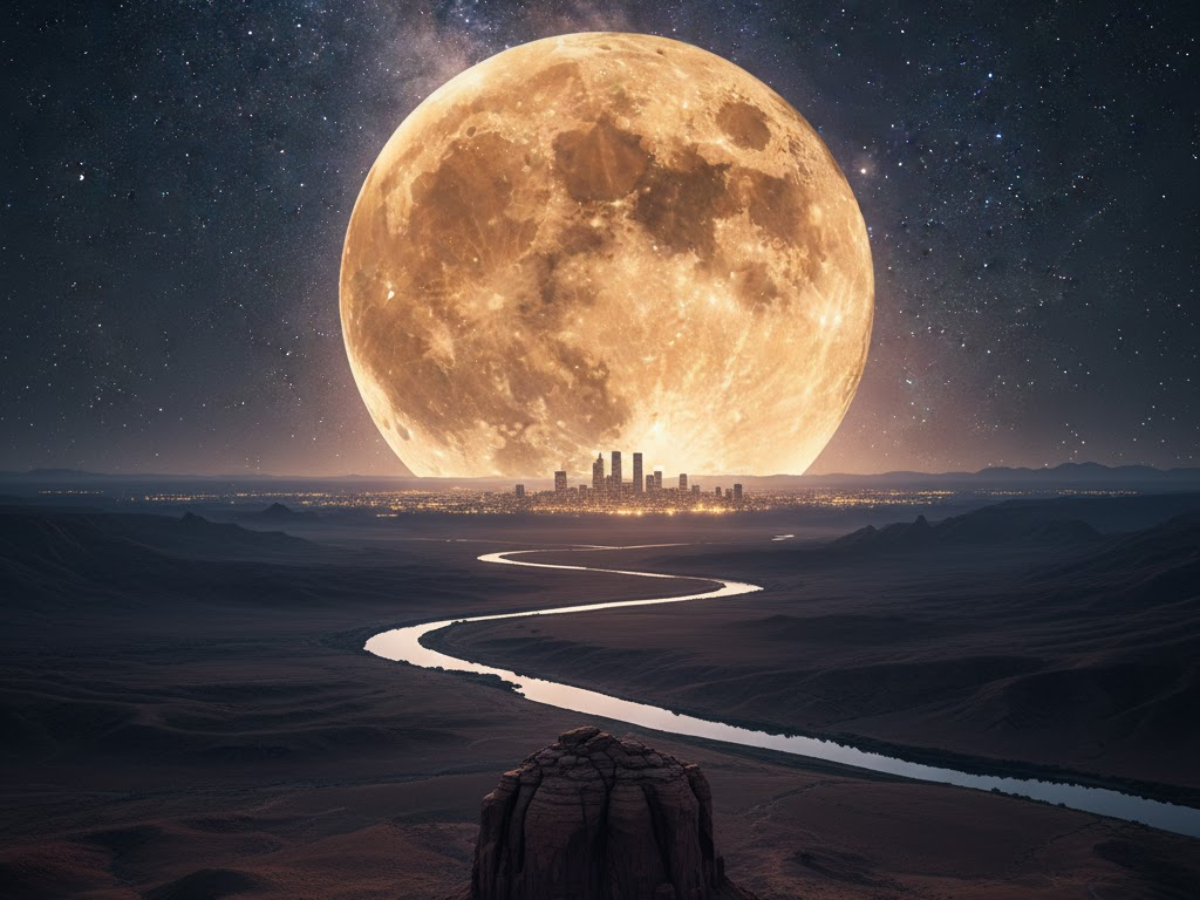
Supermoon 2026: It opens with a spectacular celestial alignment with the year’s first full moon will coincide with Earth’s closest approach to the sun, known as perihelion, on January 2–3. This rare overlap of Earth, Moon and Sun has not occurred since 1912. Skywatchers will witness an unusually bright and prominent moon to kick off the new year, a phenomenon that promises both beauty and fascination.
What is a Supermoon?
A supermoon occurs when the moon is either full or new and also happens to be at its closest point to Earth in its orbit called perigee. Full moons appear when the moon is opposite the sun in its orbit, while new moons occur when it lies between Earth and the Sun. When either of these aligns with perigee, the moon looks larger and brighter than a supermoon by popular terminology.
Where Did the Term Supermoon Originate?
The term supermoon was coined in 1979 by astrologer Richard Nolle and he defined it as a full or new moon that occurs within 90% of its closest approach to Earth. Astronomers like Fred Espenak have since refined these calculations to track changes in the moon’s orbit, providing precise supermoon predictions each year.
What Makes a Supermoon Super
Supermoons appear up to 14% larger than the smallest full moons or micromoons and up to 16% brighter than average full moons. Though subtle, this difference can be noticeable even to casual observers when comparing a supermoon to the faintest full moons of the year. The closest full supermoon of 2026, on December 24, will be the largest and brightest of the year.
Full Supermoons of 2026
| Moon Name | Date | Moon Distance (miles) | Moon Distance (km) |
|---|---|---|---|
| Wolf Moon | January 3 | 225,130 | 362,312 |
| Beaver Moon | November 24 | 224,170 | 360,768 |
| Cold Moon | December 24 | 221,667 | 356,740 |
On 22 January, 2027 the moon distance with 222,229 miles and 357,644 km.
ALSO READ: What is the Wolf Supermoon? Everything You Need to Know About 2026’s First Full Moon
New Supermoons of 2026
| Date | Moon Distance (miles) | Moon Distance (km) |
|---|---|---|
| April 17 | 226,299 | 364,194 |
| May 16 | 222,819 | 358,594 |
| June 15 | 221,966 | 357,221 |
| July 14 | 223,789 | 360,154 |
| August 12 | 228,017 | 366,958 |
On August 12 supermoon causes total solar eclipse.
Is a Supermoon Brighter?
A supermoon can appear 8% larger and 16% brighter than an average full moon. When compared to a micromoon, the difference in size reaches 14%, and brightness can be up to 30% higher. These variations make supermoons particularly striking in the night sky, offering a vivid spectacle for skywatchers.
How Often Do We Have a Supermoon?
Supermoons are relatively common, though their exact definition varies:
| Year | Full Supermoon | Distance (miles) | Distance (km) |
|---|---|---|---|
| 2017 | December 3 | 222,443 | 357,987 |
| 2018 | January 2 | 221,583 | 356,603 |
| 2019 | February 19 | 221,734 | 356,846 |
| 2020 | April 8 | 221,851 | 357,035 |
| 2021 | May 26 | 222,117 | 357,463 |
| 2022 | July 13 | 222,089 | 357,418 |
| 2023 | August 31 | 222,043 | 357,344 |
| 2024 | October 17 | 222,056 | 357,364 |
| 2025 | November 5 | 221,817 | 356,980 |
| 2026 | December 24 | 221,668 | 356,740 |
| 2027 | January 22 | 222,229 | 357,644 |
What is Supermoon Tides?
High tides during full or new moons are called spring tides when the moon is at perigee during these phases, it produces extra-high tides, sometimes called perigean spring tides, king tides or supermoon tides. These tides can be influenced by local geography and weather but are generally only slightly stronger around 4% more gravitational pull than a typical full moon.
What are Micromoons?
Micromoons are the opposite of supermoons, occurring when the moon is at its farthest distance from Earth or apogee. Full micromoons appear 12–14% smaller than full supermoons and slightly dimmer. In 2026, full micromoons will occur on May 1, May 31 and June 29, with the May 31 moon being the most distant. A new micromoon will occur on December 9.
ALSO READ: Astronomy Calendar 2026: When to See Supermoons, Meteor Showers Solar & Lunar Eclipse
Disclaimer: All lunar data are based on astronomical predictions and distances; viewing conditions may vary due to weather or geographic location.