
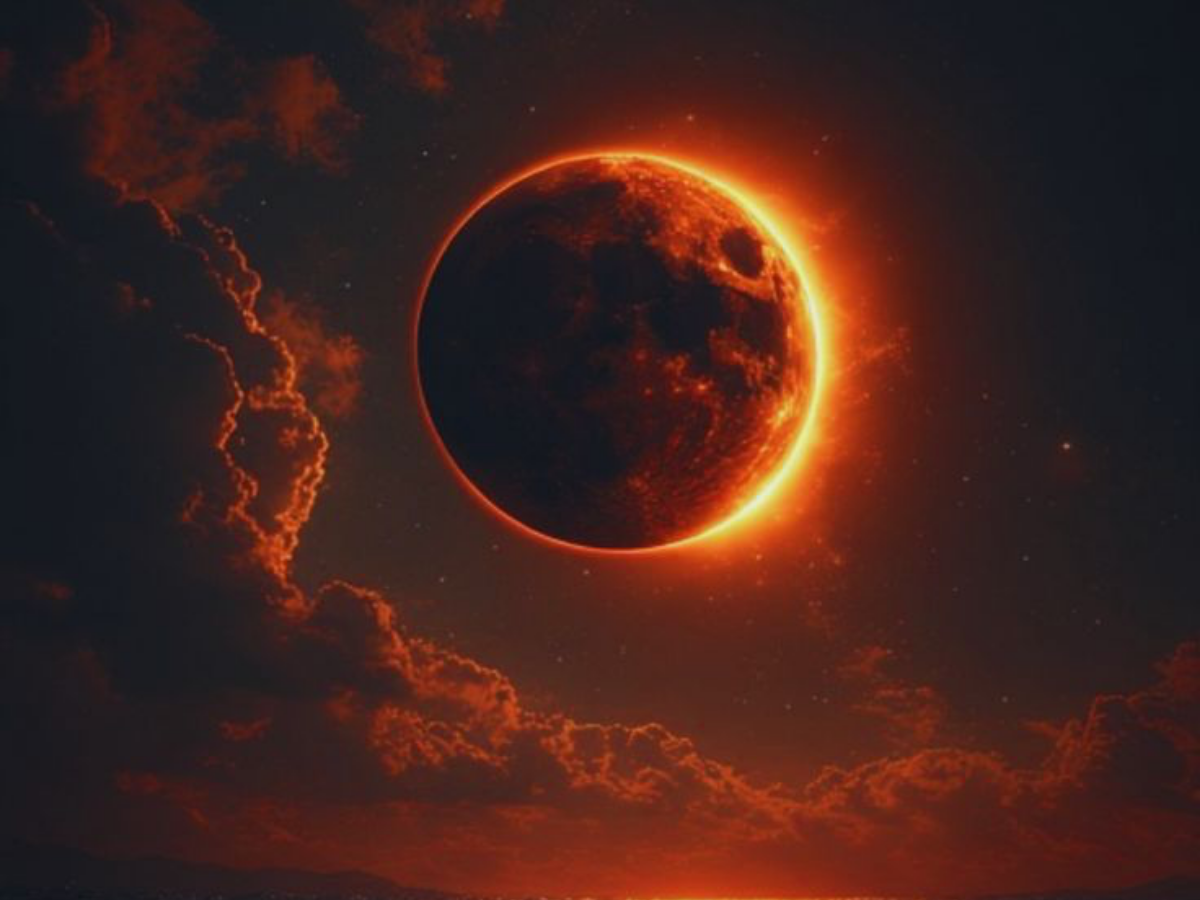
Lunar Eclipse 2026: In the year 2026 the Moon moves into the Earth’s shadow not once but twice with contrary to the mere occurrence of Solar Eclipse and the lunar Eclipse is an occurrence that takes place slowly.
What is a Lunar Eclipse
Lunar Eclipse is also known as Chandra Grahan, the Earth casts its shadow between the Sun and Moon when the Sun’s rays pass through the Earth’s atmosphere and they project layered with shadows on the Moon’s surface. It is based on their positions the moon gets partially eclipsed or turns into copper.
Lunar Eclipse 2026 Dates
| Date | Type | Timing (EST) |
| 3 MARCH, 2026 | Total | 03:44 AM – 09:23 AM |
| 27 – 28 MARCH, 2026 | Partial | 09:22 PM – 03:03 AM |
Lunar Eclipse 2026: Total Eclipse Timings
On March 3, when the Moon enters to the penumbral shadow of Earth at 3:44 am EST then progressively, Moon becomes engulfed in the umbral shadow, causing it to appear with a reddish tint and resulting from sunlight scatters in Earth’s atmosphere. The event ends at 9:23 am EST in the regions of Asia, Australia, Pacific, America and North America.
Lunar Eclipse 2026: Partial Eclipse Timings
The second eclipse will take place as the Moon makes contact with the penumbra at 9:22 pm EST on 27 August. Entering the umbra happens at 10:33 pm which will cause the Moon to form a dark spot as it makes contact with the umbra.
The event will come to an end at 3:03 am on 28 August in different places around the globe as America, Europe, Africa and Western Asia will witness the phases of the eclipse in their local times.
How to Watch Lunar Eclipse Safely
- Using Binoculars also known as small telescope which enhances details and colour transitions shifts
- Select a site that has a clear horizon and light pollution correction needed
- Check local timings as phases may vary by region
- Photography can be achieved by the common gear and stabilizer assistance
- No protective glasses or filters are required
- Lunar Eclipse are completely safe to view with the naked eye
Will the Next Lunar Eclipse be Visible in India
The total lunar eclipse on 3 March, 2026 will remain partially visible in certain parts of India and the partial lunar eclipse on August 2026 will not be visible in India.
Lunar Eclipse 2026: Will the Moon Turn Red?
When the total lunar eclipse arrives in 2026, the Moon will not disappear into darkness, it will glow in shades of red and copper, earning its familiar nickname as the blood moon.
This color change is not rare or ominous it happens because Earth slips directly between the Sun and the Moon then sunlight passes through our atmosphere before reaching the lunar surface. Blue light scatters away, while red and orange wavelengths bend and land softly on the Moon while the result is a deep, rust-colored glow.
The exact shade will depend on Earth’s atmosphere at the time. Dust, pollution or volcanic particles can make the Moon appear darker or brighter red. But the effect itself is predictable and well understood.
ALSO READ: September 2025 Eclipse: What to Know About the Rare Lunar and Solar Eclipses Coming