
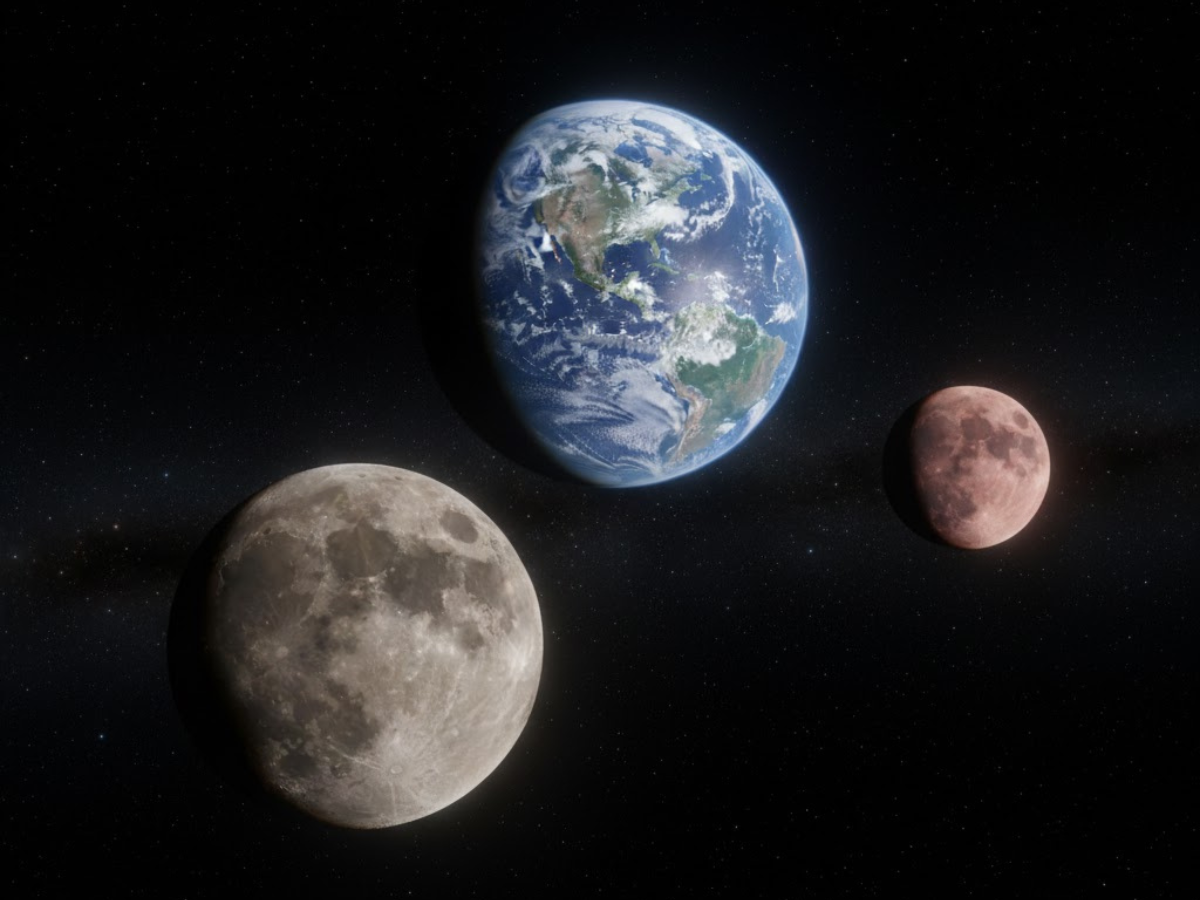
A new finding for skywatchers and space scientists is that astronomers have confirmed Earth shares its orbit with a small rock in space named 2025 PN7, this celestial visitor is not actually our second moon in the conventional sense but it behaves closely enough to earn the title quasi-moon.
Detected at the University of Hawaii’s Pan-STARRS observatory and officially announced in August 2025, this asteroid has orbited with Earth since the 1960s undetected until now.
What is Earth’s New Quasi-Moon?
Contrary to the general definition of moons, quasi-moons are asteroids that glide around the Sun in a synchronized orbit with the Earth. Even though they do not technically orbit our planet directly like the Moon their paths are highly intertwined with those of Earth roaming around the solar system.
ALSO READ: Orionid Meteor Shower 2025: When & Where to Watch Halley’s Comet Debris
An asteroid having a size of about 19 m (62 feet) almost the same as a city bus is briefly described as 2025 PN7. The tiny celestial body being faintly visible and only recently discovered, has stirred world curiosity due to its stable association with Earth.
2025 PN7: Earth’s Second Moon?
While not gravitationally bound like the Moon, 2025 PN7 closely mirrors the Earth’s orbit, to the point that it appears to closely accompany us through space.
It is a faint shadow trailing our planet in a gravitational dance and researchers are confirming that it has been orbiting near Earth for decades and, if not disturbed will do so until 2083 when it will very slowly fade away and disappear into deep space.
ALSO READ: Will Aliens Arrive on October 29? Scientists Decode 3I/ATLAS
How Long Will It Stay with Earth?
According to NASA estimates, this asteroid will be around our planet in a quasi-stable orbit for almost six more decades. After 2083, 2025 PN7 will probably move away from Earth’s orbit and continue its solitary ways around the Sun. This discovery helps the scientists understand the mechanics of the orbit and all the other hidden bodies that are silently drifting through our solar system.
Other Quasi-Moons Over Time
Earth has not had an asteroid friend for the first time here historically, some quasi-moons have been identified by astronomers, namely 469219 Kamo‘oalewa, 2006 FV35 and 2023 FW13. It is also speculated that one such object may be a chunk that broke off from our real Moon. None of these are permanent features but they do give a rare and interesting snapshot of Earth’s ever-changing cosmic environment.
ALSO READ: What is a Quasi-Moon & Why is 2023 FW13 Silently Orbiting Earth?
Disclaimer: This article is for informational purposes only. Astronomical data is subject to updates by NASA and other official scientific institutions.