
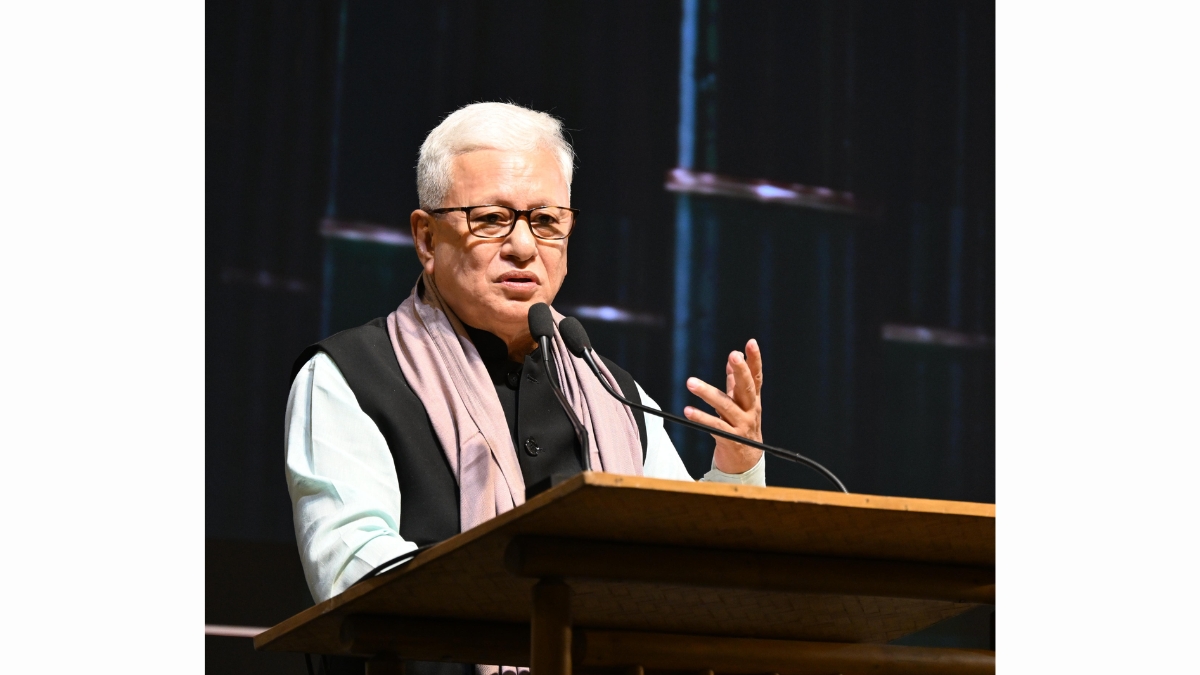
Maharashtra Governor Jishnu Dev Varma addresses the inaugural session of the Bamboo Economy & Sustainability Summit 2026 at The Westin Mumbai Powai Lake on Sunday.
Mumbai (Maharashtra) [India], September 28: Maharashtra Governor Jishnu Dev Varma on Sunday called for a bamboo-based economy that could create rural jobs, replace plastic, and help fight climate change. He warned that “today’s development should not be tomorrow’s danger.”
Varma was inaugurating the Bamboo Economy & Sustainability Summit 2026, held at The Westin Mumbai Powai Lake to mark World Bamboo Day. Over the day, farmers, farm leaders, industrialists, researchers, artisans, and policymakers from 13 states debated how bamboo could move from the margins of rural life into the mainstream economy. The Summit closed in the evening with an address by Rajasthan Governor Haribhau Bagde.
The Summit was jointly organised by The Phoenix Foundation, Latur, Tefla’s, Mumbai, and MITRA. Its driving force is Pasha Patel, known as the Bamboo Man of India. He is Chairman of the Maharashtra State Agricultural Price Commission and Executive Chairman of the Chief Minister’s Environment and Sustainable Development Task Force.
Present at the Inaugural Session
Present at the inaugural session were Horticulture, Employment Guarantee Scheme, and Khar Land Development Minister Bharat Sheth Gogawale, former Gujarat minister Bhupendrasinh Chudasama, KP Group founder-chairman Dr. Faruk Patel, Maulana Huzaifa Vastanvi, and Tefla’s Managing Director Adil Singh.
Governor Tours Exhibition First
Before taking the stage, Varma spent about 20 minutes at the exhibition of bamboo products set up at the venue. The stalls displayed engineered bamboo wood, bamboo fabric and shawls, cups, utensils, jewellery, and a range of plastic substitutes. At the stall of Bengaluru-based Mahadev Chikkanna, the Governor asked where the machinery was made and expressed interest in setting up a similar unit in his home state of Tripura.
“Plant bamboo, use bamboo, commercialise bamboo. It will strengthen the economy, generate jobs, protect the environment, and save the earth,” Varma said in his inaugural address. “Single-use plastic surrounds us from morning till night. We begin our day with a plastic toothbrush. The only viable replacement is bamboo.”
He said more research was needed to make bamboo products cheaper and more durable. Maharashtra could learn from Tripura, he said: districts like Gadchiroli could build a strong bamboo value chain that supports farmers and forest communities.

Pasha Patel speaks at the Summit as Governor Jishnu Dev Varma, Minister Bharat Sheth Gogawale and Dr Faruk Patel look on.
‘Farmers Are Like Bamboo’
Gogawale urged farmers to take up bamboo as a hedge against erratic weather. “When a storm comes, bamboo bends but does not break. The farmers of Maharashtra are just like bamboo. Whether it is drought, excessive rainfall, or landslides, they have bent under pressure but have never broken,” he said.
The minister said farmers planting bamboo can get assistance of up to Rs 7.5 lakh per hectare over three years under the Employment Guarantee Scheme, and once planted, bamboo yields income for 30 to 40 years. He said the state’s Bamboo Industry Policy, approved in October 2025, aims to attract Rs 50,000 crore in investment, create more than five lakh jobs, and set up 15 bamboo clusters. A large plantation project with the Asian Development Bank is also taking shape, he added.
Pasha Patel said the world must move from fossil fuels to biofuels. “Carbon in the air has crossed 430 ppm. The day it touches 450 ppm, human survival will be in danger. Instead of pulling energy out of the belly of the earth, we must produce it from its surface. The farmer who has been our annadata must now become our urjadata,” he said. Peepal and banyan trees take 50 years to mature, he pointed out, and only bamboo can take the country to 33 per cent green cover quickly.
Dr. Faruk Patel said the earth “is on loan to us from the next generation” and must be returned in good shape. He announced an annual KP Group award for sustainability in the bamboo sector.
Technical Sessions
The afternoon technical sessions worked through the pillars of Maharashtra’s Bamboo Industry Policy: bamboo wood, bamboo textiles, bamboo energy, and carbon credits.
Speakers noted that India imports timber worth about Rs 90,000 crore a year, and engineered bamboo wood could cut that bill. Bamboo fabric is already being made in the state, but the yarn still comes from China. Participants resolved that bamboo yarn should now be spun in Maharashtra itself.
The energy session discussed bringing part of the land allotted to tribal communities under the Forest Rights Act under bamboo plantation, on the lines of a model followed in Assam. Speakers said one kilogram of bamboo has roughly the same calorific value as one kilogram of coal, which makes bamboo biomass a viable substitute in thermal power plants.
‘Call Him Bamboo Patel’
At the valedictory session, Rajasthan Governor Haribhau Bagde, a former Maharashtra Assembly Speaker, described bamboo as the “strength and wealth” of India’s rural economy. He credited Prime Minister Narendra Modi’s decision to reclassify bamboo as grass for opening up the sector.
“Bamboo has tremendous strength. We need to replace plastic with bamboo, and we need to work in mission mode. Bamboo is green gold,” he said. He drew laughter by suggesting that Pasha Patel, who “thinks of nothing but bamboo day and night,” be renamed “Bamboo Patel.”
Bagde said exhibitions in five-star hotels rarely reach village farmers, who “believe only what they see with their own eyes.” He called for bamboo exhibitions at weekly markets and rural fairs. Rajasthan does not yet figure among India’s top bamboo-producing states, he said, and he has asked forest officials there to include bamboo in every plantation drive.
Patel told the Rajasthan Governor that Latur, with barely half a per cent forest cover, once had to get drinking water by train, and Rajasthan faces a similar risk. He said the British-era Indian Forest Act of 1927 had classified bamboo as a tree, forcing farmers to seek permission to cut or transport it, so they stopped planting it. The Centre’s reclassification of bamboo as grass, he said, made the present work possible.
Sugar and edible oil industry veteran Atul Chaturvedi said bamboo would spread rapidly across India once cellulosic ethanol from bamboo becomes competitively priced. “Bamboo was pushed into the background for many years. The time has come for it to become the front-runner,” he said.
Gujarat minister Ishwarbhai Patel, Bharatiya Kisan Union leader Yadhuvir Singh, and Mahadev Chikkanna were also present at the valedictory session.
Dignitaries release a booklet carrying the report of last year’s bamboo conference, along with a booklet by Dr Namdev Kapse, at the Summit. From left: Maulana Huzaifa Vastanvi; B.M. Farooq, Founder, Chairman and Managing Director, Fiza Group; Maharashtra Minister Bharat Sheth Gogawale; Maharashtra Governor Jishnu Dev Varma; Dr Faruk Patel, Chairman, KP Group; Bhupendrasinh Chudasama, former Minister, Gujarat; Pasha Patel, Chairman, Maharashtra State Agricultural Price Commission; Dr Namdev Kapse, author; Adil Singh, Managing Director, Tefla’s; and Babubhai Jablio, farmer leader, Gujarat.
Felicitations and Publications
Dignitaries were felicitated at the inaugural, technical, and valedictory sessions, and a bamboo sapling planted in a globe was watered as a symbol of a greener planet. A booklet carrying the report of last year’s bamboo conference was released during the day, along with a booklet by author Dr. Namdev Kapse.
The Summit continues on Monday with a session on ethanol.
About The Phoenix Foundation
The Phoenix Foundation is a social and educational movement founded by Pasha Patel at Lodga in Latur district, Maharashtra. It works to build a bamboo-based rural economy, promote environmental sustainability, and create green livelihoods for farmers and rural youth. The Foundation’s work spans bamboo nurseries and plantations, processing, product development, and skill-building, including through Pasha Patel SkillTech University at Lodga.
About Tefla’s
With over three decades of experience, Tefla’s is one of India’s established creators and curators of high-impact business platforms, bringing together industry leadership, market intelligence, global networking, and prestigious recognition. Through influential properties such as Globoil India and a diverse portfolio of conferences, exhibitions, leadership forums, and awards, Tefla’s has built enduring platforms that connect businesses, policymakers, thought leaders, and global stakeholders.
(The article has been published through a syndicated feed. Except for the headline, the content has been published verbatim. Liability lies with original publisher.)