
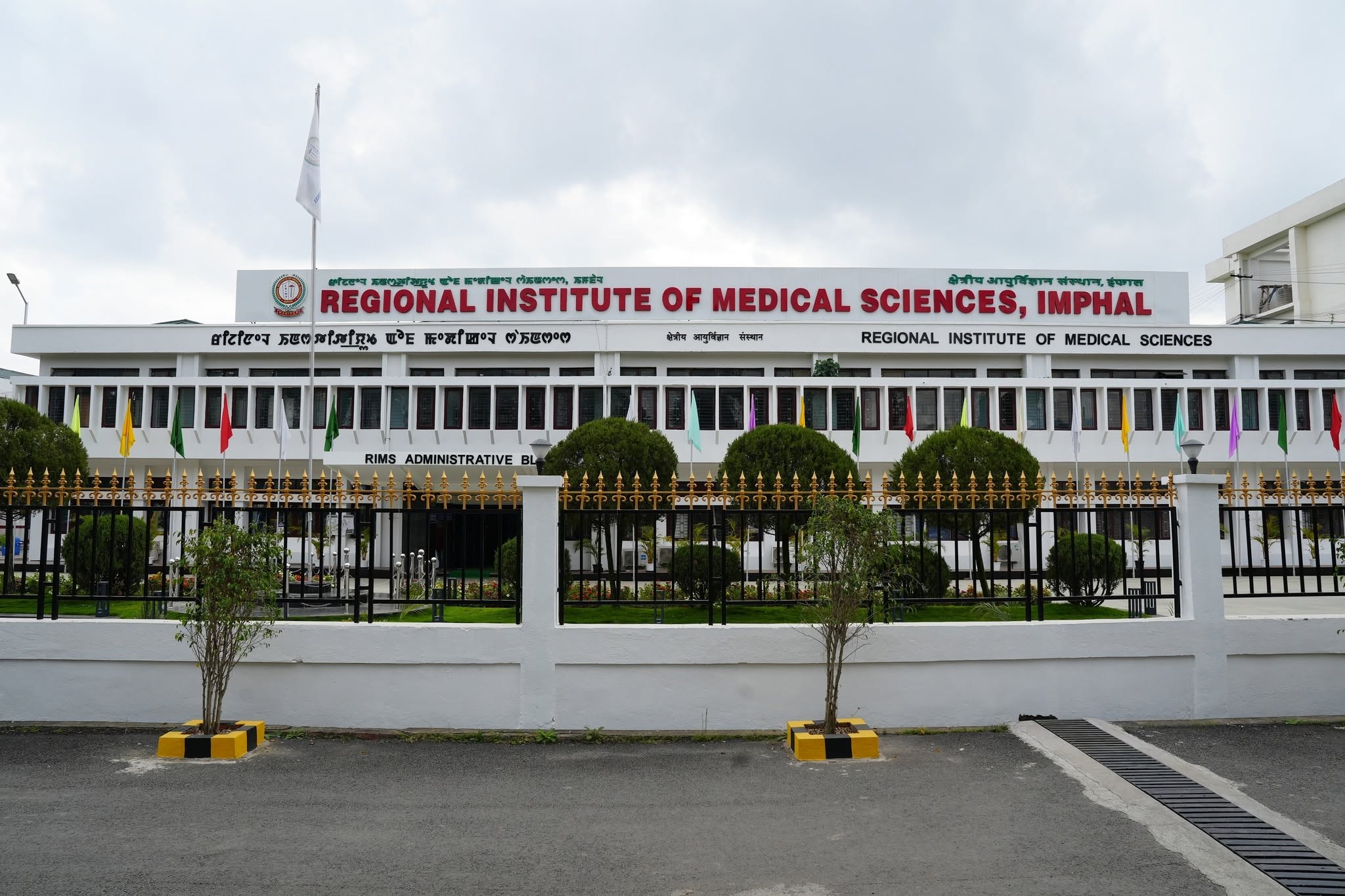
The Regional Institute of Medical Sciences (RIMS) in Imphal, a leading central government-run medical institution serving Manipur and the wider Northeast has long been a vital healthcare center. However, as Manipur’s ethnic conflict enters its fourth year, the hospital has repeatedly become a site of tension where medical neutrality meets deep communal mistrust.
The latest incident occurred on June 15, 2026, when protests broke out inside and outside the RIMS campus in Lamphelpat after three injured youths from the Kuki community were brought there for treatment. The injured were identified as Genlenmang Vaiphei (18), Lunliandaw Vaiphei (20), and Paogoulal Chongloi, also referred to as Paogou Lal.
The three had suffered gunshot wounds in a reported crossfire near Leilon Vaiphei village in Kangpokpi district, an area recently linked to the abduction and killing of Naga civilians. Security forces referred them from the 183 Military Hospital at Leimakhong and transported them under heavy escort.
Protesters, mainly from the Meitei and Naga communities, alleged that the injured youths were Kuki militants receiving preferential treatment. Crowds gathered at the hospital gates and raised slogans against security forces for escorting them into the valley.
The situation escalated into clashes. Security personnel used tear gas shells, mock bombs, and baton charges to disperse the crowd. Hospital services were disrupted, affecting emergency and critical care patients.
RIMS authorities later clarified their role in the matter. “The sole responsibility of RIMS is to provide medical care to all patients brought to the hospital,” the institute stated, adding that transportation and security arrangements were handled by the concerned authorities. The hospital also condemned the use of smoke bombs inside its premises, calling it a serious disruption to healthcare services.
The June 15 incident is part of a larger pattern that has emerged since widespread violence between the Meitei and Kuki communities erupted on May 3, 2023.
The conflict began amid disputes over land, demands for Scheduled Tribe status, and concerns over demographic changes. Since then, RIMS, located in the Meitei-dominated Imphal Valley, has become a key treatment center for victims from both communities.
The violence has displaced more than 60,000 people and resulted in hundreds of deaths. During 2023, unclaimed bodies, mainly of Kuki victims, accumulated in the RIMS morgue. The situation highlighted the difficulties faced by hill communities, many of whom were reluctant to enter the valley because of security concerns.
Doctors at the hospital reported dealing not only with severe injuries caused by gunfire and arson but also with growing tensions among staff and patients from different communities.
Manipur’s ethnic divisions between the valley-based Meiteis, who are predominantly Hindu, and the hill-based Kukis and Nagas, who are largely Christian, go back decades.
These tensions have been shaped by colonial-era “divide and rule” policies, insurgencies, and competition over resources. The 1990s witnessed deadly clashes between Naga and Kuki groups.
The violence that began in 2023, however, pushed the state into a prolonged cycle of village burnings, lynchings, and militia mobilization. Communities have repeatedly accused authorities of bias during the conflict.
RIMS occupies a central position because of both geography and necessity. Along with JNIMS, it is one of the main tertiary healthcare facilities in Imphal and serves patients from across the state.
In a state divided by ethnic lines, where movement between different areas is restricted and trust remains low, the transfer of patients from one community to another often triggers protests. Similar tensions have been seen at JNIMS, including during the transfer of bodies of Naga victims.
Many protesters question the impartiality of security forces, asking why alleged militants are escorted while civilians are not adequately protected.
The involvement of Naga groups in the 2026 incident has added another dimension to the conflict.
Recent clashes between Naga and Kuki groups in Kangpokpi, including abductions and retaliatory attacks, have brought a third major community into the dispute. As a result, RIMS has become a reflection of changing alliances and growing suspicions.
Kuki groups have blamed NSCN-IM proxies for some of the violence. Others argue that the incidents stem from factional rivalries or village defense clashes. Regardless of the differing narratives, the hospital often becomes the place where these competing claims collide.