
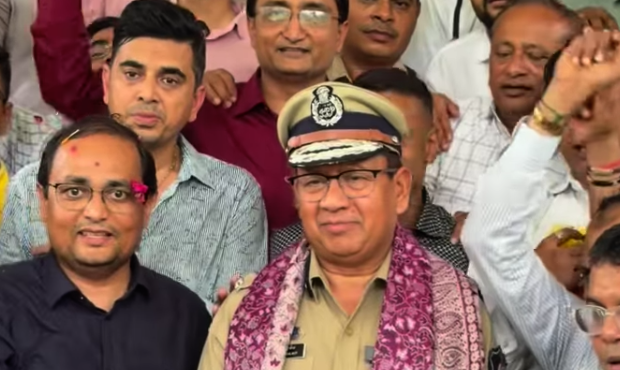
Ahmedabad: In public life, respect is easy to demand but difficult to earn. Police officers usually leave a city quietly: one order, one file, one transfer. That is why the farewell reportedly given by common citizens of Surat to Shri Anupam Singh Gahlaut stands out. It was not only a goodbye to a police commissioner; it was a small public verdict on the kind of policing people want, firm on crime, but close to citizens.
Gahlaut, a 1997-batch IPS officer, has now been appointed Commissioner of Police, Ahmedabad City, after serving as Surat Police Commissioner. Reports say his new role gives him the rare experience of leading all four major police commissionerates of Gujarat, Ahmedabad, Vadodara, Surat and Rajkot. This matters because Gujarat’s cities are changing fast, and police leadership today is no longer only about catching criminals. It is about traffic, cyber fraud, migrant safety, festivals, elections, public anger, mental health and trust.
Surat tested that model. When Gahlaut took charge in April 2024, his early message was simple: from police constable to commissioner, the force would work as one team to create a safe city. In everyday language, that meant the citizen should not feel lost between desks and ranks; the police station itself should become the first place of solution, not fear.
Several decisions during his Surat tenure reflected this practical approach. Surat Police added a seventh zone for smoother administration, covering areas such as Dumas, Dream City, Pal, Hajira, Marine and Icchapore. The new Ashwini Kumar police station was also created to improve round-the-clock policing in parts of Varachha and Kapodra. In traffic-related issues, after fatal accidents involving heavy vehicles, the police detained illegal commercial vehicles during patrol drives and planned greater use of drones and CCTV for monitoring.
One of the more human initiatives was the police study of suicide cases. Surat Police examined 1,866 suicide deaths over three years and launched dedicated phone numbers for people in extreme distress. This is important because modern policing cannot remain only a law-and-order machine. In a city of workers, traders, families and migrants, the policeman often becomes the first state representative a worried citizen meets.
The public farewell from Surat, therefore, carries a larger meaning. In India, citizens often complain about police behaviour. When ordinary people come forward to thank a police officer, it suggests that discipline and empathy can go together. It also shows that public trust is not built by slogans; it is built by small daily experiences, traffic discipline, quick response, fair hearing and visible presence.
Ahmedabad will be a bigger test. It is Gujarat’s largest police commissionerate and a sensitive urban centre with business, politics, religious processions, student life and fast-expanding suburbs. A Police Commissioner in Ahmedabad has a big responsibility. He must be strong against crime, calm during difficult situations, easy for people to approach, and ready to use modern technology to improve policing.
The lesson from Gahlaut’s Surat chapter is clear: good policing is not just about controlling crime. It is also about winning the confidence of common people. As he begins his new role in Ahmedabad, citizens will hope he brings the same commitment, honesty, and public-friendly approach to the city.