
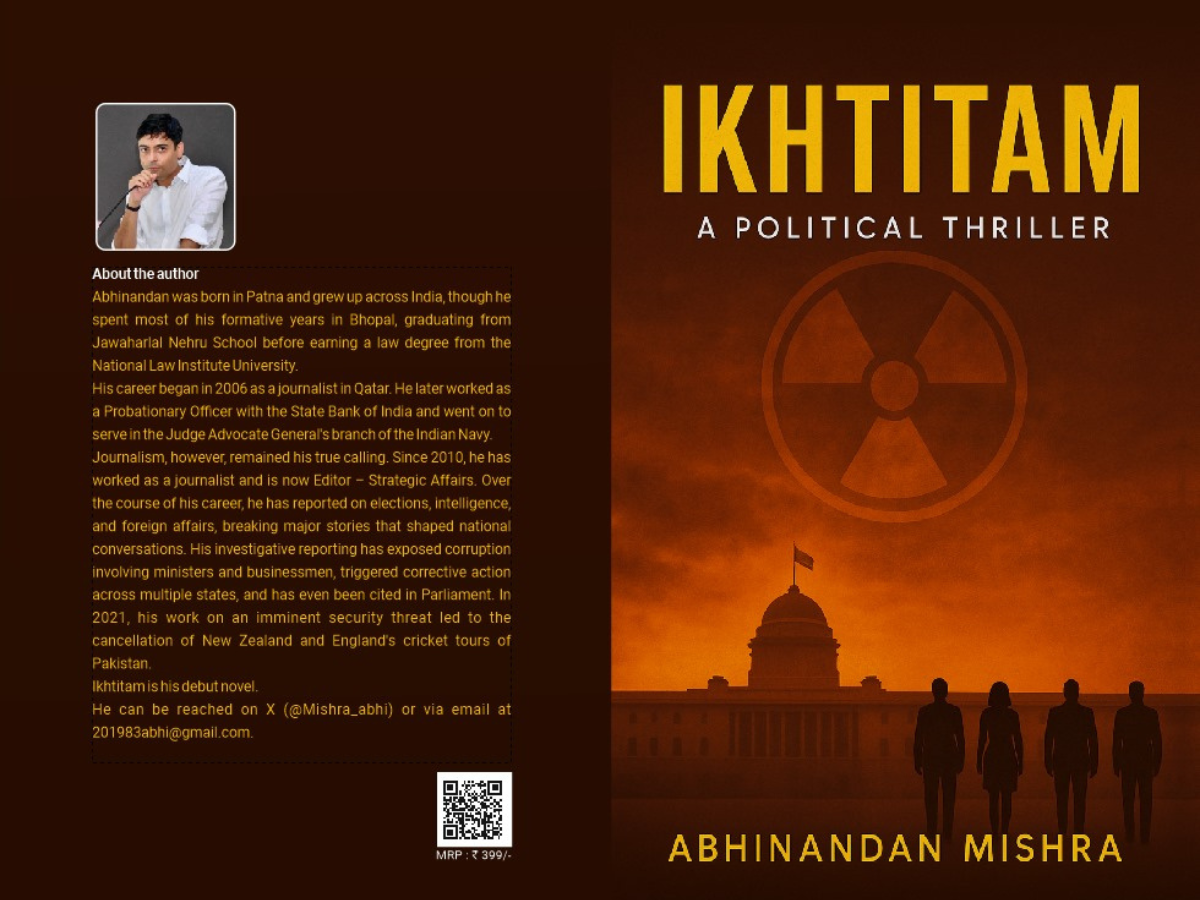
I have read many works that claim to be “political thrillers.” Most are entertainment, designed to pass the time. Ikhtitam is different. It unsettles. Because behind the names and the changed details, one can sense the echo of real files, real choices, and real costs.
The book begins with elections but not the routine kind. The narrative shows how politics, security, and foreign hands can tangle until no one is sure who is running the game. A party leader chasing power, intelligence whispers of terror plots, money flowing in strange ways, and the constant suspicion of betrayal it is all there.
What struck me most is not the action itself but the mood: the sense that danger is never far, and that decisions taken in small rooms can tilt the fate of a nation.
You can see the author has spent years reporting on politics and intelligence — the detail doesn’t come from imagination alone. The book claims that it is inspired by real people and real events- on this I left the readers to judge rather than give a confirmation or a denial.
The writing has the discipline of field notes. Meetings in cramped flats, shadow sources, the uneasy talk with retired officers all of this has the smell of truth. Fiction, yes, but not invented out of thin air. It is written by someone who has walked close to the fire.
The characters are not easy to judge. Krishna, the leader at the centre, is no saint. His fight against corruption and terror comes with compromises funds from questionable sources, allies with shadows of their own. Mrinal, the journalist-turned-operator, carries loyalty but also doubt. Even the retired intelligence man, drawn back for one last operation, is not shown as a flawless mentor.
This greyness is the strength of the book. Real life is like that. In the field, there are no clean hands, only degrees of necessity.
Some parts read larger than life, especially the closing sections with nuclear terror threat.
For a reader who has lived through actual crises, the speed and scale may feel heightened. Yet the message holds. The book reminds us that we cannot take stability for granted. One missed signal, one leak, one compromise and the price can be unbearable.
For me, Ikhtitam is less about whether every plot detail is “believable” and more about what it says of our times: that politics and security can no longer be separated, that foreign intelligence games are constant, and that even well-intentioned leaders can be trapped by ambition and fear.
The author has done something rare turned the unspoken into a story the public can grasp. It is not a comfortable read. It should not be.
Reviewed by a former insider