
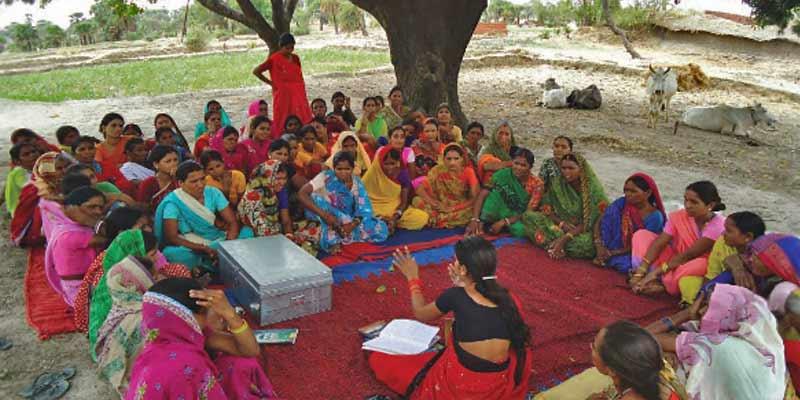
Female labor force participation in India has risen sharply in recent years, supported by targeted financial inclusion programs, digital infrastructure, and community-based networks such as women’s self-help groups. Yet structural barriers—particularly unpaid care responsibilities—continue to limit women’s full participation in the economy. Understanding how India addresses these constraints offers valuable lessons for advancing inclusive growth across the Global South.
During the NXT Fellowship, the critical role of women in the economy repeatedly surfaced as a central priority for the country’s development rather than just a matter of social policy. According to India’s Periodic Labour Force Survey (PLFS), the female labor force participation rate had fallen to around 23 percent in 2017, marking its lowest point in decades. Today, that figure has risen significantly to over 41 percent, representing millions of women entering the formal economy as entrepreneurs, workers, and primary economic decision-makers.
Ecosystems of Capital and Community
This massive structural transformation has been intentionally driven by scalable grassroots programs and digital networks:
-
DAY-NRLM Networks: Programs like the Deendayal Antyodaya Yojana-National Rural Livelihoods Mission have built one of the largest networks of women’s self-help groups (SHGs) globally, mobilizing more than 100 million women and distributing nearly ₹9.7 trillion (approximately $115 billion USD) in loans.
-
Micro-Entrepreneurship Hubs: These female SHGs operate as self-sustaining ecosystems where members share institutional knowledge, access credit, and launch small businesses that support entire local communities.
-
Digital Integration: India’s foundational digital infrastructure—comprising secure mobile payments, digital identities, and open online marketplaces—has removed traditional market barriers, making it significantly easier for women to operate directly within the formal economy.
Confronting the Care Economy
Nonetheless, important structural constraints still prevent many women from entering and remaining in the workforce. One of the most significant, and often overlooked, constraints is care work. Women in India spend an average of 5.6 hours per day on unpaid care responsibilities, compared with about 30 minutes for men. This profound gap represents a major untapped macroeconomic opportunity; the value of unpaid care work is estimated to represent as much as 15% to 17% of national GDP. Expanding structural childcare and eldercare services could unlock millions of local service jobs while allowing far more women to pursue formal employment.
Thankfully, innovative models to address the care economy are emerging globally. In Bogotá, Colombia, policymakers successfully introduced “care clusters” (manzanas del cuidado)—neighborhood hubs that provide childcare, eldercare, education, and support services in a single localized space. By systematically reducing the time women must spend on unpaid care responsibilities, the initiative aims to increase women’s participation in work and entrepreneurship.
As India aggressively moves toward its Vision 2047 goal of becoming a fully developed economy, expanding structural opportunities for women will remain one of the most important drivers of inclusive growth. For observers coming from other parts of the Global South, India offers a compelling, multi-layered case study of how policy, tech rails, and community networks can work in tandem to fundamentally reshape economic participation.
Marianna Caballero Tuesca, Columbia University, United States of America | NXT Fellow 2026