
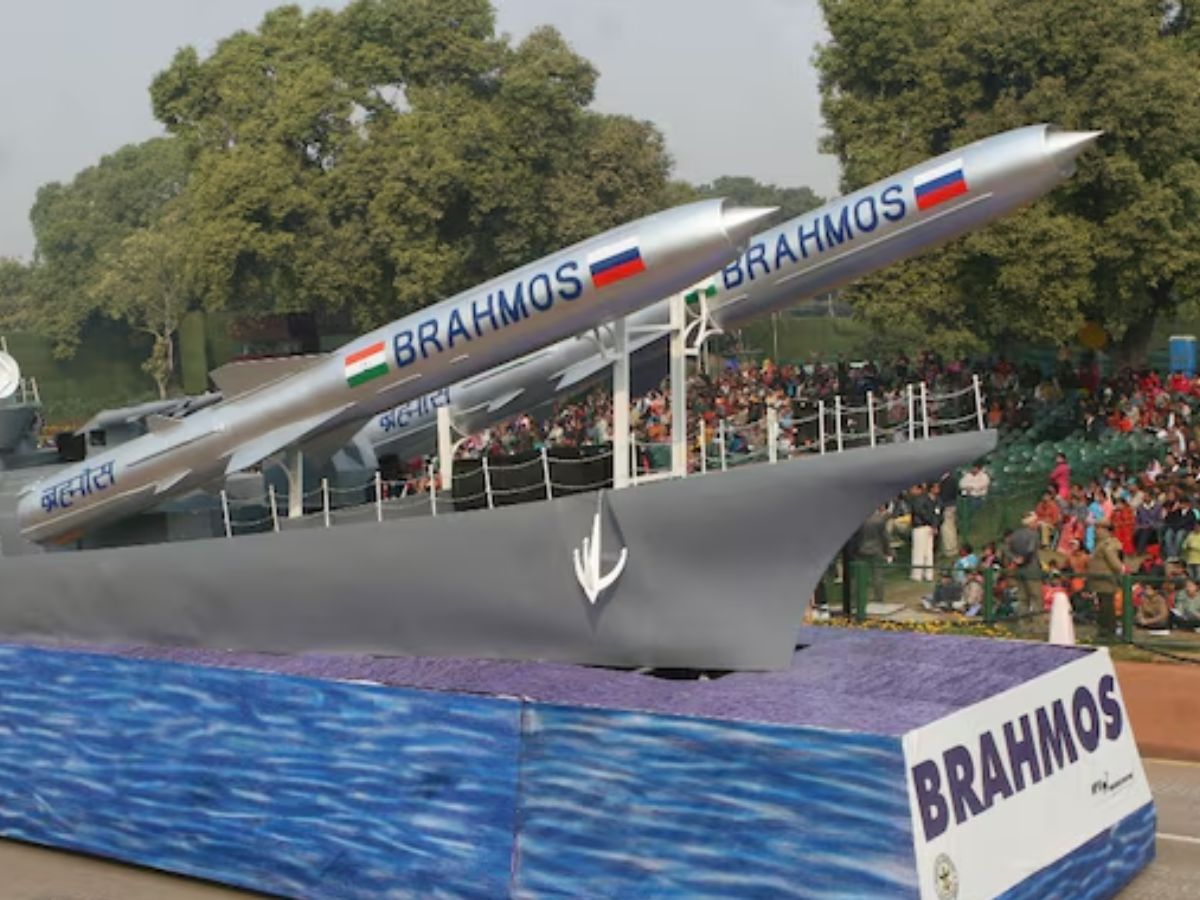
President Ferdinand R. Marcos Jr’s visit to India comes at a pivotal moment for the Philippine defense strategy. The Philippines has already acquired its first BrahMos shore-based missile battery from India, marking a major step in its push to modernise its armed forces. But static defense alone won’t secure an archipelagic nation with rising threats at sea. To fully transform its maritime deterrence, the Philippines must now integrate the naval version of the BrahMos missile.
Marcos’ visit, alongside the start of India-Philippines joint naval drills near the South China Sea, signals the start of a deeper strategic partnership. This mobile sea-based missile system is not just a force upgrade- it’s a game-changer. With shared training, systems, & goals, the Philippines and India are building something bigger, like a stable Indo-Pacific order grounded in deterrence, cooperation, & mobility.
From Shore to Sea: Shift in Deterrence Strategy
The land-based BrahMos missile battery gave the Philippines a long-range, precision strike capability, but its deterrent power is limited by geography. Fixed launchers can cover so much area, & once located, they become vulnerable to preemptive strikes. Despite camouflage, these systems can’t move or adapt quickly to threats.
By contrast, ship-based BrahMos missiles change the rules. A naval platform can move, reposition, and strike across vast maritime areas. This flexibility allows the Philippine Navy to patrol disputed waters, respond to threats, and deter aggression — all without waiting for danger to reach the coastline.
ALSO READ: PM Modi Pays Last Respects to Shibu Soren at Sir Ganga Ram Hospital
Mobility Means Survivability
Mobility gives ships a critical edge over stationary batteries, warships are moving targets, which makes them harder to detect, harder to hit. During times of tension, they can reposition quickly, disperse across a wide area, and launch without warning. That unpredictability forces adversaries like China to think twice.
It stretches their surveillance, complicates their planning, and raises the risks of miscalculation. In contested regions like the South China Sea, this mobile deterrence matters most. It ensures the Philippines can respond wherever the threat arises, not just where the batteries are placed.
Geography Demands It
The Philippines spans over 7,000 islands across vast waters. Much of its territory lies far from shore-based missile coverage. Regions like the Spratly Islands, which see frequent Chinese activity, need a persistent naval presence. Ship-based BrahMos systems allow that. They turn a limited deterrent into a roaming one, ready to counter intrusion at sea.
Building a Networked Naval Force
A BrahMos-equipped warship does more than carry firepower. It becomes a node in a larger defense web, linked with aircraft, drones, radars, and coastal systems. The result is a real-time, coordinated national defense network. A ship can receive sensor data from elsewhere and strike instantly. This increases not only deterrence but also responsiveness.
Importantly, the Philippines is not starting from scratch. The naval variant shares core technology with the shore-based system already delivered. Filipino troops have trained in India. The logistics, maintenance, and operational know-how are already in place.
ALSO READ: Prachand: India’s Indigenous Helicopter That Changed Its Defense Strategy
Marcos-Modi Partnership Signals Larger Indo-Pacific Security Role
Marcos’ visit comes just as joint India-Philippines naval drills begin in the Philippine Sea, close to the South China Sea flashpoint. His five-day trip signals more than defense shopping rather, it reflects a shared strategic vision between India and the Philippines to uphold freedom of navigation, a rule-based order, and regional stability.
As both nations grow their naval cooperation, the Indo-Pacific gains a stronger, more balanced power equation. A Philippine Navy armed with BrahMos could work alongside Indian vessels, enhancing joint operations, interoperability, and regional deterrence — a counterweight to unilateral Chinese expansion.
Unified Missile Doctrine
The shore-based BrahMos is already in the hands of the Philippine Marine Corps. A smooth doctrine between land & marine forces is produced by including the naval version.
It makes training easier, improves coordination, and increases efficacy all around. Both branches will function with similar tactics and strategic alignment thanks to this cohesive strategy.
ALSO READ: APPSC Eyes Major Reform: Prelims Only If Applications Exceed 200 Times Vacancies
Message of Resolve
Giving the Philippine Navy the naval BrahMos sends a strong statement to ASEAN and other international allies, in addition to China. The Philippines is prepared to establish its sovereignty, protect its oceans, and help create a more stable Indo-Pacific region.
That message becomes more powerful with India as a strategic partner, supported by quickness, accuracy, and a common goal.