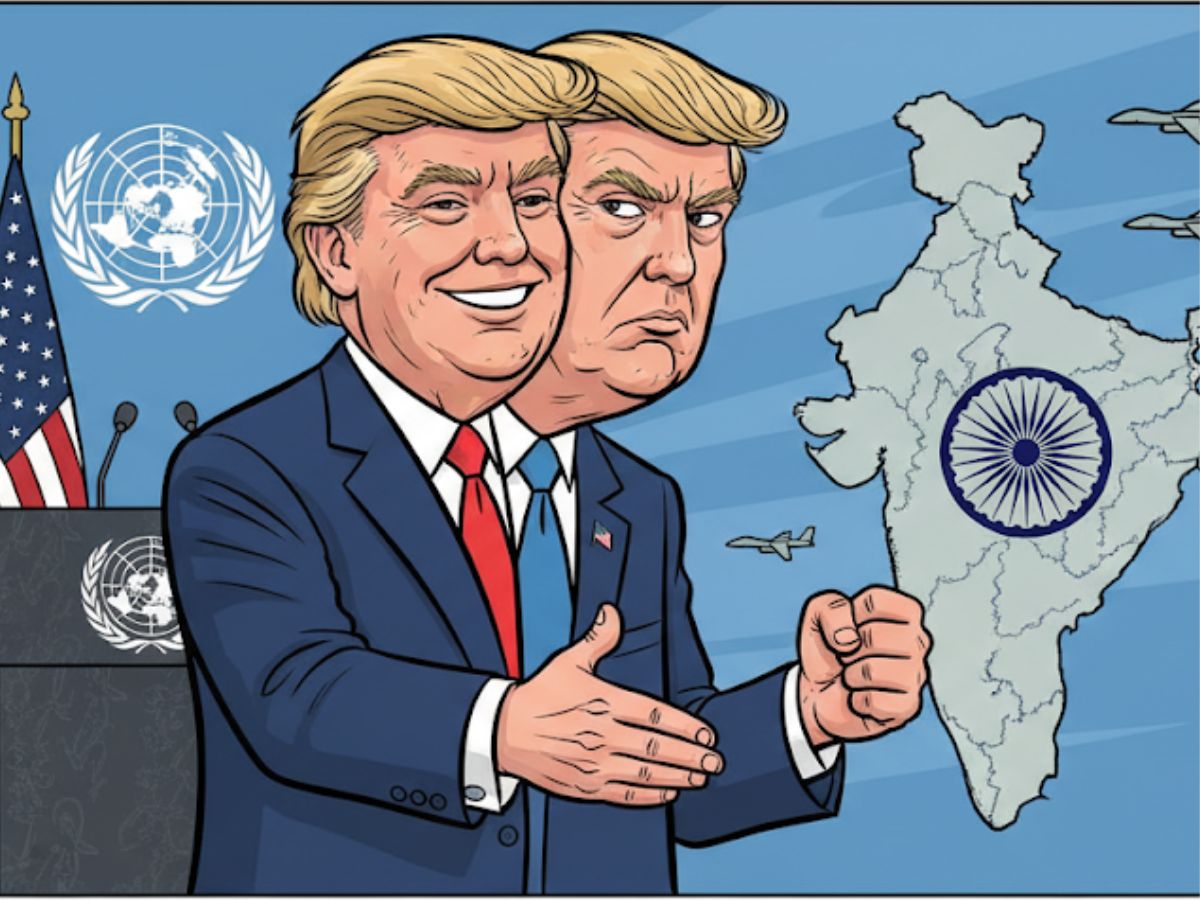
This highlights the ongoing friction over India's energy imports from Russia and underscores the unpredictable nature of the current US administration, leaving the bilateral relationship at a delicate crossroads.
In a speech that lasted just under an hour at the United Nations General Assembly (UNGA) in New York on Tuesday, US President Donald Trump mentioned India in two starkly different contexts. The mentions, however, were united by a common thread: both appeared to be direct attacks on India's stated positions, signaling a potential chill in recently warming relations.
The first was a familiar claim of mediation, while the second was a more acerbic and surprising accusation that placed India alongside China as a primary financier of the war in Ukraine. The future course of the Indo-US cooperation is being questioned by analysts due to this change in language.
President Trump once again recounted his claim of having “stopped a war” between India and Pakistan, listing it among seven such global interventions. This is a claim he has made over three dozen times, but its articulation from the UNGA podium, the world's most significant stage for diplomacy, lent it a new gravity.
What does this mean? The reference is to the de-escalation following India's air strikes in 2019. Trump has repeatedly suggested that his administration's intervention prevented a major military conflict.
India's stance: New Delhi has consistently maintained that its decision to halt further action was a sovereign one, taken after Pakistan's request and the return of Wing Commander Abhinandan Varthaman, not a direct result of US pressure. In contrast to India's own version of events, Trump's persistent claim and his open wish for a Nobel Peace Prize for the deed generate a different narrative.
The second mention of India was more pointed and broke from the recent tone of reconciliation between the two nations. In his address, Trump directly implicated India in the ongoing conflict in Europe.
“China and India are the primary funders of the ongoing war (in Ukraine) by continuing to purchase Russian oil,” Trump stated. He described such purchases as “the engine feeding Putin's war machine” and advocated for a “very strong round of powerful tariffs… would stop the bloodshed, I believe, very quickly.”
The rhetoric at the UN is not an isolated event. It is part of a broader pattern of pressure from the Trump administration.
Economic Pressure: In August, the US imposed an additional 25% levy on certain Indian imports, effectively doubling the overall tariffs to 50%. Many viewed this action as a means of pressuring New Delhi to reduce its energy agreements with Moscow
Diplomatic Consistency: US Secretary of State Marco Rubio echoed this stance earlier on Tuesday, stating that stopping Russian oil purchases remains a "main issue" in talks with India, despite acknowledging "a lot of progress." He also hinted at more sanctions to squeeze Russian revenues.
The accusatory tone is particularly surprising given the recent revival of bonhomie between Trump and Prime Minister Narendra Modi. The partnership appeared to be going well after a period of public acclaim and the resumption of trade negotiations.
The "Good Friend" Dynamic: Just weeks ago, Trump had described PM Modi as "my good friend," and India's Vice President CP Radhakrishnan noted that "Trump continues to say, ‘Modi is my great friend’".
A Mercurial Partner? This sudden shift has led to questions about the US President's consistency. Former UN diplomat and opposition leader Shashi Tharoor pointed to Trump’s “mercurial” nature. “If he could be unpredictable in a negative direction for us earlier this year, he might turn out to be unpredictably positive to us in the months and years ahead,” Tharoor theorized, adding wryly, “I think the person who claims to be able to either understand Mr Trump fully, or predict his next move, hasn't yet been born, unless it's the one married to him."