
For decades, the public discourse in developing nations has been trapped in a well-intentioned but fundamentally flawed loop: the romanticisation of poverty and the moral elevation of distribution over creation. We are told to treat economic growth as a secondary milestone, an ambition that must wait quietly in line until every social vulnerability is systematically pacified.
This is a historical lie. Modernisation is not a polite, orderly sequence of events where a nation comfortably achieves social equity before building its economic engine. Real modernisation is a simultaneous, aggressive storm of four distinct forces: market consolidation, structural capacity building, the deliberate engineering of a national identity, and the protection of that identity through a strong defence apparatus.
To look across the timeline of global superpowers is to understand that nations do not inherit wealth; they construct it through unyielding, often disruptive reforms. The economic history of the world’s leading powers clarifies the fundamental law of development: Development produces plenty before it distributes wealth. Socialism, by contrast, is obsessed with dividing a cake that hasn’t even been baked.
Historically, when nations industrialise, economic disparity initially widens into a massive chasm as capital consolidates into highly efficient economic engines. Only when wealth reaches critical mass and output achieves unmatched abundance does the per-capita gap contract, lifting the absolute floor of the impoverished. This trajectory, historically modelled as the Kuznets Curve, is visible in the rise of every major world economy.
During the Industrial Revolution and the Gilded Age, wealth disparity in the UK and the USA soared to astronomical heights. Capitalists like Rockefeller and Carnegie consolidated industries, building unified continental markets and rapid capacity. This extreme concentration created the massive industrial surpluses that eventually funded high wages, widespread philanthropy, public education, and modern infrastructure, raising the standard of living for millions.

In the late 19th century, Germany unified its fragmented regional states into a singular customs union (Zollverein) backed by Prussian military might. Similarly, Meiji Japan aggressively consolidated its feudal lands into a singular national identity, prioritising an industrial economy under the slogan “Fukoku Kyōhei” (Enrich the Country, Strengthen the Armed Forces). Both nations experienced sharp initial wealth divergence, yet this deliberate consolidation created the hyper-resilient industrial engines that later allowed them to rebuild as economic giants. In all cases, the lesson is clear, you cannot distribute poverty. Plenty must precede parity.
For nearly seventy years, India suffered under the weight of the “socialist veto”, a mindset where policies were designed to manage scarcity rather than create abundance. The prevailing cultural mood was a defeatist “kuch ho nahi sakta” (nothing can happen).
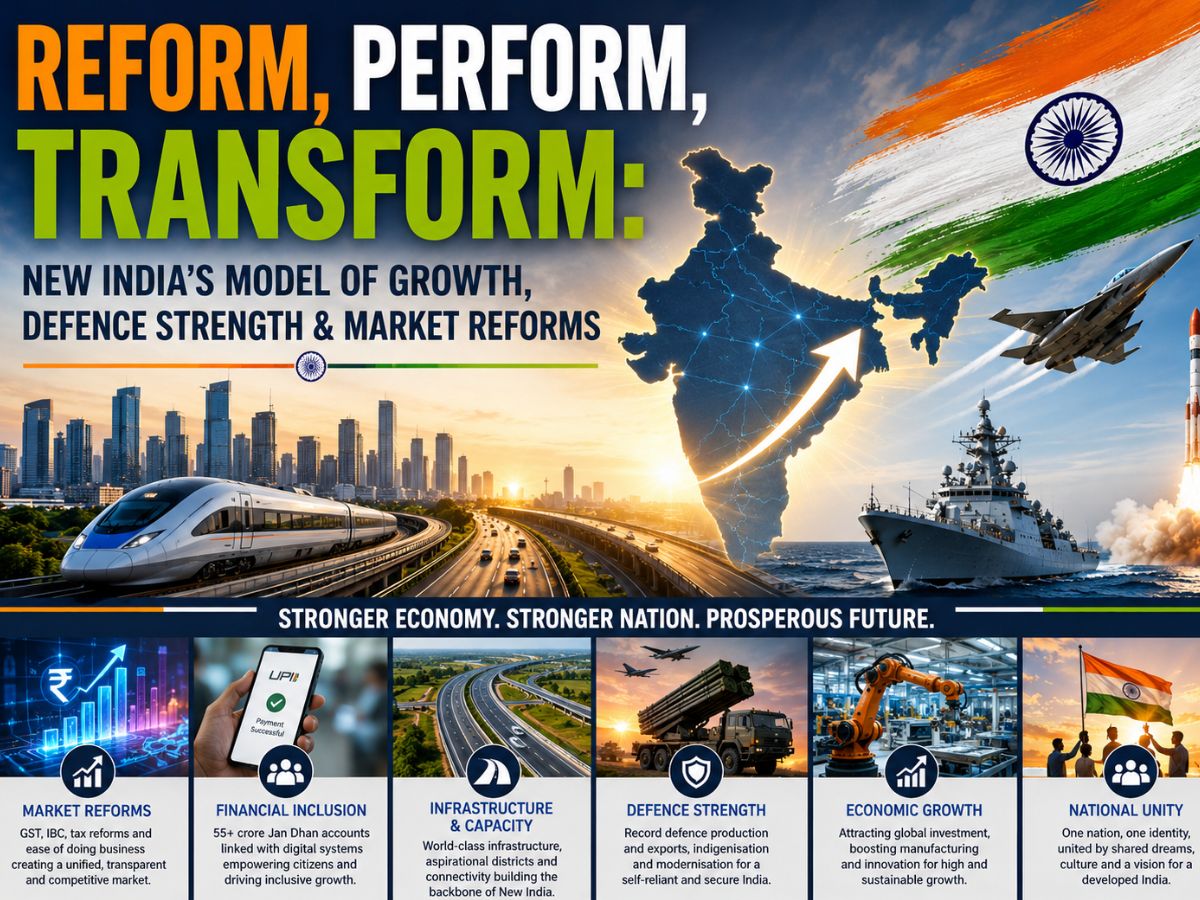
The political paradigm under the leadership and guidance of Honourable Pradhan Mantri Narendra Modi Ji shifted radically with the vision of “Reform, Perform, Transform.” This framework replaced the passive romanticisation of poverty with an active strategy of structural empowerment. Over the last decade, and leading into 2026, the government has systemically dismantled old economic fragmentations to build a modern powerhouse across the parameters of nation-building.
Where previous administrations relied on bureaucratic red tape, the current regime has executed a structural overhaul to unleash capital: The Goods and Services Tax (GST) created a unified internal market after seven decades of independence, with collections soaring past ₹19.3 lakh crore. This was fortified by the Insolvency and Bankruptcy Code (IBC), which freed up stuck capital. In a landmark move, the June 2026 Income-tax Amendment Ordinance eliminated capital gains and withholding taxes for Foreign Institutional Investors (FIIs) on government bonds, driving massive global liquidity directly into sovereign debt ahead of global index inclusions. Red-tapism has been replaced by structural transparency through the implementation of a new, simplified Income Tax Act, faceless appeals, and automated clearances.
Modernisation cannot leave the periphery behind, but instead of handing out doles, India has built structural capacity. The Aspirational Districts Programme has systematically targeted the country’s most underdeveloped regions, bringing health, education, and digital access up to baseline national standards. By linking over 55 crore Jan Dhan accounts with India’s digital stack, the state has built a direct-to-citizen engine that bypasses the corrupt middlemen of the pre-2014 era. The resolute containment and near-total removal of Naxalism under the leadership of Honourable Home Minister Amit Shah across former red corridors has brought millions of citizens back into the economic mainstream.
A nation’s sovereignty is only as strong as its military capabilities. Under previous regimes, defence procurement was plagued by policy paralysis and scandals, while elite laboratories like the DRDO were famously underutilised, at times relegated to non-strategic projects such as manufacturing mosquito repellents. Today, India’s defence production has hit a record of ₹1.78 lakh crore, with defence exports leaping by a staggering 62.66% year-on-year to hit ₹38,424 crore. India is no longer an arms beggar; it is an exporter to over 80 countries. More importantly, the nation has broken domestic monopolies by issuing Requests for Proposals (RFPs) to private consortia to build prototypes for the Advanced Medium Combat Aircraft (AMCA), India’s indigenous 5th-generation stealth fighter.
The starkest contrast between the current governance model and its opponents lies in the philosophy of identity. While the political opposition seeks to break India into fragments, weaponising caste, class, region, and language for electoral math, this government is binding the country together from Kashmir to Kanyakumari and Sirsa to Siliguri. It is a unification driven by powerful forces of shared civilizational pride anchored by the Ram Mandir, frictionless digital integration through UPI, and physical consolidation via massive expressways and dedicated freight corridors. India is no longer settling for a loose coalition of regions; it is forging an uncompromising, single national identity.
This rapid structural transformation has triggered a monumental psychological pivot: nirasha se aasha (from despair to hope). The average Indian citizen no longer asks for survival; they demand world-class infrastructure and global parity. This rising aspiration places an intense, healthy responsibility on the state, creating a consensus that only a fiercely reform-oriented governance model of NDA can deliver.
To sustain this momentum, India must urgently shift its Overton window to become unapologetically reform-friendly. As the upcoming Parliament session approaches, the nation’s youth are sending a clear signal, bring on the big-ticket reforms. This resilient New India refuses to pass down the struggle for basic amenities to the next generation; they expect to build, support, and inherit a fully developed India in their own lifetime.
We witness the bizarre spectacle of a developing country trying to provide basic third-world necessities while facing political vetoes and manufactured street protests modelled on elite, first-world grievances. This opposition suffers from a core ailment, a lifestyle of “Always Against” driven by chronic dissatisfaction.
Their entire political ecosystem operates on a bizarre loop of contradictions, on day one, they will mock the lack of 24/7 power, and on day two, they will bring out the protest drums to stop a hydroelectric dam or solar park. They will launch endless debates on data sovereignty and India’s progress in AI, yet when the world gathers at Bharat Mandpam to witness India’s AI Impact Summit, they left no stone unturned to shame the nation. They are the same people who oppose the setting up of local semiconductor plants and data centres. They lament the lack of defence modernisation, but when strategic defence deals are signed, or critical infrastructure is built along the borders, they scream foul. When global indices index corruption, they weaponise it; when decisive action is taken to root out corruption, they call it a political vendetta.
India cannot afford the luxury of this manufactured paralysis. When every infrastructure project, land acquisition, defence upgrade, and market liberalisation policy is met with calculated obstructionism, it is not the elites who suffer; it is the millions of citizens waiting to be lifted out of the third-world bracket, gifted to them by the previous regimes.
We must stop treating reform as a political choice and recognise it for what it is: an existential necessity. The era of romanticising poverty and coddling stagnant socialist dogmas must end. Aggressive capacity development, domestic manufacturing, a unified internal market, a strong military, and an ironclad national will are the only components that have ever built a superpower. The “Reform Express” is moving; it is time for the nation to leave the obstructionists behind and claim its future.