
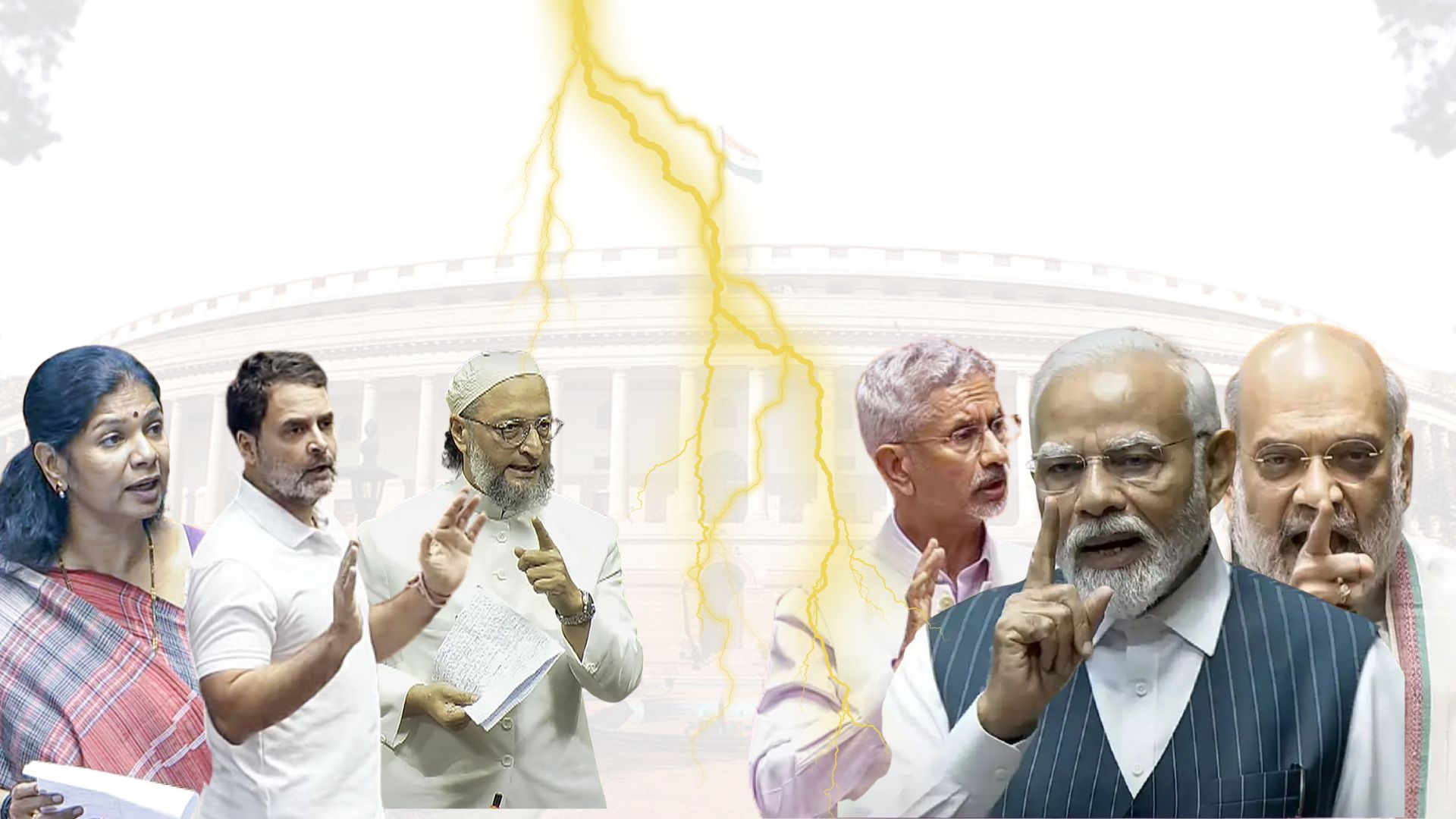
The 16-hour long debate on Operation Sindoor in Parliament, concluded recently, exposed a shallow incongruence in preparation, articulation, and conviction between the government’s side and the opposition, a reality that defined both the proceedings and the optics across the country around this high-stake session.
Government’s Dominance: Substance, Optics, and Patriotism
At the centre of the commanding performance of the government were Home Minister Amit Shah, External Affairs Minister S Jaishankar, and Prime Minister Narendra Modi. Each presented arguments in terms of clarity, conviction, and sense of national purpose:
- Amit Shah shocked the House with the revelation of detailed intelligence, forensic data, and operational details regarding Operation Sindoor – India’s cross-border raids following the Pahalgam terror attack. Shah openly accused opposition leaders of weakening India’s case by giving strength to outside claims, especially on whether the US coerced India to stop military action. At the midst of interruptions, he reproached the opposition for “not having faith in their own ministers” and put forth national interest with unwavering determination.
- S Jaishankar, who was appreciated by the Prime Minister, gave a worldwide perspective, using India’s dominance of international backing—pointing out that just three UN members voted against India’s self-defence operation. His address gave world strategic sense and also pointed out how India, not only militarily but also diplomatically, was holding fort—a message that allowed for little denying.
- Narendra Modi topped the government’s argumentation by combining policy, sentiment, and rhetoric. He dismissed charges of foreign influence, reiterated that Operation Sindoor was conducted and brought to closure in strictly Indian terms, and accused the opposition of “importing issues from Pakistan” during the national security debate.
All three had a stance that was “country over party” alluding to their attendance and leadership of all-party delegations dispatched around the world to represent India’s consensus on fighting terrorism. Such missions, which were headed by the likes of Shashi Tharoor, Kanimozhi, among other senior MPs, reflected an external united front, where leaders demanded patriotism over internal fragmentation.
Opposition Falters: Weak Substance and Missed Opportunities
The opposition, led by Rahul Gandhi, Akhilesh Yadav, and Priyanka Gandhi, were unable to match the pitch of the government either in numbers or presentation. Their interventions were marked by:
- Lack of Facts & Figures: Gaurav Gogoi and Rahul Gandhi’s argument leaned more on rhetoric, comparing Modi’s “political will” unfavourably to Indira Gandhi’s era—than on operational or diplomatic specifics. Akhilesh Yadav and Priyanka Gandhi’s interventions similarly lacked concrete criticisms or pointed evidence, resulting in little traction within the House or with the public.
- Fluid Presence: Opposition speeches, as well as government benches, observed the “tepid” and at times imprecise tone of these opposition speeches. Their failure to confront Shah’s evidence or Jaishankar’s international case left the opposition appearing unprepared and reactive.
- Missed Champions: Parliament’s finest orator and a chief of India’s recent international delegations on the issue of terror, Shashi Tharoor, was surprisingly not given a chance to speak, something that even those on the side of the treasury criticised. His absence created a noticeable lacuna in the intellectual strength of the opposition.
Notable Opposition Voices: Owaisi and Kanimozhi
Where Congress and Samajwadi Party fell short, Asaduddin Owaisi (AIMIM) stood out, holding the government accountable for failing to capitalise on national unity and questioning the larger strategic game, and Kanimozhi (DMK) held firm with subtle questioning on both government error and the actual price of keeping ongoing conflict afloat. Both brought forward concerns that had traction on points of unity, accountability, and the deeper meaning of high-profile security operations.
Conclusion
This debate became not only about Operation Sindoor, but about the seriousness and quality of Indian parliamentary democracy on issues of national security. The government, riding high on sound arguments and a solid international record, overwhelmed facts and optics, presenting the image of patriotic harmony. The mainstream opposition was not able to make a strong counterargument, leaving the rest to smaller but wiser members. The episode reaffirmed how critical it is to put aside partisanship for all concerned—particularly when the nation’s, and the world’s, eyes are upon us—to speak from the data, in clarity, and with a truly national voice.